I am a convert to the church and don't really have any members of my family that walked across the Plains in 1847 nor in fact associated with it until 1974. The fact is my relatives didn't get off the boat until 1914 at Ellis Island and none of them had anything to do with the LDS Church. I am a first generation Mormon. I am a pioneer by this interesting modern desire to want us all to be pioneers. I don't consider myself a pioneer nor do I consider joining the church as a reason to chronicle my life events.
Even living in Utah and hearing people go on about their Pioneer relatives I just see it as an exercise in self-promotion, as though having a righteous relative makes you righteous. I would just grin and bear it and would feed it by feigning interest. It made a small minority of the ward members happy to think they were from righteous stock.
My heritage is really the antithesis of the Mormon experience. I don't even recognize my Italian Catholic upbringing as being a defining thing nor did my ancestors reverence their Mafia relatives as examples of righteous living. They were glad to get away from one another. Reverencing the early Mormon Pioneers is really a foreign concept to me and my family. We didn't even reverence each other. We hardly talk to one another let alone tell our children much about our family. I don't think that we are that out of the ordinary. I would say we were typical lower working class people.
As the church grows millions of us have nothing in common with the Pioneers since in no way are we related to them nor have we been brought up hearing stories about them unless we work in the Primary. With the correlation of the manuals we only hear a few of the selected stories over and over and not in any detail since most of us don't have a lot in common with pioneers only in the fact they were also members once. The only connection is that they came before us and preserved the church. As I go around the world all of the members can tell stories of how the church developed but none the members in other countries know much other than about the former Church Presidents let alone apostles, seventies, or Utah pioneers.
Even as a member all of adult life I still don't relate with the pioneers. I put up with it in Sunday School but I mostly just tune out the one or two lessons when members go on about how they are the descendant of this polygamous person or general authority.
Even as a history major I never could buy in to the stories of the Pioneers and the Utah experience. I thought they were just telling us the stories so a few people could feel good about their forebears and justify why a small group hold the top spots in leadership positions. It helped me to situate myself in the culture.
I always viewed the stories as a form of instruction and parallel in some way to the Jewish experience of when they were close to God good things happened and when they weren't bad things happened. It was akin to the Jews wandering the the wilderness with all dying off before being allowed in the promised land. The Pioneers died out of hardship. I can't really relate to either group and only in abstract terms understand any similarities to the life we live today.
The only Utah story I could relate to was Orrin Porter Rockwell gunning down the desperadoes on the streets of Salt Lake City. I thought of him as a cold-blooded killer like some of my family members and the westerns I watched as a kid. I had a hard time swallowing the Mountain Meadow Massacre. I felt sorry for Joseph Smith and how he was treated and felt I would have been a better friend than the ones he had in Kirtland and Nauvoo. I know I couldn't have handled Brigham and the life in the Utah territory where men wrestled over polygamous wives and chewed tobacco for teeth problems. I was glad I lived today not then. I did respect Brigham's business acumen but couldn't understand how his kids fought over the estate with the church corporation.
The Pioneer stories were ones that made for revisionist faith-promoting tales where people who would have died meaningless deaths are elevated in to martyrs for the cause who died wending their way to Zion. I don't get goose bumps when I think about the stories of people who did dumb things like walk across the ice and have their toes cut off or were laid in shallow graves and the wolves ate their bodies because they went too late in the year. I see their stories as moral lessons like George Washington cutting down a cherry tree or my father wearing burlap sacks on his feet as shoes during the depression when he went to school in the snow. I wonder every time I heard Pioneer stories why did they go out so late in the year and why would anyone get so choked up about it and try to glamorize something that was well tragic and ill-advised. One consolation was that they didn't eat each other like the Donner party. It served a purpose that thousands of people came to Utah and colonized the west. There were thousands more who came and colonized the West then even us Mormons.
My family conquered the entire world but unfortunately no one glamorizes how they were involved in the conquest of the world. The only story I know is that my family took care of the olive groves for the Mafia. My grandfather was a bag man and collected self-insurance on Saturdays from local businesses.
I don't have any relatives to justify why I am a leader today in the church nor do I ever believe that I will be a leader. My ancestors lived their lives and did nothing extraordinary other than live normal lives. I am not my father nor his father nor his father's father. I am not a gambler, killer, or adulterer. I am not a sinner or a saint. I am just a Joe blow Mormon who joined the church and makes minor contributions. If you want to make me feel good by pretending I am a modern pioneer that is your business but me I don't consider what I did anything but ordinary.
I have to choose to live my life by a certain moral compass. No one that came before really inspires me today. I have always seen history as learning from the lessons or failures of the past. We use pioneer stories as a tool to try to emulate the Saints of the past and get our members to live heroic lives. Unfortunately most of us are just ordinary people. I live in the present not the past. No person is an island but when it comes down to it only living people affect me from general authorities to family. I really can't relate with the Pioneers and see them as being just ordinary people who got in a jam. Once they got to Utah they were no different than any other God-fearing person other than they were members of the Lord's church.
As Latter-day Saints we like to tell stories about why a man or woman rose to be a leader. It is like reading Horatio Alger stories. It is the story of how God had a special mission or they were so righteous or dragged themselves up by their boot straps.
I never met my Grandfather B. I hear all kinds of bad things about him. I am suspect when I hear about past people--people who knew them have filters good and bad. People tend to remember the extremes good or bad. Most of us aren't sinners or saints totally. We are a bunch of people who make decisions based on our experiences some good and some bad. The term pioneer just means one who came before. It renders our lives meaningless when we glamorize and twist events to make them more than they are.
Most of us are just common ordinary people. The majority of Mormons today aren't related to the Pioneers. Our stories are the same oh same oh. We get up, go to work, mow the yard, go to church in a never-ending cycle. Our family ancestors traveled by the same modes of transportation of the Pioneers some died making their way to better opportunities. It is nice they have a monument to them and we can stop off if we want and find out about them.
When my life is over and done with, I doubt people will care one way or the other about my being a modern pioneer. I say if it makes you feel good to think you will be remembered idealistically then fine. The truth is we remember so little about even close relatives like our grandparents as we grow older. The only way we live on is that we had children and they had children. By the time you get to the third generation even those who remember us will know very little about us.
Showing posts with label pioneers. Show all posts
Showing posts with label pioneers. Show all posts
Friday, July 24, 2009

Thursday, July 23, 2009
She Said: Should Mormons in the Diaspora Celebrate Pioneer Day?
It has only been in recent years that I have slowly become aware that not every convert to the Church shares my deep identification with the Mormon pioneers. I have loved the epic story of the trek to the Salt Lake Valley. I appreciate its archetypal connotations. My heart thrills with the stories of the pioneer heroes and heroines, and I consider each of their stories part of my legacy as a Mormon, though my LDS heritage begins with myself.
In the last few years there has been some grumbling by members who don't have Mormon pioneers in their genealogy that it annoys them to celebrate the July 24th holiday, a commemoration of the day the first company of pioneers entered the Salt Lake Valley. I think partly to appease these voices, there has been an emphasis on "modern-day pioneers"--those who lead the way for others to follow and who blaze trails in other ways than traditionally recognized. There's a new Primary song, "I Can Be a Modern-Day Pioneer," there are more talks given by General Authorities on the subject, and there are articles such as the latest Mormon Times article "Pioneer Journeys of a Different Era."
There is a sudden dearth of Pioneer Day activities in wards outside of Utah, and in our ward last Sunday the only talk which mentioned pioneers emphasized modern-day contributions rather than those who crossed the plains.
I just want to register a caution to those who wish to move away from the traditional veneration of these honorable forebears. I want to remember their devotion to a faith that meant more to them than life itself. Social scientists often point to the Jewish culture and theorize that the reason it survived through so many years and the scattering of the people to so many different places was the very persecution which caused them to band together in small groups, and their longing remembrance of their homeland.
 By the rivers of Babylon, there we sat down,
yea, we wept, when we remembered Zion.
We hanged our harps upon the willows in the midst thereof.
For there they that carried us away captive required of us a song;
and they that wasted us required of us mirth, saying,
Sing us one of the songs of Zion.
How shall we sing the Lord’s song in a strange land?
If I forget thee, O Jerusalem, let my right hand forget her cunning.
If I do not remember thee, let my tongue cleave to the roof of my mouth;
if I prefer not Jerusalem above my chief joy.
Psalm 137)
This Psalm is a poignant lyrical device for recalling the story of Israel's exodus from Egypt and its arrival in the promised land. It acts as an earnest reminder both to the exiled Israelites and to later biblical readers of the importance of the promised land for the celebration of the Jewish faith.
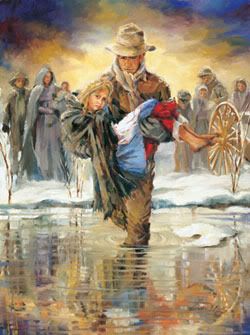 Now that we Latter-day Saints experience little real persecution, and the importance of our history and sacred places is beginning to wane, are we in danger of losing some valuable aspect of our culture? Are we losing our Psalms, our legends, our traditional customs and stories?
I'd like to hear what our readers think. Do you feel a connection to the Mormon pioneers? Or do you think the holiday is unnecessary, especially to LDS of other cultures living in many different countries of the world? Should we attempt to graft new converts in to the Utah Mormon pioneer heritage, or should we transfer our loyalties to "modern-day pioneers?"
In the last few years there has been some grumbling by members who don't have Mormon pioneers in their genealogy that it annoys them to celebrate the July 24th holiday, a commemoration of the day the first company of pioneers entered the Salt Lake Valley. I think partly to appease these voices, there has been an emphasis on "modern-day pioneers"--those who lead the way for others to follow and who blaze trails in other ways than traditionally recognized. There's a new Primary song, "I Can Be a Modern-Day Pioneer," there are more talks given by General Authorities on the subject, and there are articles such as the latest Mormon Times article "Pioneer Journeys of a Different Era."
There is a sudden dearth of Pioneer Day activities in wards outside of Utah, and in our ward last Sunday the only talk which mentioned pioneers emphasized modern-day contributions rather than those who crossed the plains.
I just want to register a caution to those who wish to move away from the traditional veneration of these honorable forebears. I want to remember their devotion to a faith that meant more to them than life itself. Social scientists often point to the Jewish culture and theorize that the reason it survived through so many years and the scattering of the people to so many different places was the very persecution which caused them to band together in small groups, and their longing remembrance of their homeland.
By the rivers of Babylon, there we sat down, yea, we wept, when we remembered Zion.
We hanged our harps upon the willows in the midst thereof.
For there they that carried us away captive required of us a song;
and they that wasted us required of us mirth, saying,
Sing us one of the songs of Zion.
How shall we sing the Lord’s song in a strange land?
If I forget thee, O Jerusalem, let my right hand forget her cunning.
If I do not remember thee, let my tongue cleave to the roof of my mouth;
if I prefer not Jerusalem above my chief joy.
Psalm 137)
This Psalm is a poignant lyrical device for recalling the story of Israel's exodus from Egypt and its arrival in the promised land. It acts as an earnest reminder both to the exiled Israelites and to later biblical readers of the importance of the promised land for the celebration of the Jewish faith.
Now that we Latter-day Saints experience little real persecution, and the importance of our history and sacred places is beginning to wane, are we in danger of losing some valuable aspect of our culture? Are we losing our Psalms, our legends, our traditional customs and stories? I'd like to hear what our readers think. Do you feel a connection to the Mormon pioneers? Or do you think the holiday is unnecessary, especially to LDS of other cultures living in many different countries of the world? Should we attempt to graft new converts in to the Utah Mormon pioneer heritage, or should we transfer our loyalties to "modern-day pioneers?"
Subscribe to:
Posts (Atom)


