OK, I take your point, and I guess I agree that there are no victimless sins. For one, if ransom or substitution atonement theory holds any water, Christ at least had to suffer for my sins, even when they are as benign as staying up late. And secondly, I guess if I am in a bad mood due to my lack of sleep, others must suffer as well. But perhaps I can use this opportunity to talk about gradation of sins.
Calvin argued that all sin is mortal in the sense that it rightly deserves death. Since God commands perfect obedience to the whole law, the slightest misdeed puts us in opposition, and requires the atonement of Christ in order to be overcome. This is the teaching that we hear so often in the Mormon Church, and what, I think, influences Dr. B.'s discomfort in his previous post.
Most rational thinkers, however, realize that some sins are more destructive than others. In the Dante's The Divine Comedy a variety of sinners representing a gradation of sins and punishments are presented as Dante and the spirit of his guide, the classic poet Virgil, travel through the nine circles of Hell. The progression of sins revealed in the Inferno range from the least to the greatest. The lesser sins, which are really sins of omission rather than commission, belong to those spirits who inhabit Limbo, the first circle of Hell. The levels descend with the seriousness of the sin. Self -indulgent sins come next, followed by malicious sins.
The Roman Catholic church divides sin into the categories "venial" (lesser sins that do not concern a grave matter or are committed without full understanding), and "mortal" (which, unless confessed and absolved condemn a person's soul to Hell after death). Protestantism rejects the distinction between mortal and venial sin but affirms the gradation of sin. Levels of sin are also acknowledged in the Judaic tradition and in Islam. The very fact that we believe in degrees of glory in the afterlife should be an indication that Latter-day saint theology also involves the gradation of sin.
But we don't talk very much about this in the Mormon Church. In fact, many of our youth (and even adults) get the idea that a sin is a sin; and that is why you get some who, following a sip of coffee or an alcoholic beverage, think they are going to hell anyway, so why bother trying to keep any of the other commandments.
According to Rabbeinu Yona in the Jewish tradition, it is important to distinguish between gradations of sin for a number of reasons. First, this is necessary in order that the requisite repentance be commensurate with the misdeed. In Mormon terms, since we must confess the sin of adultery to a bishop, need we do the same when we gossip or get a speeding ticket? Second, determining relative importance of different sins is required so that the sense of guilt and shame be of the proper dimensions. How much pain and anguish need we suffer over staying up late at night when there are other, more important issues which might better merit our attention?
Saturday, October 10, 2009

Saturday, September 5, 2009
He Said: Situational Religion in Keeping the Sabbath Day Holy
Today I was talking to a relative who was visiting some friends for the Labor Day weekend. She told me that her LDS friends were planning a big Barbecue for her tomorrow on Sunday where many people she knew from an LDS support group were coming with their families. I didn't say anything to her because she would have taken it as unapproving but in my mind flashed the thought your friends aren't honoring the Sabbath Day and keeping it holy. It is always a knee jerk reaction that I have since joining the LDS Church. I have a sense of guilt whenever a questionable activity is engaged in from partying to watching sports to going to concerts etc.
I got to thinking about the practice and find that the concept of keeping the Sabbath Day holy is not as so cut and dry as leaders and speakers in church claim. In fact I believe it is a situational practice that has to be guided by a person's sense of right or wrong. If we were to examine the situation of my relative we would see that her friends are trying to do a kind deed to help her feel better about her life. She is in a marriage that she considers difficult with a husband she considers to be extreme and takes vacations apart from him to get some type of emotional and intellectual fulfilment with people of like minds. The only reason for doing it on Sunday that I could come up with is that since many of them are professional people they couldn't do it on Saturday since they have their yard work to do and since she is traveling home on Monday evening they didn't want to have it and be rushed. In their minds they probably feel that visiting with family and friends is an acceptable Sunday activity.
LDS general authorities in the name of religion stay in hotels, fly on airplanes, eat at restaurants, and travel in rent a cars. Frankly I don't have a problem since even Christ picked an ear of corn on the Sabbath to demonstrate you need to use your good sense on the matter. LDS leaders justify their practice on the basis of their minimizing their time away from family and to be to work on Monday at the Church Office Building. No matter how justified it sends a mixed signal to me as a member. When I travel on Sunday which I try to avoid I feel justified that my ox is in the mire and it is just necessary. Some people find a church in a strange town but I suspect more don't than do.
Although I understand their logic there is a part of me that feels a sense of guilt in having picnics or parties on the Sabbath. When I was a non-Mormon I lived a non-Sabbath worshipping type of life. I have always had difficulty reconciling whether having parties on Sunday was really breaking the Sabbath. Even the Jews socialize on their Sabbath. My wife and I started on Monday taking a free Biblical Hebrew reading class and the head of the College of Charleston's Jewish Studies Center invited us all Saturday for a free mid-morning brunch where a large repast would be shared after Synagogue.
Being a convert to the Church my family never honored the Sabbath Day nor did my wife's family in the manner of what we are taught in the LDS Church. My family had a dual lifestyle in that for the first half of my childhood I went to church at least once a week. For the first twelve years my parents who went to church about six times a year would make sure all of us children went every week. My mom would get out of bed long enough to make sure we were up getting ready and told us to hit the road. We went to the ten o'clock mass in the Catholic Church. After church our father and mother would take us on occasion out to a local restaurant or we would go get some Italian bread and have a lunch of home-made ravioli or pasta followed by watching baseball or football or an old movie. In the evening we would go to a friend's bar every other week where my father would sit at the bar talking to his friend and my mother and us would go in the back and socialize with his wife and have pizzaburgers. We would play in the back yard with ourselves or his grandchildren until it was dark. Every now and then we could go up front and play the pinball machine that would pay out dimes if we win and have a bag of potato chips, a Peter Paul Mounds or Almond Joy and a glass of Squirt. Around eight o'clock there would be a friendly game for the adults of illegal poker where they played for dimes and we children would watch television. Somewhere between ten and midnight we would go home with our parents carrying us to the car.
On the alternating week we would go twenty miles away to our grandparents home. Our father was not welcome since he was an alcoholic and had gotten in to a few physical fights with our mother. Her parents didn't welcome him since they insisted he change and encouraged my mother to leave him. She loved him and put up with his behavior. We also had large family gatherings like my wife's friends. We would have horseshoe pitching, croquet, board games, sack races to name a few things for kids. The adults stood around or sat at picnic tables and talked for hours about religion but mostly their lives. With eleven children and progeny there were as many as sixty people. My grandmother made her fried chicken with potatoes and other vegetables. Some weeks we only went in the evening when my father would go to visit some friends that ran a restaurant and he always bought us hot fresh piping donuts. I felt sorry for him that he was unwelcome and never understood how he would have to spend five or six hours waiting to take us home in a different town than his home. Our grandmother didn't usually go to an organized church but watched Oral Roberts, Billy Graham, and Kathryn Kuhlman on television. We would listen to the scriptures on her phonograph. After the religion programs we would watch wrestling and Bonanza or the Texaco Theatre with Bob Hope.
My wife's father a Protestant minister would spend the morning in to the early afternoon in church activities. Occasionally the family would go to brunch or out to a restaurant. Once their religious services were over that was the end of the Sabbath Day.
When I joined the church as a missionary and later at BYU I was encouraged to more strictly adhere to keeping the Sabbath Day holy. Some of the activities that I engaged in were scripture reading, attending church and firesides, writing in my journal, reading LDS religious books, home teaching, and taking an occasional nap. When I married my wife she was even more strict having joined the church shortly before graduating from a religious university. She was a Baptist that didn't believe in card playing nor frivolous activities. She considered a few of my activities like watching tv unacceptable Sabbath Day activities. Most of my married life I have had ups and downs when it comes to reading books or watching television on Sunday.
In Faith Precedes the Miracle Spencer W. Kimball says on one hand:
I got to thinking about the practice and find that the concept of keeping the Sabbath Day holy is not as so cut and dry as leaders and speakers in church claim. In fact I believe it is a situational practice that has to be guided by a person's sense of right or wrong. If we were to examine the situation of my relative we would see that her friends are trying to do a kind deed to help her feel better about her life. She is in a marriage that she considers difficult with a husband she considers to be extreme and takes vacations apart from him to get some type of emotional and intellectual fulfilment with people of like minds. The only reason for doing it on Sunday that I could come up with is that since many of them are professional people they couldn't do it on Saturday since they have their yard work to do and since she is traveling home on Monday evening they didn't want to have it and be rushed. In their minds they probably feel that visiting with family and friends is an acceptable Sunday activity.
LDS general authorities in the name of religion stay in hotels, fly on airplanes, eat at restaurants, and travel in rent a cars. Frankly I don't have a problem since even Christ picked an ear of corn on the Sabbath to demonstrate you need to use your good sense on the matter. LDS leaders justify their practice on the basis of their minimizing their time away from family and to be to work on Monday at the Church Office Building. No matter how justified it sends a mixed signal to me as a member. When I travel on Sunday which I try to avoid I feel justified that my ox is in the mire and it is just necessary. Some people find a church in a strange town but I suspect more don't than do.
Although I understand their logic there is a part of me that feels a sense of guilt in having picnics or parties on the Sabbath. When I was a non-Mormon I lived a non-Sabbath worshipping type of life. I have always had difficulty reconciling whether having parties on Sunday was really breaking the Sabbath. Even the Jews socialize on their Sabbath. My wife and I started on Monday taking a free Biblical Hebrew reading class and the head of the College of Charleston's Jewish Studies Center invited us all Saturday for a free mid-morning brunch where a large repast would be shared after Synagogue.
Being a convert to the Church my family never honored the Sabbath Day nor did my wife's family in the manner of what we are taught in the LDS Church. My family had a dual lifestyle in that for the first half of my childhood I went to church at least once a week. For the first twelve years my parents who went to church about six times a year would make sure all of us children went every week. My mom would get out of bed long enough to make sure we were up getting ready and told us to hit the road. We went to the ten o'clock mass in the Catholic Church. After church our father and mother would take us on occasion out to a local restaurant or we would go get some Italian bread and have a lunch of home-made ravioli or pasta followed by watching baseball or football or an old movie. In the evening we would go to a friend's bar every other week where my father would sit at the bar talking to his friend and my mother and us would go in the back and socialize with his wife and have pizzaburgers. We would play in the back yard with ourselves or his grandchildren until it was dark. Every now and then we could go up front and play the pinball machine that would pay out dimes if we win and have a bag of potato chips, a Peter Paul Mounds or Almond Joy and a glass of Squirt. Around eight o'clock there would be a friendly game for the adults of illegal poker where they played for dimes and we children would watch television. Somewhere between ten and midnight we would go home with our parents carrying us to the car.
On the alternating week we would go twenty miles away to our grandparents home. Our father was not welcome since he was an alcoholic and had gotten in to a few physical fights with our mother. Her parents didn't welcome him since they insisted he change and encouraged my mother to leave him. She loved him and put up with his behavior. We also had large family gatherings like my wife's friends. We would have horseshoe pitching, croquet, board games, sack races to name a few things for kids. The adults stood around or sat at picnic tables and talked for hours about religion but mostly their lives. With eleven children and progeny there were as many as sixty people. My grandmother made her fried chicken with potatoes and other vegetables. Some weeks we only went in the evening when my father would go to visit some friends that ran a restaurant and he always bought us hot fresh piping donuts. I felt sorry for him that he was unwelcome and never understood how he would have to spend five or six hours waiting to take us home in a different town than his home. Our grandmother didn't usually go to an organized church but watched Oral Roberts, Billy Graham, and Kathryn Kuhlman on television. We would listen to the scriptures on her phonograph. After the religion programs we would watch wrestling and Bonanza or the Texaco Theatre with Bob Hope.
My wife's father a Protestant minister would spend the morning in to the early afternoon in church activities. Occasionally the family would go to brunch or out to a restaurant. Once their religious services were over that was the end of the Sabbath Day.
When I joined the church as a missionary and later at BYU I was encouraged to more strictly adhere to keeping the Sabbath Day holy. Some of the activities that I engaged in were scripture reading, attending church and firesides, writing in my journal, reading LDS religious books, home teaching, and taking an occasional nap. When I married my wife she was even more strict having joined the church shortly before graduating from a religious university. She was a Baptist that didn't believe in card playing nor frivolous activities. She considered a few of my activities like watching tv unacceptable Sabbath Day activities. Most of my married life I have had ups and downs when it comes to reading books or watching television on Sunday.
In Faith Precedes the Miracle Spencer W. Kimball says on one hand:
Gordon B. Hinckley said:
The Lord wrote concerning the sanctity of the Sabbath when His finger touched the tablets of stone on Sinai: Keep the Sabbath day holy. And that commandment has been reiterated in modern times as set forth in the fifty-ninth section of the Doctrine and Covenants. Let us be a Sabbath-keeping people. Now I do not want to be prudish. I do not want you to lock your children in the house and read the Bible all afternoon to them. Be wise. Be careful. But make that day a day when you can sit down with your families and talk about sacred and good things. "Keep the Sabbath holy," saith the Lord to all people and particularly to this people. (Smithfield/Logan Utah Regional Conference, priesthood leadership session, April 20, 1996.)
Ezra Taft Benson gave a few suggestion on what to do on the Sabbath:
a. Activities that contribute to greater spirituality.I think there is plenty of leeway in keeping the Sabbath day holy. Visiting with friends seems to be one that is situational. I am not sure just what really constitutes keeping the sabbath day holy once church is over. Many Latter-day Saints like to knock off home and visiting teaching as an acceptable practice. I think since there are conflicting things that makes keeping the Sabbath Day holy it is rather confusing and a situational matter.
b. Essential Church meetings in the house of prayer.
c. Acquisition of spiritual knowledge-reading the scriptures, Church history and biographies, and the inspired words of the Brethren.
d. Resting physically, getting acquainted with family, relating scriptural stories to children, bearing testimony, building family unity.
e. Visiting the sick and aged shut-ins.
f. Singing the songs of Zion and listening to inspiring music.
g. Paying devotions to the Most High-prayer, personal and family; fasting, administrations, father's blessings.
h. Preparing food with singleness of heart-simple meals prepared largely on Saturday.
Wednesday, September 2, 2009
Friday, August 14, 2009
He Said: Suicide
I read a very shocking piece in Time Magazine piece last week by Nancy Gibbs entitled Going Too Far with Assisted Suicide? Nancy Gibbs questioned a growing liberal practice in Switzerland where doctors will assist in the suicide of a person in death on demand saying that it is a person's right to decide the timing of their own death. Gibbs said a prominent British man who had no terminal condition wanted to join his wife who was suffering with cancer in to the next life because he loved her so much and couldn't live without her.
I went to the Handbook of Instructions and thought that surely the LDS Church leaders must condemn suicide in any form since taking one's life would probably be viewed as murder. I was wrong I didn't find one single mention in the 2006 edition not even a discussion under baptisms for the dead about people who have killed themselves. I think the assisted suicide angle merits at least a mention.
This got me thinking so I went to LDS.Org and did a search on suicide in general. To my surprise this is what I discovered was the policy from the Answers to Questions topic suicide :
I remember many years ago I read Gary Bergera's Brigham Young University: A House of Faith which tells of the suicide of George Brimhall, who was president of BYU from 1904 until 1921. Brimhall was in a depressed state of mind for many years suffering from chest and adominal pains and finally killed himself with a hunting rifle.
Bergera writes:
A devout Mormon, Brimhall had two wives and fourteen children, although his second wife, Flora Robertson, a former student, lived in seclusion in Spanish Fork after their marriage. Brimhall was afflicted with intense chest and abdominal pain throughout his life, but only his closest associates were aware of the sometimes intense discomfort. Eleven years following his release as president, when the pain had become unbearable, he commited suicide with a hunting rifle. "He did it the hard way, but bless him--he was courageous," commented one colleague following Brimhall's death (Hansen).
I did some further research and read that he used his big toe to pull the trigger. At his funeral one of the general authorities said that we shouldn't judge George Brimhall because only the Lord knew his state of mind and that the Lord would consider Brimhall's life in totality at the judgment bar.
Recently I have been grappling with some serious back pain which rendered me unable to even sit for an extended period of time without having dozens of back spasms which were intense and occurred every time I even moved whether sitting, lying or standing.
I used to think that anyone that wanted to die including terminally ill people didn't have much strength of character and needed to endure to the end. I gained a more empathic feeling and better understanding of their pain when I was in extreme pain. There were a couple times during my ordeal when I couldn't stand the pain and thought who would want to live out their lives with such excruciating agony and maybe death wasn't such a bad option. Having been diagnosed with degenerative arthritis I realize that the quality of my life will diminish over the next twenty to thirty years as my vertebrates fuse together.
Luckily I was able through the use of electrical stimulation to get the muscles in my back to relax and now the pain is bearable although I have a couple of tender spots that will never go away. I told my doctor who is also LDS and a bishop about my recent lapse in feeling. I would never consider it because I saw my father die an agonizing death when they pulled the plug. I learned that we as humans will fight to the end for life.
The doctor said he has a few patients that feel the same way but suicide should never be an option. That is what he is there for to help them improve the quality of their lives and that there were many options short of killing yourself. I told him I personally I would never kill myself but I can now understand better why some would want to end their pain and lives when the quality of their lives was so miserable. It is a sobering thought to consider the ethical and moral implications of suicide and particularly assisted suicide.
I had heard of a few older people feeling that way and even more who gave up the will to live and die shortly after a spouse. But this is the first time in the last couple of decades I ever heard of any openly offing themselves because of the loss of a spouse through assisted suicide. There have probably been a few who secretly committed suicide similarly but it wasn't so openly dicussed as though it is the right of any person to just go and be assisted in drinking poison or other instrument of death.The story of Sir Edward's "death pact" was at first sight an irresistible love story. His wife Joan, 74, a former ballerina, had a diagnosis of terminal liver and pancreatic cancer; because assisted suicide is illegal in Britain, they traveled to a Zurich clinic, where, for a fee of about $7,000 per patient, the group Dignitas arranges for death by barbiturate. "They drank a small quantity of clear liquid and then lay down on the beds next to each other," their son Caractacus said. They fell asleep and died within minutes, he reported, calling it a "very civilized" final act.
Civilized, in this case, is a relative term...The problem is that Sir Edward, while in failing health at age 85, was not dying. His eyesight was nearly gone, his hearing was weak, and he faced the prospect of life without his soulmate. But sorrow is not grounds for a doctor to assist in a suicide in most places that allow it. Nor is despair. The Netherlands permits euthanasia for those suffering intolerable pain; Oregon requires two doctors to confirm that the patient has less than six months to live.
Some euthanasia activists, including Dignitas founder Ludwig Minelli, believe in death on demand. "If you accept the idea of personal autonomy," he argues, "you can't make conditions that only terminally ill people should have this right." Autonomy and dignity are precious values; the phrase sanctity of life can sound sterile and pious in the face of profound pain and suffering. But Minelli is arguing for much more: that autonomy is an overriding right. This view rejects the idea that society might ever value my life more than I do or derive a larger benefit from treating every life as precious, to the point of protecting me from myself.
I went to the Handbook of Instructions and thought that surely the LDS Church leaders must condemn suicide in any form since taking one's life would probably be viewed as murder. I was wrong I didn't find one single mention in the 2006 edition not even a discussion under baptisms for the dead about people who have killed themselves. I think the assisted suicide angle merits at least a mention.
This got me thinking so I went to LDS.Org and did a search on suicide in general. To my surprise this is what I discovered was the policy from the Answers to Questions topic suicide :
I don't think the leaders of the church are by any means supporting suicide they are just saying we shouldn't judge others who do because no one understands what lead to the suicide.Although it is wrong to take one's own life, a person who commits suicide may not be responsible for his or her acts. Only God can judge such a matter. Elder M. Russell Ballard of the Quorum of the Twelve Apostles has said:
"Obviously, we do not know the full circumstances surrounding every suicide. Only the Lord knows all the details, and he it is who will judge our actions here on earth.
"When he does judge us, I feel he will take all things into consideration: our genetic and chemical makeup, our mental state, our intellectual capacity, the teachings we have received, the traditions of our fathers, our health, and so forth" ("Suicide: Some Things We Know, and Some We Do Not," Ensign, Oct. 1987, 8).
I remember many years ago I read Gary Bergera's Brigham Young University: A House of Faith which tells of the suicide of George Brimhall, who was president of BYU from 1904 until 1921. Brimhall was in a depressed state of mind for many years suffering from chest and adominal pains and finally killed himself with a hunting rifle.
Bergera writes:
A devout Mormon, Brimhall had two wives and fourteen children, although his second wife, Flora Robertson, a former student, lived in seclusion in Spanish Fork after their marriage. Brimhall was afflicted with intense chest and abdominal pain throughout his life, but only his closest associates were aware of the sometimes intense discomfort. Eleven years following his release as president, when the pain had become unbearable, he commited suicide with a hunting rifle. "He did it the hard way, but bless him--he was courageous," commented one colleague following Brimhall's death (Hansen).
I did some further research and read that he used his big toe to pull the trigger. At his funeral one of the general authorities said that we shouldn't judge George Brimhall because only the Lord knew his state of mind and that the Lord would consider Brimhall's life in totality at the judgment bar.
Recently I have been grappling with some serious back pain which rendered me unable to even sit for an extended period of time without having dozens of back spasms which were intense and occurred every time I even moved whether sitting, lying or standing.
I used to think that anyone that wanted to die including terminally ill people didn't have much strength of character and needed to endure to the end. I gained a more empathic feeling and better understanding of their pain when I was in extreme pain. There were a couple times during my ordeal when I couldn't stand the pain and thought who would want to live out their lives with such excruciating agony and maybe death wasn't such a bad option. Having been diagnosed with degenerative arthritis I realize that the quality of my life will diminish over the next twenty to thirty years as my vertebrates fuse together.
Luckily I was able through the use of electrical stimulation to get the muscles in my back to relax and now the pain is bearable although I have a couple of tender spots that will never go away. I told my doctor who is also LDS and a bishop about my recent lapse in feeling. I would never consider it because I saw my father die an agonizing death when they pulled the plug. I learned that we as humans will fight to the end for life.
The doctor said he has a few patients that feel the same way but suicide should never be an option. That is what he is there for to help them improve the quality of their lives and that there were many options short of killing yourself. I told him I personally I would never kill myself but I can now understand better why some would want to end their pain and lives when the quality of their lives was so miserable. It is a sobering thought to consider the ethical and moral implications of suicide and particularly assisted suicide.
Tuesday, August 4, 2009
He Said: On Turning 50

BiV for the past ten years has been fighting a losing battle with age. I discovered a few years back that in her mind she thought she was still 18. Now as a decade has moved on she has moved up to 29. Twenty-nine is a good age since sex experts maintain that women are at their sexual prime from middle to late 20s. Ten years ago I would have been able to handle such perkiness but now that I have passed fifty my mind and body are pretty close to being the same in age so it has limited benefits.
I hate to kill idealism and so I haven't rained on her parade. If she wants to think she is twenty-nine then who am I to ruin her mental image of herself as Peter Pan at the height of their physical perfection. There are many benefits to thinking you are twenty-nine. Eighteen brought greater problems since not all eighteen years were very mature and until the last year BiV mirrored an eighteen year old in her development. She has been gradually increasing in maturity the last few years and is finally closer to acting like someone's parent. I definitely don't think she can cope with being someones grandmother.
BiV genetically looks younger and has the metabolism of a 25 year old. Her blood pressure is 118/70. She runs three miles a day and can do a mini-triathlon albeit slow. She will probably live to be ninety or a hundred in chronological age with little health problems. She will outlive me by decades. In fact she could remarry and be married longer possibly to the second man.
I have always had a mental picture of BiV as a fresh twenty-three old returned sister missionary. I married her because she was cute and spiritual. After her mission she became more feminist and liberal. They say that many returned missionaries have a crisis after their mission. Her change has lasted for twenty-seven years chronological years maybe her mental age will go up the next decade or two and she can come to a middle ground. Maybe when she is ninety she will act fifty which she is turning this fall.
I unfortunately have been less fortunate than BiV. I have serious health problems including high blood pressure, diabetes, and arthritis. I look and feel my age which today on my birthday is 54. I on the other hand feel 80 and have the aches and pains to prove it.
All my life people have told me that I am an old spirit. Even Wiccans think of me as being thousands of years old. I briefly chatted with a few who told me I had a powerful spirit. I see myself as an old bent over wizard who has faced some serious psychological and physical challenges.
I lost my idealism several years ago. I enjoy living with BiV because you never know what she is capable of. It keeps me young to be around her plus I keep her out of trouble. Most of my adult life has been protecting her like Uther Pendragon in the last episode of Merlin when he slew the Dark Knight with Excalibur. I have to slay a lot of dragons for my eight children and my wife who are all about the same mental age. I hope to last ten or twenty more years, after that they will have to grow up and take care of themselves.
Monday, August 3, 2009
She Said: How to Stay 29 Forever
Most of you must know by now that I am close to having that BIG birthday. And you also know that I'm really fighting it. An upcoming event that exacerbates the problem is that my first grandchild will be born in that same month. It's not that I don't want a new baby in the family, it's just that--I don't have any desire to be a grandma. I'm not moving gracefully into that stage of life.
That there is a term for "mid-life crisis" shows that I am not alone in this. Like many my age, I'm doing everything I can to stave off old age. I have changed my diet, I exercise faithfully 5 times a week, I moisturize! Dylan Thomas' villanelle has become more and more meaningful to me:
 In Jungian psychology the puer aeternus, or the Peter Pan figure, is an archetype, or a "primordial, structural element of the human psyche".
Luckily, like all archetypes the puer (or puella, for women) has both a positive and an negative aspect. The positive side of the puer is the Divine Child who symbolizes newness, potential for growth, hope for the future. He is open to new beginnings, is imaginative, inspirational, and a dreamer in the positive sense. He also foreshadows the hero that he sometimes becomes. The negative side is the child/adult who refuses to grow up and meet the challenges of life face on. On this side, certain life patterns keep on being repeated again and again without the achievement of any real inner or outer change.
I feel a certain empathy for those who relate to the Peter Pan myth. Michael Jackson is often cited as the most well-known recent example of this phenomenon:
I am Peter Pan in my heart, too.
I assume that Dr. B., in responding to this post, will tell me to grow up. In overcoming the Peter Pan mentality, Rahima Spottiswood mentions "the themes of abandonment and danger" that one must face, "the trials and ordeals suffered by all child gods and youthful heroes of myth and legend which reflect back to us the human condition of which we are all a part." It is true, I am afraid of abandonment. I am fearful of going forward, of aging, of losing the magic and the faith and the simplicity of childhood.
Some psychologists have said that archetypes cannot be chosen or abandoned. It is not necessary that the archetype be overcome. It needs to be recognized as the gift it is and worked with. Once the psyche understands what kind of archetype it is carrying, the individual can find ways to work with it in order to release its projections and take back the energy. In this way, the archetype can become an ally to the individual.
This sounds intriguing to me. I wonder if this technique is simply an avoidance of real life, a very "Peter-pannish" response, or if it actually holds promise for helping me integrate that foolish soul inside and the maturing container that houses it. Is growing up essential to finding happiness?
That there is a term for "mid-life crisis" shows that I am not alone in this. Like many my age, I'm doing everything I can to stave off old age. I have changed my diet, I exercise faithfully 5 times a week, I moisturize! Dylan Thomas' villanelle has become more and more meaningful to me:
Do not go gentle into that good night,
Old age should burn and rave at close of day;
Rage, rage against the dying of the light.
Though wise men at their end know dark is right,
Because their words had forked no lightning they
Do not go gentle into that good night.
Good men, the last wave by, crying how bright
Their frail deeds might have danced in a green bay,
Rage, rage against the dying of the light.
Wild men who caught and sang the sun in flight,
And learn, too late, they grieved it on its way,
Do not go gentle into that good night.
Grave men, near death, who see with blinding sight
Blind eyes could blaze like meteors and be gay,
Rage, rage against the dying of the light.
And you, my father, there on the sad height,
Curse, bless me now with your fierce tears, I pray.
Do not go gentle into that good night.
Rage, rage against the dying of the light.
In Jungian psychology the puer aeternus, or the Peter Pan figure, is an archetype, or a "primordial, structural element of the human psyche".Luckily, like all archetypes the puer (or puella, for women) has both a positive and an negative aspect. The positive side of the puer is the Divine Child who symbolizes newness, potential for growth, hope for the future. He is open to new beginnings, is imaginative, inspirational, and a dreamer in the positive sense. He also foreshadows the hero that he sometimes becomes. The negative side is the child/adult who refuses to grow up and meet the challenges of life face on. On this side, certain life patterns keep on being repeated again and again without the achievement of any real inner or outer change.
I feel a certain empathy for those who relate to the Peter Pan myth. Michael Jackson is often cited as the most well-known recent example of this phenomenon:
In a 2003 interview, Jackson told interviewer Martin Bashir, "I am Peter Pan". Bashir said, "No, you're Michael Jackson". Jackson then stated, "I'm Peter Pan in my heart".
I am Peter Pan in my heart, too.
I assume that Dr. B., in responding to this post, will tell me to grow up. In overcoming the Peter Pan mentality, Rahima Spottiswood mentions "the themes of abandonment and danger" that one must face, "the trials and ordeals suffered by all child gods and youthful heroes of myth and legend which reflect back to us the human condition of which we are all a part." It is true, I am afraid of abandonment. I am fearful of going forward, of aging, of losing the magic and the faith and the simplicity of childhood.
Some psychologists have said that archetypes cannot be chosen or abandoned. It is not necessary that the archetype be overcome. It needs to be recognized as the gift it is and worked with. Once the psyche understands what kind of archetype it is carrying, the individual can find ways to work with it in order to release its projections and take back the energy. In this way, the archetype can become an ally to the individual.
This sounds intriguing to me. I wonder if this technique is simply an avoidance of real life, a very "Peter-pannish" response, or if it actually holds promise for helping me integrate that foolish soul inside and the maturing container that houses it. Is growing up essential to finding happiness?
Friday, July 31, 2009
He Said: Redeeming Zion
My wife has been enamored of a bunch of minor attempts at living the United Order. She thinks building a house or two makes them righteous. I know of Habitat for Humanity which built thousands of houses more than these groups. I was in a ward where the High Priest group roofed about five houses in a year. There are lots of groups that share their money and possessions but that does not meet the intent the Lord had when he revealed the principle to Joseph Smith.
Even for the limited success there are lots of problems and discontent among individuals in these groups. Unfortunately due to the mishandling of the property of former members that are thrown out of such groups legal contentions have splintered their assets. The Lord told the Saints in revelation that the Lord would not allow the principle to be lived fully until Zion is redeemed. Personally I think the Lord will reveal a way that if a person puts in their assets they can recover them later. That is the flaw in their current attempts.
They say that timing is everything. The law of consecration which is tied up in the United Order has been put on hold until the Saints redeem Zion. Zion is defined by us as Jackson County, Missouri and particularly the Temple Lot that is owned by the Church of Christ (Temple Lot). Unfortunately this group has never had much success and has about six thousand members so they aren't exactly converting thousands. The LDS Church has its eye on acquiring the site and is waiting in the wings for the day when the Lord opens the way for Zion to be redeemed and then the law of consecration will be established by the Savior who will come in the last days.
There have been communal attempts by all the various groups of Saints. In the days of Brigham Young they made attempts at cooperatives and attempted living the United Order but they quickly learned that due to the nature of men and women that such efforts were not usually successful and we are now living the lesser law.
In the case of the United Order there is a tendency on the part of the leaders of any religious group to misuse their power that is where the breakdown occurs. It has come to my attention that even among fundamentalist groups that who holds and retains property is determined by leaders who frankly grab land and property and wives. The problem occurs when a person is tossed out for supposedly not being worthy. I find it fascinating that they are clueless when the federal government comes in and says wait a minute you violated the former person's rights.
If in their capricious opinion a man no longer is worthy they just throw him out of his wife and strip him of his wives and children and residences and give it to themselves or friends. Many times it is due to the greed of such men who are controlling and frankly have lost their priesthood due to unrighteous behavior. Only God knows the heart of men and women and I suspect there are several cases where the seizures are frankly unrighteous. God saved wicked cities and people when there were a few righteous.
The Lord was smart enough to know that most men can not handle communal property rights without treading on the rights of others in a unrighteous manner from time to time. Hence in Section 105 the Lord tells Joseph Smith that Zion will have to wait until the Latter-day Saints redeem Jackson County which will be after the Lord comes in the millennium.
I have not seen any group including the fundamentalists redeem Jackson County yet. They have few compounds that come close but unfortunately they do something stupid that brings the state or federal government down on them. Joseph Smith was smart enough to have the Lord tell him the state of the future. The FLDS seem to build Zion in Texas, Arizona and Utah rather than Missouri. In fact no group including our own has redeemed Zion. Let me reiterate the Law of Consecration won't be realized until Zion is redeemed.
For the last several decades all the groups have been marking time. All the players are poised around the area but none has had success in converting the gentiles. The Community of Christ (RLDS Church) has their site. The Church of Christ (Temple Lot) keeps the other groups from getting the temple lot. None of these groups has redeemed Zion in any fashion. The LDS Church has a sizeable group of members and a visitor's center but nothing spectacular has happened in Jackson County. We did pick up the farm next to Adam-ondi-Ahman but alas none of these groups has redeemed Zion. The United Order and the law of consecration as well as Zion are on hold. Only the Lord himself will redeem Zion when he is good and ready which is not now.
Marion G. Romney in April Conference 1966 gave the LDS General Authorities' perspective on how the United Order has been modified today within the Church:
Marion Romney was smart enough to realize that you can't strip away the agency of those involved in the practice. It takes a righteous group to live the law of consecration. If you want to live the law of consecration in my opinion you need to work within the organization to convert a group of people who are so righteous they would be able to usher in the second coming.
None of the bozos I read about in any of these splinter groups make me want to run off and join them. They would steal my wife and children take my money and property and discard me like a piece of rubbish. They would cloak their supposed treatment as I am unworthy when it is really just their need for power and covetousness which is a sin. Me I will do all in my power to usher in Christ's second coming and stick with the good ship Zion (LDS). If I am to be tossed out let he who knows our heart and deeds make the determination because there is no man on this earth capable of that or the Lord wouldn't have told Joseph what he did in Section 105 and that included Joseph Smith who was not ready to institute consecration. If Joseph Smith wasn't ready why do a bunch of lesser men think they can do it?
The Lord didn't say to redeem Utah, Arizona, Texas, or any other place than Zion which the Prophet Joseph defined as the New Jerusalem in Jackson County, Missouri. All these groups better get their butts over to Missouri and start building up Zion. The LDS Church has a better shot than any of these other groups because we are working there to position ourselves when the Savior comes again.
Even for the limited success there are lots of problems and discontent among individuals in these groups. Unfortunately due to the mishandling of the property of former members that are thrown out of such groups legal contentions have splintered their assets. The Lord told the Saints in revelation that the Lord would not allow the principle to be lived fully until Zion is redeemed. Personally I think the Lord will reveal a way that if a person puts in their assets they can recover them later. That is the flaw in their current attempts.
They say that timing is everything. The law of consecration which is tied up in the United Order has been put on hold until the Saints redeem Zion. Zion is defined by us as Jackson County, Missouri and particularly the Temple Lot that is owned by the Church of Christ (Temple Lot). Unfortunately this group has never had much success and has about six thousand members so they aren't exactly converting thousands. The LDS Church has its eye on acquiring the site and is waiting in the wings for the day when the Lord opens the way for Zion to be redeemed and then the law of consecration will be established by the Savior who will come in the last days.
There have been communal attempts by all the various groups of Saints. In the days of Brigham Young they made attempts at cooperatives and attempted living the United Order but they quickly learned that due to the nature of men and women that such efforts were not usually successful and we are now living the lesser law.
In the case of the United Order there is a tendency on the part of the leaders of any religious group to misuse their power that is where the breakdown occurs. It has come to my attention that even among fundamentalist groups that who holds and retains property is determined by leaders who frankly grab land and property and wives. The problem occurs when a person is tossed out for supposedly not being worthy. I find it fascinating that they are clueless when the federal government comes in and says wait a minute you violated the former person's rights.
If in their capricious opinion a man no longer is worthy they just throw him out of his wife and strip him of his wives and children and residences and give it to themselves or friends. Many times it is due to the greed of such men who are controlling and frankly have lost their priesthood due to unrighteous behavior. Only God knows the heart of men and women and I suspect there are several cases where the seizures are frankly unrighteous. God saved wicked cities and people when there were a few righteous.
The Lord was smart enough to know that most men can not handle communal property rights without treading on the rights of others in a unrighteous manner from time to time. Hence in Section 105 the Lord tells Joseph Smith that Zion will have to wait until the Latter-day Saints redeem Jackson County which will be after the Lord comes in the millennium.
I have not seen any group including the fundamentalists redeem Jackson County yet. They have few compounds that come close but unfortunately they do something stupid that brings the state or federal government down on them. Joseph Smith was smart enough to have the Lord tell him the state of the future. The FLDS seem to build Zion in Texas, Arizona and Utah rather than Missouri. In fact no group including our own has redeemed Zion. Let me reiterate the Law of Consecration won't be realized until Zion is redeemed.
For the last several decades all the groups have been marking time. All the players are poised around the area but none has had success in converting the gentiles. The Community of Christ (RLDS Church) has their site. The Church of Christ (Temple Lot) keeps the other groups from getting the temple lot. None of these groups has redeemed Zion in any fashion. The LDS Church has a sizeable group of members and a visitor's center but nothing spectacular has happened in Jackson County. We did pick up the farm next to Adam-ondi-Ahman but alas none of these groups has redeemed Zion. The United Order and the law of consecration as well as Zion are on hold. Only the Lord himself will redeem Zion when he is good and ready which is not now.
Marion G. Romney in April Conference 1966 gave the LDS General Authorities' perspective on how the United Order has been modified today within the Church:
The final words of the Lord in suspending the order were: "And let those commandments which I have given concerning Zion and her law be executed and fulfilled, after her redemption." (D&C 105:34.) Further implementation of the order must therefore await the redemption of Zion. Here Zion means Jackson County, Missouri. When Zion is redeemed, as it most certainly shall be, it will be redeemed under a government and by a people strictly observing those "just and holy principles" of the Constitution that accord to men their God-given moral agency, including the right to private property. If, in the meantime, socialism takes over in America, it will have to be displaced, if need be, by the power of God, because the United Order can never function under socialism or "the welfare state," for the good and sufficient reason that the principles upon which socialism and the United Order are conceived and operated are inimical. In the meantime, while we await the redemption of Zion and the earth and the establishment of the United Order, we as bearers of the priesthood should live strictly by the principles of the United Order insofar as they are embodied in present church practices, such as the fast offering, tithing, and the welfare activities. Through these practices we could as individuals, if we were of a mind to do so, implement in our own lives all the basic principles of the United Order.
As you will recall, the principles underlying the United Order are consecration and stewardships and then the contribution of surpluses into the bishop's storehouse. When the law of tithing was instituted four years after the United Order experiment was suspended, the Lord required the people to put "all their surplus property . . . into the hands of the bishop" (D&C 119:1); thereafter they were to "pay one-tenth of all their interest annually. . . ." (D&C 119:4.) This law, still in force, implements to a degree at least the United Order principle of stewardships, for it leaves in the hands of each person the ownership and management of the property from which he produces the needs of himself and family. Furthermore to use again the words of President Clark: ". . . in lieu of residues and surpluses which were accumulated and built up under the United Order, we, today, have our fast offerings, our Welfare donations, and our tithing all of which may be devoted to the care of the poor, as well as for the carrying on of the activities and business of the Church." What prohibits us from giving as much in fast offerings as we would have given in surpluses under the United Order? Nothing but our own limitations.
Furthermore, we had under the United Order a bishop's storehouse in which were collected the materials from which to supply the needs and the wants of the poor. We have a bishop's storehouse under the Welfare Plan, used for the same purpose. . . . "We have now under the Welfare Plan all over the Church, . . . land projects . . . farmed for the benefit of the poor. . . . "Thus . . . in many of its great essentials, we have, [in] the Welfare Plan . . . the broad essentials of the United Order. Furthermore, having in mind the assistance which is being given from time to time . . . to help set people up in business or in farming, we have a plan which is not essentially unlike that which was in the United Order when the poor were given portions from the common fund."
It is thus apparent that when the principles of tithing and the fast are properly observed and the Welfare Plan gets fully developed and wholly into operation, "we shall not be so very far from carrying out the great fundamentals of the United Order." (Conference Report, October 1942, pp. 51-58.) The only limitation on you and me is within ourselves. A Prayer: And now in line with these remarks for three things I pray:
- That the Lord will somehow quicken our understanding of the differences between socialism and the United Order and give us a vivid awareness of the awful portent of those differences.
- That we will develop the understanding, the desire, and the courage born of the Spirit, to eschew socialism and to support and sustain, in the manner revealed and as interpreted by the Lord, those just and holy principles embodied in the Constitution of the United States for the protection of all flesh, in the exercise of their God-given agency.
- That through faithful observance of the principles of tithing, the fast, and the welfare program, we will prepare ourselves to redeem Zion and ultimately live the United Order, in the name of Jesus Christ. Amen.
Marion Romney was smart enough to realize that you can't strip away the agency of those involved in the practice. It takes a righteous group to live the law of consecration. If you want to live the law of consecration in my opinion you need to work within the organization to convert a group of people who are so righteous they would be able to usher in the second coming.
None of the bozos I read about in any of these splinter groups make me want to run off and join them. They would steal my wife and children take my money and property and discard me like a piece of rubbish. They would cloak their supposed treatment as I am unworthy when it is really just their need for power and covetousness which is a sin. Me I will do all in my power to usher in Christ's second coming and stick with the good ship Zion (LDS). If I am to be tossed out let he who knows our heart and deeds make the determination because there is no man on this earth capable of that or the Lord wouldn't have told Joseph what he did in Section 105 and that included Joseph Smith who was not ready to institute consecration. If Joseph Smith wasn't ready why do a bunch of lesser men think they can do it?
The Lord didn't say to redeem Utah, Arizona, Texas, or any other place than Zion which the Prophet Joseph defined as the New Jerusalem in Jackson County, Missouri. All these groups better get their butts over to Missouri and start building up Zion. The LDS Church has a better shot than any of these other groups because we are working there to position ourselves when the Savior comes again.
Thursday, July 30, 2009
Living the United Order Today
Today I'm going to write about what's on my mind--the United Order; and specifically how it is being lived today by a group of people living out on the Utah/Arizona border. I wrote a post giving the background over at Mormon Matters. Here on this blog I'd like to discuss whether or not the Law of Consecration is a viable alternative in today's world.
As we Mormons know, there were several attempts at living the United Order (a vehicle established to manage the law of consecration) in the early days of Utah. Church rhetoric states that the United Order is no longer necessary. Consecration is understood to mean selfless dedication of time and means to help "build Zion" through spreading the gospel by means of missionary work, temple and family-history work. Faithful members are now asked to tithe and give other donations to support those endeavors, as well as to serve in the church's unpaid ministries.
In the conversation over at Mormon Matters, a lot of attention is being paid to whether polygamy is moral or legal. So I don't want to talk about that here. I want to discuss whether it is possible or advisable to live consecration in this day and age. Is it legally feasible? Do you think there would still be so many problems if the group attempting it were not involved in polygamy? Would it be possible to sustain the desire to live communally if the people were not doing it for religious reasons? Why did the LDS church move away from the United Order as a way of living consecration? Is this just too hard for modern capitalists to do?
Do you ever have a longing to live in a United Order, like I do?
(Here's a house that was built in a day, The FLDS community accomplishes this by donating their time and the materials--and working together for the common good.)
As we Mormons know, there were several attempts at living the United Order (a vehicle established to manage the law of consecration) in the early days of Utah. Church rhetoric states that the United Order is no longer necessary. Consecration is understood to mean selfless dedication of time and means to help "build Zion" through spreading the gospel by means of missionary work, temple and family-history work. Faithful members are now asked to tithe and give other donations to support those endeavors, as well as to serve in the church's unpaid ministries.
In the conversation over at Mormon Matters, a lot of attention is being paid to whether polygamy is moral or legal. So I don't want to talk about that here. I want to discuss whether it is possible or advisable to live consecration in this day and age. Is it legally feasible? Do you think there would still be so many problems if the group attempting it were not involved in polygamy? Would it be possible to sustain the desire to live communally if the people were not doing it for religious reasons? Why did the LDS church move away from the United Order as a way of living consecration? Is this just too hard for modern capitalists to do?
Do you ever have a longing to live in a United Order, like I do?
(Here's a house that was built in a day, The FLDS community accomplishes this by donating their time and the materials--and working together for the common good.)
Tuesday, July 28, 2009
She Said: Is it True? Is it Kind? Does it Improve on the Silence?
When Dr. B. told me he was going to write on this topic (being honest) and the perspective he was going to take, I replied that I would take the position that "Some things that are true are not very useful!" This was a bit of a joke at the time, since I'm not the hugest fan of how Boyd K. Packer employed that statement.
HOWEVER.
Upon reading Dr. B.'s post I am beginning to believe, for the first time, that Elder Packer had a point!
OK, I admit it. I fudge the truth. One, I had to edit out that part in DH's post where he told my ACTUAL weight. That certainly wasn't very useful. And I'm not so sure the part about the wrinkles and bags under my eyes was useful either.
I think that we all want to make ourselves look good. We want to emphasize the parts of ourselves that are virtuous, lovely, and of good report, and we want to make sure that, if we are discussing our foibles, that our friends will understand our motivations and mitigating circumstances that led us there. In terms of a temple recommend, I'm not really sure that it is necessary to discuss and confess every little piece of unworthiness that exists in our soul. We are all unworthy to enter into a perfectly pure place. But the questions are there to establish basic boundaries, and to help us examine ourselves gently. Our leaders don't probe into exactly how we calculate our tithing, or how we define the Word of Wisdom--and I think there is a reason for that. What Dr. B. calls the "macro view" isn't necessary in passing a temple recommend interview. I learned that the Bishop doesn't want to hear that I told my husband I spent $20.00 at WalMart when I actually spent $50.00. This is something I need to deal with on my own, and is between myself, my husband, and the Lord.
The most eloquent (and attributable) quote on this subject is one from the controversial nineteenth-century guru Sai Baba: "Before you speak, ask yourself, is it kind, is it necessary, is it true, does it improve on the silence?" This is very similar to the story of Socrates' "Triple Filter."
Can these "truth tests" be applied to a temple recommend interview? How detailed are you when you answer the questions? How necessary is it to admit that you took a pen or some paper clips from work, or that you yelled at your children? How best shall we honor the truth in our lives while "improving on the silence?"
HOWEVER.
Upon reading Dr. B.'s post I am beginning to believe, for the first time, that Elder Packer had a point!
OK, I admit it. I fudge the truth. One, I had to edit out that part in DH's post where he told my ACTUAL weight. That certainly wasn't very useful. And I'm not so sure the part about the wrinkles and bags under my eyes was useful either.
I think that we all want to make ourselves look good. We want to emphasize the parts of ourselves that are virtuous, lovely, and of good report, and we want to make sure that, if we are discussing our foibles, that our friends will understand our motivations and mitigating circumstances that led us there. In terms of a temple recommend, I'm not really sure that it is necessary to discuss and confess every little piece of unworthiness that exists in our soul. We are all unworthy to enter into a perfectly pure place. But the questions are there to establish basic boundaries, and to help us examine ourselves gently. Our leaders don't probe into exactly how we calculate our tithing, or how we define the Word of Wisdom--and I think there is a reason for that. What Dr. B. calls the "macro view" isn't necessary in passing a temple recommend interview. I learned that the Bishop doesn't want to hear that I told my husband I spent $20.00 at WalMart when I actually spent $50.00. This is something I need to deal with on my own, and is between myself, my husband, and the Lord.
The most eloquent (and attributable) quote on this subject is one from the controversial nineteenth-century guru Sai Baba: "Before you speak, ask yourself, is it kind, is it necessary, is it true, does it improve on the silence?" This is very similar to the story of Socrates' "Triple Filter."
Can these "truth tests" be applied to a temple recommend interview? How detailed are you when you answer the questions? How necessary is it to admit that you took a pen or some paper clips from work, or that you yelled at your children? How best shall we honor the truth in our lives while "improving on the silence?"
Saturday, July 25, 2009
He Said: A Perspective on Being Honest in Dealing with Your Fellow Man
Several years ago my wife broke down and admitted that in her temple recommend she admitted to her bishop that she wasn't always honest in her dealings with her fellow man since she told small lies to me her husband all the time about different things i.e. reporting lower expenses at Walmart etc. She was looking at the question with a macro view. Most of think of the question in the micro view.
This particular question is hard to actually answer and is mostly answered by persons including me once or twice in my life like "I am trying to do that." In terms of the macro view, I am not a usual person since I tend to be brutally honest and say whatever is on my mind. This may actually border on being non-Christian. It is not an enduring quality that many of my fellow Saints particularly enjoy about me.
My wife constantly says to me something to elicit that I think she is drop-dead gorgeous. I always think of her even today as when she was twenty-three and weighed about 110 pounds. I thinks she was cute as a button. I once told her when we were first married that I would love her even when she was old. Lately as she has approached fifty she has been more insecure and I have to tell her constantly that I love her more than anyone else. For the most part I am telling the truth but every now and then I am forced to not say something about some physical feature like a wrinkle or grey hair or bags under her eyes or age spots. I use silence as a way to not discuss them. I still find her attractive but I don't want to add to her insecurities. When I was young I would say I love you but you could learn to lose those extra few pounds and live with the fight that might ensue.
I have a compulsion to tell the truth, the whole truth and nothing but the truth. I am not sure that many Mormons including my own children to my spouse to my fellow members want to hear the brutal truth. You smoked some pot so you are not living the word of wisdom and shouldn't go to the temple etc. Some people like to let it all hang out. In PECs which I despised going to I heard every problem of every member for years and years. It just plain depressed me when a well meaning leader discussed their problems with a desire to help them. Sometimes it was way too much information. In my quorums I hear about how we don't measure up by not home teaching, reading scriptures, holding home evening etc. I am tempted to be honest and say how can you, who lie about doing it from time to time, lean on the rest of us?
I am convinced that it is almost impossible if we don't want to traumatize everyone around us to tell the truth and be totally honest. When I was a student at BYU I attended a class by Elmer Knowles about self-disclosure. He said the only difference between a rational and sane person and a irrational and insane person was how and what they disclosed. He said if you want to improve your relationships with others you needed to choose what you self-disclose.
When I am pushed to be honest I will tell the truth. I am not into telling little white lies like my wife and many that I encounter. I think it is more honest to just not say anything when asked and say you refuse to comment. Most of us think of the honesty part as involving money so strictly speaking I would interpret the question as do you steal from others?
I learned a lesson about honesty from Yoshihiko Kikuchi when I left a $.19 ball point pen in his office one day when visiting and he mailed it back. The postage cost more than the pen. I think about how many of us put a pen in our pockets at a store or work and never return it. I think about how many of us blog at work on company time or fudge a little on travel expenses. Or find a package of toilet paper in a shopping cart or find an item on our grocery list the clerk made a mistake in our favor and we don't give them back the money next time we go in. I think about how we round up or down our tithing.
I think we either need to repent or we should realize that the question is asked us to minimize our bad behavior. Many more of us can answer the micro question and be in compliance but even fewer can ask the macro question and be in compliance. I think the number of honest people who can answer 100% are candidates for Enoch's City or could dance on the head of a pin.
This particular question is hard to actually answer and is mostly answered by persons including me once or twice in my life like "I am trying to do that." In terms of the macro view, I am not a usual person since I tend to be brutally honest and say whatever is on my mind. This may actually border on being non-Christian. It is not an enduring quality that many of my fellow Saints particularly enjoy about me.
My wife constantly says to me something to elicit that I think she is drop-dead gorgeous. I always think of her even today as when she was twenty-three and weighed about 110 pounds. I thinks she was cute as a button. I once told her when we were first married that I would love her even when she was old. Lately as she has approached fifty she has been more insecure and I have to tell her constantly that I love her more than anyone else. For the most part I am telling the truth but every now and then I am forced to not say something about some physical feature like a wrinkle or grey hair or bags under her eyes or age spots. I use silence as a way to not discuss them. I still find her attractive but I don't want to add to her insecurities. When I was young I would say I love you but you could learn to lose those extra few pounds and live with the fight that might ensue.
I have a compulsion to tell the truth, the whole truth and nothing but the truth. I am not sure that many Mormons including my own children to my spouse to my fellow members want to hear the brutal truth. You smoked some pot so you are not living the word of wisdom and shouldn't go to the temple etc. Some people like to let it all hang out. In PECs which I despised going to I heard every problem of every member for years and years. It just plain depressed me when a well meaning leader discussed their problems with a desire to help them. Sometimes it was way too much information. In my quorums I hear about how we don't measure up by not home teaching, reading scriptures, holding home evening etc. I am tempted to be honest and say how can you, who lie about doing it from time to time, lean on the rest of us?
I am convinced that it is almost impossible if we don't want to traumatize everyone around us to tell the truth and be totally honest. When I was a student at BYU I attended a class by Elmer Knowles about self-disclosure. He said the only difference between a rational and sane person and a irrational and insane person was how and what they disclosed. He said if you want to improve your relationships with others you needed to choose what you self-disclose.
When I am pushed to be honest I will tell the truth. I am not into telling little white lies like my wife and many that I encounter. I think it is more honest to just not say anything when asked and say you refuse to comment. Most of us think of the honesty part as involving money so strictly speaking I would interpret the question as do you steal from others?
I learned a lesson about honesty from Yoshihiko Kikuchi when I left a $.19 ball point pen in his office one day when visiting and he mailed it back. The postage cost more than the pen. I think about how many of us put a pen in our pockets at a store or work and never return it. I think about how many of us blog at work on company time or fudge a little on travel expenses. Or find a package of toilet paper in a shopping cart or find an item on our grocery list the clerk made a mistake in our favor and we don't give them back the money next time we go in. I think about how we round up or down our tithing.
I think we either need to repent or we should realize that the question is asked us to minimize our bad behavior. Many more of us can answer the micro question and be in compliance but even fewer can ask the macro question and be in compliance. I think the number of honest people who can answer 100% are candidates for Enoch's City or could dance on the head of a pin.
Friday, July 24, 2009
He Said: Reverencing Pioneers: I Don't Relate
I am a convert to the church and don't really have any members of my family that walked across the Plains in 1847 nor in fact associated with it until 1974. The fact is my relatives didn't get off the boat until 1914 at Ellis Island and none of them had anything to do with the LDS Church. I am a first generation Mormon. I am a pioneer by this interesting modern desire to want us all to be pioneers. I don't consider myself a pioneer nor do I consider joining the church as a reason to chronicle my life events.
Even living in Utah and hearing people go on about their Pioneer relatives I just see it as an exercise in self-promotion, as though having a righteous relative makes you righteous. I would just grin and bear it and would feed it by feigning interest. It made a small minority of the ward members happy to think they were from righteous stock.
My heritage is really the antithesis of the Mormon experience. I don't even recognize my Italian Catholic upbringing as being a defining thing nor did my ancestors reverence their Mafia relatives as examples of righteous living. They were glad to get away from one another. Reverencing the early Mormon Pioneers is really a foreign concept to me and my family. We didn't even reverence each other. We hardly talk to one another let alone tell our children much about our family. I don't think that we are that out of the ordinary. I would say we were typical lower working class people.
As the church grows millions of us have nothing in common with the Pioneers since in no way are we related to them nor have we been brought up hearing stories about them unless we work in the Primary. With the correlation of the manuals we only hear a few of the selected stories over and over and not in any detail since most of us don't have a lot in common with pioneers only in the fact they were also members once. The only connection is that they came before us and preserved the church. As I go around the world all of the members can tell stories of how the church developed but none the members in other countries know much other than about the former Church Presidents let alone apostles, seventies, or Utah pioneers.
Even as a member all of adult life I still don't relate with the pioneers. I put up with it in Sunday School but I mostly just tune out the one or two lessons when members go on about how they are the descendant of this polygamous person or general authority.
Even as a history major I never could buy in to the stories of the Pioneers and the Utah experience. I thought they were just telling us the stories so a few people could feel good about their forebears and justify why a small group hold the top spots in leadership positions. It helped me to situate myself in the culture.
I always viewed the stories as a form of instruction and parallel in some way to the Jewish experience of when they were close to God good things happened and when they weren't bad things happened. It was akin to the Jews wandering the the wilderness with all dying off before being allowed in the promised land. The Pioneers died out of hardship. I can't really relate to either group and only in abstract terms understand any similarities to the life we live today.
The only Utah story I could relate to was Orrin Porter Rockwell gunning down the desperadoes on the streets of Salt Lake City. I thought of him as a cold-blooded killer like some of my family members and the westerns I watched as a kid. I had a hard time swallowing the Mountain Meadow Massacre. I felt sorry for Joseph Smith and how he was treated and felt I would have been a better friend than the ones he had in Kirtland and Nauvoo. I know I couldn't have handled Brigham and the life in the Utah territory where men wrestled over polygamous wives and chewed tobacco for teeth problems. I was glad I lived today not then. I did respect Brigham's business acumen but couldn't understand how his kids fought over the estate with the church corporation.
The Pioneer stories were ones that made for revisionist faith-promoting tales where people who would have died meaningless deaths are elevated in to martyrs for the cause who died wending their way to Zion. I don't get goose bumps when I think about the stories of people who did dumb things like walk across the ice and have their toes cut off or were laid in shallow graves and the wolves ate their bodies because they went too late in the year. I see their stories as moral lessons like George Washington cutting down a cherry tree or my father wearing burlap sacks on his feet as shoes during the depression when he went to school in the snow. I wonder every time I heard Pioneer stories why did they go out so late in the year and why would anyone get so choked up about it and try to glamorize something that was well tragic and ill-advised. One consolation was that they didn't eat each other like the Donner party. It served a purpose that thousands of people came to Utah and colonized the west. There were thousands more who came and colonized the West then even us Mormons.
My family conquered the entire world but unfortunately no one glamorizes how they were involved in the conquest of the world. The only story I know is that my family took care of the olive groves for the Mafia. My grandfather was a bag man and collected self-insurance on Saturdays from local businesses.
I don't have any relatives to justify why I am a leader today in the church nor do I ever believe that I will be a leader. My ancestors lived their lives and did nothing extraordinary other than live normal lives. I am not my father nor his father nor his father's father. I am not a gambler, killer, or adulterer. I am not a sinner or a saint. I am just a Joe blow Mormon who joined the church and makes minor contributions. If you want to make me feel good by pretending I am a modern pioneer that is your business but me I don't consider what I did anything but ordinary.
I have to choose to live my life by a certain moral compass. No one that came before really inspires me today. I have always seen history as learning from the lessons or failures of the past. We use pioneer stories as a tool to try to emulate the Saints of the past and get our members to live heroic lives. Unfortunately most of us are just ordinary people. I live in the present not the past. No person is an island but when it comes down to it only living people affect me from general authorities to family. I really can't relate with the Pioneers and see them as being just ordinary people who got in a jam. Once they got to Utah they were no different than any other God-fearing person other than they were members of the Lord's church.
As Latter-day Saints we like to tell stories about why a man or woman rose to be a leader. It is like reading Horatio Alger stories. It is the story of how God had a special mission or they were so righteous or dragged themselves up by their boot straps.
I never met my Grandfather B. I hear all kinds of bad things about him. I am suspect when I hear about past people--people who knew them have filters good and bad. People tend to remember the extremes good or bad. Most of us aren't sinners or saints totally. We are a bunch of people who make decisions based on our experiences some good and some bad. The term pioneer just means one who came before. It renders our lives meaningless when we glamorize and twist events to make them more than they are.
Most of us are just common ordinary people. The majority of Mormons today aren't related to the Pioneers. Our stories are the same oh same oh. We get up, go to work, mow the yard, go to church in a never-ending cycle. Our family ancestors traveled by the same modes of transportation of the Pioneers some died making their way to better opportunities. It is nice they have a monument to them and we can stop off if we want and find out about them.
When my life is over and done with, I doubt people will care one way or the other about my being a modern pioneer. I say if it makes you feel good to think you will be remembered idealistically then fine. The truth is we remember so little about even close relatives like our grandparents as we grow older. The only way we live on is that we had children and they had children. By the time you get to the third generation even those who remember us will know very little about us.
Even living in Utah and hearing people go on about their Pioneer relatives I just see it as an exercise in self-promotion, as though having a righteous relative makes you righteous. I would just grin and bear it and would feed it by feigning interest. It made a small minority of the ward members happy to think they were from righteous stock.
My heritage is really the antithesis of the Mormon experience. I don't even recognize my Italian Catholic upbringing as being a defining thing nor did my ancestors reverence their Mafia relatives as examples of righteous living. They were glad to get away from one another. Reverencing the early Mormon Pioneers is really a foreign concept to me and my family. We didn't even reverence each other. We hardly talk to one another let alone tell our children much about our family. I don't think that we are that out of the ordinary. I would say we were typical lower working class people.
As the church grows millions of us have nothing in common with the Pioneers since in no way are we related to them nor have we been brought up hearing stories about them unless we work in the Primary. With the correlation of the manuals we only hear a few of the selected stories over and over and not in any detail since most of us don't have a lot in common with pioneers only in the fact they were also members once. The only connection is that they came before us and preserved the church. As I go around the world all of the members can tell stories of how the church developed but none the members in other countries know much other than about the former Church Presidents let alone apostles, seventies, or Utah pioneers.
Even as a member all of adult life I still don't relate with the pioneers. I put up with it in Sunday School but I mostly just tune out the one or two lessons when members go on about how they are the descendant of this polygamous person or general authority.
Even as a history major I never could buy in to the stories of the Pioneers and the Utah experience. I thought they were just telling us the stories so a few people could feel good about their forebears and justify why a small group hold the top spots in leadership positions. It helped me to situate myself in the culture.
I always viewed the stories as a form of instruction and parallel in some way to the Jewish experience of when they were close to God good things happened and when they weren't bad things happened. It was akin to the Jews wandering the the wilderness with all dying off before being allowed in the promised land. The Pioneers died out of hardship. I can't really relate to either group and only in abstract terms understand any similarities to the life we live today.
The only Utah story I could relate to was Orrin Porter Rockwell gunning down the desperadoes on the streets of Salt Lake City. I thought of him as a cold-blooded killer like some of my family members and the westerns I watched as a kid. I had a hard time swallowing the Mountain Meadow Massacre. I felt sorry for Joseph Smith and how he was treated and felt I would have been a better friend than the ones he had in Kirtland and Nauvoo. I know I couldn't have handled Brigham and the life in the Utah territory where men wrestled over polygamous wives and chewed tobacco for teeth problems. I was glad I lived today not then. I did respect Brigham's business acumen but couldn't understand how his kids fought over the estate with the church corporation.
The Pioneer stories were ones that made for revisionist faith-promoting tales where people who would have died meaningless deaths are elevated in to martyrs for the cause who died wending their way to Zion. I don't get goose bumps when I think about the stories of people who did dumb things like walk across the ice and have their toes cut off or were laid in shallow graves and the wolves ate their bodies because they went too late in the year. I see their stories as moral lessons like George Washington cutting down a cherry tree or my father wearing burlap sacks on his feet as shoes during the depression when he went to school in the snow. I wonder every time I heard Pioneer stories why did they go out so late in the year and why would anyone get so choked up about it and try to glamorize something that was well tragic and ill-advised. One consolation was that they didn't eat each other like the Donner party. It served a purpose that thousands of people came to Utah and colonized the west. There were thousands more who came and colonized the West then even us Mormons.
My family conquered the entire world but unfortunately no one glamorizes how they were involved in the conquest of the world. The only story I know is that my family took care of the olive groves for the Mafia. My grandfather was a bag man and collected self-insurance on Saturdays from local businesses.
I don't have any relatives to justify why I am a leader today in the church nor do I ever believe that I will be a leader. My ancestors lived their lives and did nothing extraordinary other than live normal lives. I am not my father nor his father nor his father's father. I am not a gambler, killer, or adulterer. I am not a sinner or a saint. I am just a Joe blow Mormon who joined the church and makes minor contributions. If you want to make me feel good by pretending I am a modern pioneer that is your business but me I don't consider what I did anything but ordinary.
I have to choose to live my life by a certain moral compass. No one that came before really inspires me today. I have always seen history as learning from the lessons or failures of the past. We use pioneer stories as a tool to try to emulate the Saints of the past and get our members to live heroic lives. Unfortunately most of us are just ordinary people. I live in the present not the past. No person is an island but when it comes down to it only living people affect me from general authorities to family. I really can't relate with the Pioneers and see them as being just ordinary people who got in a jam. Once they got to Utah they were no different than any other God-fearing person other than they were members of the Lord's church.
As Latter-day Saints we like to tell stories about why a man or woman rose to be a leader. It is like reading Horatio Alger stories. It is the story of how God had a special mission or they were so righteous or dragged themselves up by their boot straps.
I never met my Grandfather B. I hear all kinds of bad things about him. I am suspect when I hear about past people--people who knew them have filters good and bad. People tend to remember the extremes good or bad. Most of us aren't sinners or saints totally. We are a bunch of people who make decisions based on our experiences some good and some bad. The term pioneer just means one who came before. It renders our lives meaningless when we glamorize and twist events to make them more than they are.
Most of us are just common ordinary people. The majority of Mormons today aren't related to the Pioneers. Our stories are the same oh same oh. We get up, go to work, mow the yard, go to church in a never-ending cycle. Our family ancestors traveled by the same modes of transportation of the Pioneers some died making their way to better opportunities. It is nice they have a monument to them and we can stop off if we want and find out about them.
When my life is over and done with, I doubt people will care one way or the other about my being a modern pioneer. I say if it makes you feel good to think you will be remembered idealistically then fine. The truth is we remember so little about even close relatives like our grandparents as we grow older. The only way we live on is that we had children and they had children. By the time you get to the third generation even those who remember us will know very little about us.
Thursday, July 23, 2009
She Said: Should Mormons in the Diaspora Celebrate Pioneer Day?
It has only been in recent years that I have slowly become aware that not every convert to the Church shares my deep identification with the Mormon pioneers. I have loved the epic story of the trek to the Salt Lake Valley. I appreciate its archetypal connotations. My heart thrills with the stories of the pioneer heroes and heroines, and I consider each of their stories part of my legacy as a Mormon, though my LDS heritage begins with myself.
In the last few years there has been some grumbling by members who don't have Mormon pioneers in their genealogy that it annoys them to celebrate the July 24th holiday, a commemoration of the day the first company of pioneers entered the Salt Lake Valley. I think partly to appease these voices, there has been an emphasis on "modern-day pioneers"--those who lead the way for others to follow and who blaze trails in other ways than traditionally recognized. There's a new Primary song, "I Can Be a Modern-Day Pioneer," there are more talks given by General Authorities on the subject, and there are articles such as the latest Mormon Times article "Pioneer Journeys of a Different Era."
There is a sudden dearth of Pioneer Day activities in wards outside of Utah, and in our ward last Sunday the only talk which mentioned pioneers emphasized modern-day contributions rather than those who crossed the plains.
I just want to register a caution to those who wish to move away from the traditional veneration of these honorable forebears. I want to remember their devotion to a faith that meant more to them than life itself. Social scientists often point to the Jewish culture and theorize that the reason it survived through so many years and the scattering of the people to so many different places was the very persecution which caused them to band together in small groups, and their longing remembrance of their homeland.
 By the rivers of Babylon, there we sat down,
yea, we wept, when we remembered Zion.
We hanged our harps upon the willows in the midst thereof.
For there they that carried us away captive required of us a song;
and they that wasted us required of us mirth, saying,
Sing us one of the songs of Zion.
How shall we sing the Lord’s song in a strange land?
If I forget thee, O Jerusalem, let my right hand forget her cunning.
If I do not remember thee, let my tongue cleave to the roof of my mouth;
if I prefer not Jerusalem above my chief joy.
Psalm 137)
This Psalm is a poignant lyrical device for recalling the story of Israel's exodus from Egypt and its arrival in the promised land. It acts as an earnest reminder both to the exiled Israelites and to later biblical readers of the importance of the promised land for the celebration of the Jewish faith.
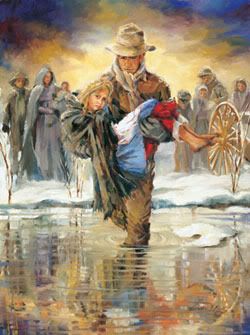 Now that we Latter-day Saints experience little real persecution, and the importance of our history and sacred places is beginning to wane, are we in danger of losing some valuable aspect of our culture? Are we losing our Psalms, our legends, our traditional customs and stories?
I'd like to hear what our readers think. Do you feel a connection to the Mormon pioneers? Or do you think the holiday is unnecessary, especially to LDS of other cultures living in many different countries of the world? Should we attempt to graft new converts in to the Utah Mormon pioneer heritage, or should we transfer our loyalties to "modern-day pioneers?"
In the last few years there has been some grumbling by members who don't have Mormon pioneers in their genealogy that it annoys them to celebrate the July 24th holiday, a commemoration of the day the first company of pioneers entered the Salt Lake Valley. I think partly to appease these voices, there has been an emphasis on "modern-day pioneers"--those who lead the way for others to follow and who blaze trails in other ways than traditionally recognized. There's a new Primary song, "I Can Be a Modern-Day Pioneer," there are more talks given by General Authorities on the subject, and there are articles such as the latest Mormon Times article "Pioneer Journeys of a Different Era."
There is a sudden dearth of Pioneer Day activities in wards outside of Utah, and in our ward last Sunday the only talk which mentioned pioneers emphasized modern-day contributions rather than those who crossed the plains.
I just want to register a caution to those who wish to move away from the traditional veneration of these honorable forebears. I want to remember their devotion to a faith that meant more to them than life itself. Social scientists often point to the Jewish culture and theorize that the reason it survived through so many years and the scattering of the people to so many different places was the very persecution which caused them to band together in small groups, and their longing remembrance of their homeland.
By the rivers of Babylon, there we sat down, yea, we wept, when we remembered Zion.
We hanged our harps upon the willows in the midst thereof.
For there they that carried us away captive required of us a song;
and they that wasted us required of us mirth, saying,
Sing us one of the songs of Zion.
How shall we sing the Lord’s song in a strange land?
If I forget thee, O Jerusalem, let my right hand forget her cunning.
If I do not remember thee, let my tongue cleave to the roof of my mouth;
if I prefer not Jerusalem above my chief joy.
Psalm 137)
This Psalm is a poignant lyrical device for recalling the story of Israel's exodus from Egypt and its arrival in the promised land. It acts as an earnest reminder both to the exiled Israelites and to later biblical readers of the importance of the promised land for the celebration of the Jewish faith.
Now that we Latter-day Saints experience little real persecution, and the importance of our history and sacred places is beginning to wane, are we in danger of losing some valuable aspect of our culture? Are we losing our Psalms, our legends, our traditional customs and stories? I'd like to hear what our readers think. Do you feel a connection to the Mormon pioneers? Or do you think the holiday is unnecessary, especially to LDS of other cultures living in many different countries of the world? Should we attempt to graft new converts in to the Utah Mormon pioneer heritage, or should we transfer our loyalties to "modern-day pioneers?"
Monday, July 20, 2009
He Said: Judging Righteous Judgment
As a Latter-day Saint I have seen a dichotomy about this concept of judging one another. I think BiV and her friends have some merit in discussing the term “omniscience mechanism”but I don't think they are totally correct in how operationally judgment works in the Church. We have commandments and standards that tell us that certain sins are an abomination to the Lord. We don't tell gay people they can't be in the church we just say they can't act on those sins. As to a gluttonous person that goes back to the gradations of sin. Our leaders don't consider gluttony on par with sexual transgression. These people talk out of both sides of their mouths. One day BiV tell us there are victimless sin like gluttony then the next day she tell us all sin is of the same value so why should one be treated less than another one.
On the one hand we are told by LDS leaders as every day members not to judge others and to be kinder and gentler in our treatment of others. Jesus told us he who is without sin should not to cast the first stone. Most of the time I don't have a clue if there is a gay person in my ward since it is not something we discuss. It doesn't matter what the sin is we have a series of judgments in this church. God has outlined them throughout the Bible and they have consequences.
On the other hand Joseph Smith in the JST changed the scripture in Matthew 7:2 to read: " Judge not unrighteously, that ye be not judged: but judge righteous judgment." In the church we have bishops and stake presidents who constantly judge certain sins and mete out disciplinary action. We have wives and husbands who enter in to a covenant relationship with us. We have stewardships in which home teachers and visiting teachers are supposed to help us and encourage us to better gospel living.
I don't know but maybe the gluttonous person needs to be chastened also by our leaders if that is a sin that is holding them back from entering the kingdom of God. In operation how is judgment really conducted in the Church and how does it work. I would be more inclined to trim down if I knew I couldn't get a temple recommend. But the reality is that there are many fat leaders who still have the Spirit. It isn't on the temple recommend questions yet.
As a young missionary serving under M. Russell Ballard he taught us that there is a series of judgments or accountability in which our bishops, stake leaders, general authorities and righteous priesthood fathers would give an accountability to the Lord in his making a final judgment. If if Christ is the final judge we are constantly being judged in the church by those with stewardship over us.
Joseph Fielding Smith in The Way to Perfection describes a prophetic accounting or judgment process:
BiV likes to quote trendy people who have interesting ideas like “omniscience mechanism.” She and her philosophical friends tend to place a framework over LDS doctrine and practice that just doesn't mesh with our operational procedures that make priesthood judgments. She doesn't take in to account that in Mormon doctrine we have developed a system in which righteous judgment is made on the basis of having the Spirit and discernment. It is the very thing that LDS leaders use in declaring a person is not in compliance with the standards of the Gospel or is in compliance with Gospel standards and about worthiness to partake of the sacrament or go to the temple or hold membership in the church.
Finite people make decisions that are bound in heaven throughout Old Testament, New Testament, and Latter-day times. If we were to say no one can make a righteous judgment only God than the practices of our religion would be nullified such as sealing people and worthiness issues. Christ and his leaders determine sin and its progressive discipline. Even Joseph Smith understood this when he set up the organization of the Church with a system of stewardship with accountability. Prophets and church leaders are constantly giving us advice and determining our status or worthiness. To me that is making righteous judgments.
I don't disagree that in the end the individual has to stand before Christ. I just disagree that that is the only judgment taking place on the way to the final reckoning.
Harold B. Lee said:
Recently someone attacked me for being overweight. They were absolutely correct in their assessment that I need to lose some weight. In fact an apostle told me the very same thing that I needed to get control of myself. We all know that the body is a temple of God when you feel sick from diabetes or high blood pressure you can't minister as well as when you are healthy. The apostle told me what he said out of love. Sometimes we make judgments even if they are not fully informed and they help a person to be more in tune with the Spirit or help them to fulfill their mission better here on this earth.
As to the example about an overweight person I will use myself adding I am not gay though. My wife is not very accepting of the fact that I am also overweight and constantly encourages me to eat better and exercise more. If she were to just love me by being less judgemental would I all of a sudden become thin? I don't think so. Loving the person has nothing to do with acceptance of them in a less than perfect state. She knows that I would be more effective in terms of my service in the kingdom if I were thinner. People would not be putting down my posts on non-weight related subjects based on who do I a chubby person think I am to discuss retiring to thy bed early. Yadda Yadda Yadda.
Sometimes we have to have the Spirit and render righteous judgment. Some of us are lazy and we need to be called to repentance. Passive love doesn't always conquer all, there has to be action on the part of the person who is not in compliance. The Lord may in the end declare we didn't measure up and we find themselves on the outside looking in after the final judgment.
Harold B. Lee says it in that we need to be better each day that comes from the previous day so we can perfect ourselves. A little righteous judgment from loved ones and leaders might be the nudge we need in overcoming damning behaviors to overcome our carnal natures.
BiV and her friends are correct in that is that Christ is the final judge and the keeper of the gate. He makes the final decision. Harold B. Lee also said:
On the one hand we are told by LDS leaders as every day members not to judge others and to be kinder and gentler in our treatment of others. Jesus told us he who is without sin should not to cast the first stone. Most of the time I don't have a clue if there is a gay person in my ward since it is not something we discuss. It doesn't matter what the sin is we have a series of judgments in this church. God has outlined them throughout the Bible and they have consequences.
On the other hand Joseph Smith in the JST changed the scripture in Matthew 7:2 to read: " Judge not unrighteously, that ye be not judged: but judge righteous judgment." In the church we have bishops and stake presidents who constantly judge certain sins and mete out disciplinary action. We have wives and husbands who enter in to a covenant relationship with us. We have stewardships in which home teachers and visiting teachers are supposed to help us and encourage us to better gospel living.
I don't know but maybe the gluttonous person needs to be chastened also by our leaders if that is a sin that is holding them back from entering the kingdom of God. In operation how is judgment really conducted in the Church and how does it work. I would be more inclined to trim down if I knew I couldn't get a temple recommend. But the reality is that there are many fat leaders who still have the Spirit. It isn't on the temple recommend questions yet.
As a young missionary serving under M. Russell Ballard he taught us that there is a series of judgments or accountability in which our bishops, stake leaders, general authorities and righteous priesthood fathers would give an accountability to the Lord in his making a final judgment. If if Christ is the final judge we are constantly being judged in the church by those with stewardship over us.
Joseph Fielding Smith in The Way to Perfection describes a prophetic accounting or judgment process:
Like Russell Ballard says there is a series of judgments up to the person's final reckoning that includes individual accountability and stewardship accountability by leaders responsible for us. If you can't make judgments than how is this possible and why does it happen?
BiV likes to quote trendy people who have interesting ideas like “omniscience mechanism.” She and her philosophical friends tend to place a framework over LDS doctrine and practice that just doesn't mesh with our operational procedures that make priesthood judgments. She doesn't take in to account that in Mormon doctrine we have developed a system in which righteous judgment is made on the basis of having the Spirit and discernment. It is the very thing that LDS leaders use in declaring a person is not in compliance with the standards of the Gospel or is in compliance with Gospel standards and about worthiness to partake of the sacrament or go to the temple or hold membership in the church.
Finite people make decisions that are bound in heaven throughout Old Testament, New Testament, and Latter-day times. If we were to say no one can make a righteous judgment only God than the practices of our religion would be nullified such as sealing people and worthiness issues. Christ and his leaders determine sin and its progressive discipline. Even Joseph Smith understood this when he set up the organization of the Church with a system of stewardship with accountability. Prophets and church leaders are constantly giving us advice and determining our status or worthiness. To me that is making righteous judgments.
I don't disagree that in the end the individual has to stand before Christ. I just disagree that that is the only judgment taking place on the way to the final reckoning.
Harold B. Lee said:
I sat with a youngster yesterday who is in his early twenties, and he is wondering now, worrying, he is fretting for fear he is not in the niche where he can give the best service. And I said, "Son, all you have to worry about is that you are doing your best in the place where you are today. That is all you have to be concerned about. You are not going to be judged by how you measure to someone else who has achieved a high station in the industrial or financial or religious world. The only measure by which you are going to be measured is, How will you compare with what you had the capacity to do? That is the measure the Lord's going to measure you by, to see whether or not you have done, to the best of your ability, whatever came within your hands this day, and if you can answer the same honestly day by day. And the only day you have to worry about is today. There is nothing you can do about yesterday except repent. That means if you made mistakes yesterday, don't be making them today. Don't worry about tomorrow, because you may have no tomorrows. This is the masterpiece you ought to be thinking about today. And if you can always witness honestly that whatever you did, you did to the best of your ability, and next day try improvement on that, when your life's end comes, of you it can be said in truth, his was a successful life because he lived to the best that was in him. That's all the Lord expects of any one of His children. We are all born with different capacities, some to do one thing, some to do the other, and all He asks is that we do our best; and that's the measure by which we'll be judged when that time comes."As if to point a finger at control as being a bad thing is to miss the whole point of judgment. God controls who gets in the various degrees of glory. No unclean thing can enter in to the kingdom of God. The standard works are replete with scriptures that talk about what happens and there are numerous scriptures that talk about prophets and holy men judging righteous judgment or giving counsel. There is in the LDS church a series of judgments or accounting by everyone from parents to church leaders to the prophets of dispensations to the final judge Christ.
Recently someone attacked me for being overweight. They were absolutely correct in their assessment that I need to lose some weight. In fact an apostle told me the very same thing that I needed to get control of myself. We all know that the body is a temple of God when you feel sick from diabetes or high blood pressure you can't minister as well as when you are healthy. The apostle told me what he said out of love. Sometimes we make judgments even if they are not fully informed and they help a person to be more in tune with the Spirit or help them to fulfill their mission better here on this earth.
As to the example about an overweight person I will use myself adding I am not gay though. My wife is not very accepting of the fact that I am also overweight and constantly encourages me to eat better and exercise more. If she were to just love me by being less judgemental would I all of a sudden become thin? I don't think so. Loving the person has nothing to do with acceptance of them in a less than perfect state. She knows that I would be more effective in terms of my service in the kingdom if I were thinner. People would not be putting down my posts on non-weight related subjects based on who do I a chubby person think I am to discuss retiring to thy bed early. Yadda Yadda Yadda.
Sometimes we have to have the Spirit and render righteous judgment. Some of us are lazy and we need to be called to repentance. Passive love doesn't always conquer all, there has to be action on the part of the person who is not in compliance. The Lord may in the end declare we didn't measure up and we find themselves on the outside looking in after the final judgment.
Harold B. Lee says it in that we need to be better each day that comes from the previous day so we can perfect ourselves. A little righteous judgment from loved ones and leaders might be the nudge we need in overcoming damning behaviors to overcome our carnal natures.
BiV and her friends are correct in that is that Christ is the final judge and the keeper of the gate. He makes the final decision. Harold B. Lee also said:
The only judge who can render a righteous judgment will be the Infinite Judge who knows all things from before the beginning of man upon the earth, even to the end of man. He will take all things into His view, and the judgment that will be rendered, you may be sure, will be a righteous judgment where mercy tempers justice, and yet justice has its part. If that were not so, it would make mockery of the laws that God prepared for us to obey if we are to inherit His gloryBut in our journey as church members a series of judgments are made that influence us on the way to the final judgment. Since even church leaders and prophets can make mistakes we have a final reckoning where everything is revealed and made right. Lets hope that those in positions of responsibility over us render righteous judgments that help us prepare for the final one.
Friday, July 17, 2009
He Said: Victimless Sins
I have heard the term victimless sins used by LDS bloggers this past year as something that is just between the person and God. Victimless sins I have read arguments or comments about include the Word of Wisdom, Sleep Patterns, Pornography, and Masturbation.
In a recent post on Retire to Thy Bed Early BiV and several of her commenters discussed victimless sin. They suggest that counsel given by the Lord in the Book of Commandments or Doctrine and Covenants is merely a guideline without actual implications and if they choose to stay up late at night there aren't any real consequences.
When I worked at BYU I worked for Reed Benson who had a sleeping disorder. He couldn't sleep at night and would get just a few hours of sleep if he was lucky. One day he came in and told me how he fell asleep at the wheel and drove down the hill by the Grant Building. He was lucky he didn't get killed. There are many cases of people who have limited sleep that have slower response times in doing things. My post showed that longevity is affected by those who don't get enough sleep. I admit that sleep is a minor problem but if we are all put on this earth with a mission and we cut that mission short it might have eternal consequences. For example a person is tired and they don't interact with someone that might have been converted to the gospel. If the Lord didn't think there wasn't an affect he wouldn't have given this as a revelation to Joseph Smith.
The concept of victimless sin has been grating at me ever since I wrote a post last year on masturbation. Nick Literski and others criticized me justifying their acceptance of this practice as a victimless sin. I argue that when a person masturbates they visualize some person in their minds many times a real person as the object of their desire. I posted a couple of weeks ago about whether mental adultery is a sin. I thought for sure the proponents of victimless sin would raise up arms but they were pretty tame. BiV didn't even respond saying that no one would refute it.
Today I came across a case study on masturbation and pornography that give us real life consequences of just how such sins are not victimless but can devastate other family members.
One blogger in Addicted to Porn who is very open on her blog tells the sad story of her husband Jack who engaged in such supposedly victimless sins as pornography and masturbation. I don't know if this is a fictious name or not but it is very revealing story of how supposedly victimless actions affect others:
There are other victimless sins such as the phenomenon of chatting with other men for women or women with men which can sometimes go from supposedly harmless gospel discussions to flirtatious online affairs to possible mental adultery. David Bednar decried this tendency in a recent CES fireside Things As They Really Are. The really is a promise that temple goers make about who are feelings should be toward. Once a person engages in such practices it is hard for them to stop.
Victimless sins are like a pebble thrown in a pond that ripple in ways that a sinner has no idea will affect others. Many times the victimless sinner blames an unintended victim such as a spouse of why they practice a supposed victimless sin in the first place.
In a recent post on Retire to Thy Bed Early BiV and several of her commenters discussed victimless sin. They suggest that counsel given by the Lord in the Book of Commandments or Doctrine and Covenants is merely a guideline without actual implications and if they choose to stay up late at night there aren't any real consequences.
When I worked at BYU I worked for Reed Benson who had a sleeping disorder. He couldn't sleep at night and would get just a few hours of sleep if he was lucky. One day he came in and told me how he fell asleep at the wheel and drove down the hill by the Grant Building. He was lucky he didn't get killed. There are many cases of people who have limited sleep that have slower response times in doing things. My post showed that longevity is affected by those who don't get enough sleep. I admit that sleep is a minor problem but if we are all put on this earth with a mission and we cut that mission short it might have eternal consequences. For example a person is tired and they don't interact with someone that might have been converted to the gospel. If the Lord didn't think there wasn't an affect he wouldn't have given this as a revelation to Joseph Smith.
The concept of victimless sin has been grating at me ever since I wrote a post last year on masturbation. Nick Literski and others criticized me justifying their acceptance of this practice as a victimless sin. I argue that when a person masturbates they visualize some person in their minds many times a real person as the object of their desire. I posted a couple of weeks ago about whether mental adultery is a sin. I thought for sure the proponents of victimless sin would raise up arms but they were pretty tame. BiV didn't even respond saying that no one would refute it.
Today I came across a case study on masturbation and pornography that give us real life consequences of just how such sins are not victimless but can devastate other family members.
One blogger in Addicted to Porn who is very open on her blog tells the sad story of her husband Jack who engaged in such supposedly victimless sins as pornography and masturbation. I don't know if this is a fictious name or not but it is very revealing story of how supposedly victimless actions affect others:
Our sex life continued to struggle, his interest in me was nil, he would literally do anything he could to avoid me. It really hurt. I often thought he was gay but told myself that it’s ok for him to have those tendencies as long as he doesn’t act on them. I really didn’t know what to think. I knew that being around him made me feel dirty, discouraged, and unattractive; it drove me crazy! I knew I never would have thought that marriage to a return missionary priesthood holder would have been so lonely. I loved having my babies and tried very hard to mentally and emotionally block out the mean and negative things that Jack would say and do.
Ten years after we were married, I was pregnant with my fifth baby (finally a boy), Half-way thru the term of that pregnancy for whatever reason, (a conference talk, I guess) he decided to tell me that he was addicted to pornography and that he was on his way that night to repent. I went thru stages of disbelief to horror to depression. I wasn’t even sure what pornography was. I associated it with pedophiles, rapists and perverts. I was very shocked and scared. I went to therapists, we went to therapists, he went to therapists, and all left me more shocked and more discouraged.
One of the hardest things to accept was the habit of masturbation that came with the addiction. “Addiction” I could not understand at all why anyone would call pornography and masturbation “Addiction”! If it was an “addiction”, would he never stop? If he could never stop… how would I stay married? How could he have repentance? I had so many mixed up feelings and emotions. I hated him. He stole ten years of my life, he threw away my righteous desires, he took the love and cherish that I could have had, and wanted with all of my heart, and tricked me. What kind of sick person could hide something so awful, for so long from his wife! When I would cry myself to sleep with loneliness and despair, he never once tried to calm me with the true reasons he didn’t want me? Why did he want so badly for me to hate myself in every way? He let me lose my self esteem, he let me feel dirty, he let me be angry and lonely, he let me hate myself for wanting to be with him.
I still wonder what porn star he was making love to in his mind when I conceived our children. For the last ten years I’d given birth to four of his daughters! During that time I stayed in the house as much as possible; I didn’t want to go anywhere. I loved being home with my babies, I loved holding and playing with them, I loved watching them play with each other and with their friends. I loved planning things for them. When the kids were sick or they would not go to bed, I had a hard time; Otherwise, I loved and cherished every minute with each one of them. I felt so blessed to have them.
When Jack was in town, he was a great dad. I seemed to let that trump all the other negative behaviors he had. Jack was out of town all the time! When he was gearing up to leave, and when he would return, we would always fight! I felt so guilty because I was convinced it was me being controlling. I wanted his help when he was home, but I hated it when he would undo and/or redo everything when he got back. Not once did he hint that the fighting before he left and after his return had to do with the sick double life he had when he was gone.
Church was the worst! That was his Turf. He was the honorable priesthood authority in our home. He was a return missionary! He prayed long prayers every night. He diligently served in his callings. He took the kids to church and I stayed home. I was insecure about what other women thought of me. I was not active enough growing up to always follow their LDS lingo, and I was certainly not pretty enough or worthy enough to be in their circle. For ten years he knew my struggles and my insecurities and never once gave a hint of his own short comings, sins or dirty little secrets. It was very hard to accept that I had married a person who could keep up such a lie.
I wondered what kind of sick thoughts he had. What did he think of our daughters? What did he think when he saw other peoples daughters in porn? If he didn’t respect women, how could he even have a testimony? Or did he? What kind of stupid girl was I, that I did not see this coming? I remembered JG saying “he could not imagine only seeing one naked woman for the rest of his life” I knew my husband felt the same way.
He punished me for not smelling good, not looking good, not taking enough time with the kids, not praying enough, not driving well enough, not making dinner good enough, not wearing the right socks, using the right knife, anything he could think of he would make it a point to make a personal attack on me, I believed that I wasn’t good enough. All that time, he was holding me to a ridiculous standard. He wanted me to be a fantasy! No matter how I tried, he would never be satisfied or pleased because what he wanted was porn. He married me, not because he loved me, but because he thought that being married would cure him. Just as I thought being married to a priesthood holder would make me happy, we both lost.
You can read the rest of her post and see how she lost her self-esteem and how a supposed victimless sin destroyed her trust in her husband.
There are other victimless sins such as the phenomenon of chatting with other men for women or women with men which can sometimes go from supposedly harmless gospel discussions to flirtatious online affairs to possible mental adultery. David Bednar decried this tendency in a recent CES fireside Things As They Really Are. The really is a promise that temple goers make about who are feelings should be toward. Once a person engages in such practices it is hard for them to stop.
Victimless sins are like a pebble thrown in a pond that ripple in ways that a sinner has no idea will affect others. Many times the victimless sinner blames an unintended victim such as a spouse of why they practice a supposed victimless sin in the first place.
Thursday, July 16, 2009
He Said: When Gospel Conversations are a Waste of Time

Having grown up a Roman Catholic I haven't always been as open about listening to other religions as BiV. In fact I told the LDS missionaries to get lost on at least two occasions in my life. Both times I was miffed because they were obnoxious and inconsiderate of my opinions and a drain on my time. I talked with them when I had an interest after reading the Book of Mormon and solicited the missionary discussions all seven in one day because I didn't want to be pressured to join if I didn't want to. Theologically to me the argument wasn't openness but authority. I felt that the Catholic Church at one time held the keys but there was a falling away and the LDS Church and Joseph Smith were a restoration of the same primitive Church.
Even though I served a mission I had the same expectation while a missionary that I was seeking the honest in heart that would let me in only if they wanted and held a similar viewpoint. I never got too upset or depressed when people slammed the door in my face. I was on a mission to find those already prepared and fortunately I never baptized people that had to be persuaded from already established other religion. The thirty-eight people who joined the church just plain didn't believe in the existing religion they had once belonged to and where seeking the truth. I learned early as a missionary that "a man convinced against his own will remains of the same opinion still."
On my mission I saw the competition for finding new people was usually Jehovah's Witnesses. It was unfortunate for us because they sweep in a neighborhood. A group of ten or twenty of them go out together and knock the same houses. People were not inclined to even talk to us if they had been recently swept. I encountered them about a dozen times in my life and on my mission I once went to a couple of discussions with an elder in their church. He was trying to convert my companion and me rather than the other way around. I was very turned off by the depressing belief that our spirits are held in the collective mind of God and that our bodies rot in the ground unless we are one of the 144,000 then our spirits live on. I also considered it the height of arrogance that a non-Jehovah witness could not pray with them. I have caused Jehovah Witness women teachers to get up and leave when I start praying since only they believe they can pray to God in a gathering. Over the years my wife has let them in the door or accepted their literature whenever they come by. She even attended their once a year sacrament meeting. Of course she couldn't take of the sacrament since only one of the 144,000 can. On a couple of occasions I have driven them mad when I insist that I know that I am one of the 144,000 because I have had a couple of experiences where I have walked and talked with Jesus. In fact I would take the sacrament if I attended because I definitely feel I am one of the high priests that is mentioned in the Bible. I read a pamphlet on my mission by Mark E. Petersen that talked about some of these doctrines that he said are mistaken beliefs and I still remember that he said that they were sincere people, sincerely wrong.
I don't agree that we should listen to just anyone who comes along. On the few occasions when I listened to other religious groups it was some pretty whacked out stuff. Once I listened to a New Age guy read to me from the Book of Urantia. It was some heady stuff even Joseph Smith seemed tame compared to its premises which mingled Christian doctrine in. In fact they would accept Joseph Smith as a prophet. I also encountered many Bahai's who thought Joseph Smith and Muhammed great teachers as was Jesus Christ.
My concern isn't just the time you spend listening but when you aid someone that feels you are an unbeliever. When I was going to school at BYU I lived on the west side of Provo. One day I came home from school and my wife had invited six fundamentalist missionaries all who were between sixteen and eighteen to have dinner. When it became about nine o'clock and they hadn't left I started to get concerned. She never asked me if they could sleep there. Finally I was able to get her alone and she said they were going without purse and script and she told them they could stay with us a day or two. It miffed me because not only did I have to listen to them attack my religion I was aiding and abetting those who would destroy other members faith. I didn't feel good that they were using my apartment as a base for their efforts. When I engaged them in a conversation they weren't especially interested in honest discussion and conceded that neither of us was going to feel any different. The funny thing was that a year later one of them supposedly converted to Mormonism and was a student at BYU. Now that I know they infiltrate the church I wonder if this girl was pretending to convert so she could go to the temple eventually.
I unlike my wife don't see what they do as harmless. One time I was assigned to be a home teacher to an infiltrated fundamentalist who was attending medical school in Missouri. She had moved in to our ward and she and her children were attending church like members in full fellowship. On my first visit as I was walking downstairs to give them a home teaching lesson in their family room I looked up at the wall and saw a photograph with an older man surrounded by about four or five women and a couple dozen children. Without missing a beat I said is that your husband and his wives and children. She said how did you know? I said the spirit just revealed it to me. Needless to say when I reported it to the bishop things were slightly different. I did met the husband who told me his convoluted story with which I was totally unimpressed. I felt sorry for the women he caused to lose their membership in the true church, the loss of his first marriage and wife, and it confirmed my attitude that we should be selective in what we listen to. It gave me a sick feeling in my gut to see how devious Satan really can be. The only value I see in listening to everyone is that if you have the Holy Spirit you will be able to cut through the crap.
Today I believe as I am getting older and have less time on this earth that we should have partially open minds and be discerning or selective in what messages we listen to. Even when I go to a job-related conference I get up and walk out if a lecture is boring or not of great value and I go to a different one. I don't have time to hear everything. I figure it is like when I first heard about Mormonism if the Lord wants me to hear it I will eventually hear it. If something resonates with me I listen if not I do other things.
Wednesday, July 15, 2009
She Said: Letting Missionaries in the Door
 Latter-day Saints have a strong missionary tradition that commenced from the very first days of the Church. We are known in many countries for our proselyting missionaries. For a long time I only knew of one other denomination that sent proselyting missionaries around, and that was the Jehovah's Witnesses. But in the past few years my door has been knocked upon by various Christian missionaries. When we lived in Vernal, there was even an evangelical group who went around specifically to convert Mormons away from their beliefs.
I have always enjoyed my discussions with these proselyting missionaries. Once I met with a set of Jehovah's Witnesses for several weeks. Through studying with them, I gained a greater understanding of the use of the Tetragrammaton in the Old Testament. I was privileged to be invited to their worship service, and I observed with interest their unique procedures in partaking of the Sacrament. Christian missionaries have provided wonderful examples for me in charity and being personally involved in projects to benefit the underprivileged. And Fundamentalist missionaries, while rare today, helped me appreciate our unique restoration heritage when they stayed with us for a few days in the early 1980's.
 Since our Church consists of so many converts, myself and Dr. B. among them, it is obvious that if these members hadn't been willing to entertain the missionaries--to let them in the door and listen to them, they would never had had the opportunity to hear the restored gospel and join the Church. But now that they are baptized members, should they shut their doors to missionaries of other faiths?
I am of the opinion that one should always hold an open mind when it comes to matters of religion. If we honestly seek the truth, we must be open to any conclusion. Our scriptures urge us to look for truth and knowledge wherever it may be found. I think that this includes in discussion with and examination of other faith traditions. People are generally afraid of uncertainty. They hesitate to challenge their secure world view, a view which is supported by the other members of their religion. But speaking with others with different paradigms and challenging our own assumptions is important. Religion is a search for truth, not a search for security, pleasure, friendship or approval.
That is why, when members of other religions knock on my door, I invite them in.
Subscribe to:
Posts (Atom)


