Friday, July 17, 2009

He Said: Victimless Sins

I have heard the term victimless sins used by LDS bloggers this past year as something that is just between the person and God. Victimless sins I have read arguments or comments about include the Word of Wisdom, Sleep Patterns, Pornography, and Masturbation.

In a recent post on Retire to Thy Bed Early BiV and several of her commenters discussed victimless sin. They suggest that counsel given by the Lord in the Book of Commandments or Doctrine and Covenants is merely a guideline without actual implications and if they choose to stay up late at night there aren't any real consequences.

When I worked at BYU I worked for Reed Benson who had a sleeping disorder. He couldn't sleep at night and would get just a few hours of sleep if he was lucky. One day he came in and told me how he fell asleep at the wheel and drove down the hill by the Grant Building. He was lucky he didn't get killed. There are many cases of people who have limited sleep that have slower response times in doing things. My post showed that longevity is affected by those who don't get enough sleep. I admit that sleep is a minor problem but if we are all put on this earth with a mission and we cut that mission short it might have eternal consequences. For example a person is tired and they don't interact with someone that might have been converted to the gospel. If the Lord didn't think there wasn't an affect he wouldn't have given this as a revelation to Joseph Smith.

The concept of victimless sin has been grating at me ever since I wrote a post last year on masturbation. Nick Literski and others criticized me justifying their acceptance of this practice as a victimless sin. I argue that when a person masturbates they visualize some person in their minds many times a real person as the object of their desire. I posted a couple of weeks ago about whether mental adultery is a sin. I thought for sure the proponents of victimless sin would raise up arms but they were pretty tame. BiV didn't even respond saying that no one would refute it.

Today I came across a case study on masturbation and pornography that give us real life consequences of just how such sins are not victimless but can devastate other family members.

One blogger in Addicted to Porn who is very open on her blog tells the sad story of her husband Jack who engaged in such supposedly victimless sins as pornography and masturbation. I don't know if this is a fictious name or not but it is very revealing story of how supposedly victimless actions affect others:

Our sex life continued to struggle, his interest in me was nil, he would literally do anything he could to avoid me. It really hurt. I often thought he was gay but told myself that it’s ok for him to have those tendencies as long as he doesn’t act on them. I really didn’t know what to think. I knew that being around him made me feel dirty, discouraged, and unattractive; it drove me crazy! I knew I never would have thought that marriage to a return missionary priesthood holder would have been so lonely. I loved having my babies and tried very hard to mentally and emotionally block out the mean and negative things that Jack would say and do.

Ten years after we were married, I was pregnant with my fifth baby (finally a boy), Half-way thru the term of that pregnancy for whatever reason, (a conference talk, I guess) he decided to tell me that he was addicted to pornography and that he was on his way that night to repent. I went thru stages of disbelief to horror to depression. I wasn’t even sure what pornography was. I associated it with pedophiles, rapists and perverts. I was very shocked and scared. I went to therapists, we went to therapists, he went to therapists, and all left me more shocked and more discouraged.

One of the hardest things to accept was the habit of masturbation that came with the addiction. “Addiction” I could not understand at all why anyone would call pornography and masturbation “Addiction”! If it was an “addiction”, would he never stop? If he could never stop… how would I stay married? How could he have repentance? I had so many mixed up feelings and emotions. I hated him. He stole ten years of my life, he threw away my righteous desires, he took the love and cherish that I could have had, and wanted with all of my heart, and tricked me. What kind of sick person could hide something so awful, for so long from his wife! When I would cry myself to sleep with loneliness and despair, he never once tried to calm me with the true reasons he didn’t want me? Why did he want so badly for me to hate myself in every way? He let me lose my self esteem, he let me feel dirty, he let me be angry and lonely, he let me hate myself for wanting to be with him.

I still wonder what porn star he was making love to in his mind when I conceived our children. For the last ten years I’d given birth to four of his daughters! During that time I stayed in the house as much as possible; I didn’t want to go anywhere. I loved being home with my babies, I loved holding and playing with them, I loved watching them play with each other and with their friends. I loved planning things for them. When the kids were sick or they would not go to bed, I had a hard time; Otherwise, I loved and cherished every minute with each one of them. I felt so blessed to have them.

When Jack was in town, he was a great dad. I seemed to let that trump all the other negative behaviors he had. Jack was out of town all the time! When he was gearing up to leave, and when he would return, we would always fight! I felt so guilty because I was convinced it was me being controlling. I wanted his help when he was home, but I hated it when he would undo and/or redo everything when he got back. Not once did he hint that the fighting before he left and after his return had to do with the sick double life he had when he was gone.

Church was the worst! That was his Turf. He was the honorable priesthood authority in our home. He was a return missionary! He prayed long prayers every night. He diligently served in his callings. He took the kids to church and I stayed home. I was insecure about what other women thought of me. I was not active enough growing up to always follow their LDS lingo, and I was certainly not pretty enough or worthy enough to be in their circle. For ten years he knew my struggles and my insecurities and never once gave a hint of his own short comings, sins or dirty little secrets. It was very hard to accept that I had married a person who could keep up such a lie.

I wondered what kind of sick thoughts he had. What did he think of our daughters? What did he think when he saw other peoples daughters in porn? If he didn’t respect women, how could he even have a testimony? Or did he? What kind of stupid girl was I, that I did not see this coming? I remembered JG saying “he could not imagine only seeing one naked woman for the rest of his life” I knew my husband felt the same way.

He punished me for not smelling good, not looking good, not taking enough time with the kids, not praying enough, not driving well enough, not making dinner good enough, not wearing the right socks, using the right knife, anything he could think of he would make it a point to make a personal attack on me, I believed that I wasn’t good enough. All that time, he was holding me to a ridiculous standard. He wanted me to be a fantasy! No matter how I tried, he would never be satisfied or pleased because what he wanted was porn. He married me, not because he loved me, but because he thought that being married would cure him. Just as I thought being married to a priesthood holder would make me happy, we both lost.

You can read the rest of her post and see how she lost her self-esteem and how a supposed victimless sin destroyed her trust in her husband.

There are other victimless sins such as the phenomenon of chatting with other men for women or women with men which can sometimes go from supposedly harmless gospel discussions to flirtatious online affairs to possible mental adultery. David Bednar decried this tendency in a recent CES fireside Things As They Really Are. The really is a promise that temple goers make about who are feelings should be toward. Once a person engages in such practices it is hard for them to stop.

Victimless sins are like a pebble thrown in a pond that ripple in ways that a sinner has no idea will affect others. Many times the victimless sinner blames an unintended victim such as a spouse of why they practice a supposed victimless sin in the first place.


Thursday, July 16, 2009

He Said: When Gospel Conversations are a Waste of Time


Having grown up a Roman Catholic I haven't always been as open about listening to other religions as BiV. In fact I told the LDS missionaries to get lost on at least two occasions in my life. Both times I was miffed because they were obnoxious and inconsiderate of my opinions and a drain on my time. I talked with them when I had an interest after reading the Book of Mormon and solicited the missionary discussions all seven in one day because I didn't want to be pressured to join if I didn't want to. Theologically to me the argument wasn't openness but authority. I felt that the Catholic Church at one time held the keys but there was a falling away and the LDS Church and Joseph Smith were a restoration of the same primitive Church.

Even though I served a mission I had the same expectation while a missionary that I was seeking the honest in heart that would let me in only if they wanted and held a similar viewpoint. I never got too upset or depressed when people slammed the door in my face. I was on a mission to find those already prepared and fortunately I never baptized people that had to be persuaded from already established other religion. The thirty-eight people who joined the church just plain didn't believe in the existing religion they had once belonged to and where seeking the truth. I learned early as a missionary that "a man convinced against his own will remains of the same opinion still."

On my mission I saw the competition for finding new people was usually Jehovah's Witnesses. It was unfortunate for us because they sweep in a neighborhood. A group of ten or twenty of them go out together and knock the same houses. People were not inclined to even talk to us if they had been recently swept. I encountered them about a dozen times in my life and on my mission I once went to a couple of discussions with an elder in their church. He was trying to convert my companion and me rather than the other way around. I was very turned off by the depressing belief that our spirits are held in the collective mind of God and that our bodies rot in the ground unless we are one of the 144,000 then our spirits live on. I also considered it the height of arrogance that a non-Jehovah witness could not pray with them. I have caused Jehovah Witness women teachers to get up and leave when I start praying since only they believe they can pray to God in a gathering. Over the years my wife has let them in the door or accepted their literature whenever they come by. She even attended their once a year sacrament meeting. Of course she couldn't take of the sacrament since only one of the 144,000 can. On a couple of occasions I have driven them mad when I insist that I know that I am one of the 144,000 because I have had a couple of experiences where I have walked and talked with Jesus. In fact I would take the sacrament if I attended because I definitely feel I am one of the high priests that is mentioned in the Bible. I read a pamphlet on my mission by Mark E. Petersen that talked about some of these doctrines that he said are mistaken beliefs and I still remember that he said that they were sincere people, sincerely wrong.

I don't agree that we should listen to just anyone who comes along. On the few occasions when I listened to other religious groups it was some pretty whacked out stuff. Once I listened to a New Age guy read to me from the Book of Urantia. It was some heady stuff even Joseph Smith seemed tame compared to its premises which mingled Christian doctrine in. In fact they would accept Joseph Smith as a prophet. I also encountered many Bahai's who thought Joseph Smith and Muhammed great teachers as was Jesus Christ.

My concern isn't just the time you spend listening but when you aid someone that feels you are an unbeliever. When I was going to school at BYU I lived on the west side of Provo. One day I came home from school and my wife had invited six fundamentalist missionaries all who were between sixteen and eighteen to have dinner. When it became about nine o'clock and they hadn't left I started to get concerned. She never asked me if they could sleep there. Finally I was able to get her alone and she said they were going without purse and script and she told them they could stay with us a day or two. It miffed me because not only did I have to listen to them attack my religion I was aiding and abetting those who would destroy other members faith. I didn't feel good that they were using my apartment as a base for their efforts. When I engaged them in a conversation they weren't especially interested in honest discussion and conceded that neither of us was going to feel any different. The funny thing was that a year later one of them supposedly converted to Mormonism and was a student at BYU. Now that I know they infiltrate the church I wonder if this girl was pretending to convert so she could go to the temple eventually.

I unlike my wife don't see what they do as harmless. One time I was assigned to be a home teacher to an infiltrated fundamentalist who was attending medical school in Missouri. She had moved in to our ward and she and her children were attending church like members in full fellowship. On my first visit as I was walking downstairs to give them a home teaching lesson in their family room I looked up at the wall and saw a photograph with an older man surrounded by about four or five women and a couple dozen children. Without missing a beat I said is that your husband and his wives and children. She said how did you know? I said the spirit just revealed it to me. Needless to say when I reported it to the bishop things were slightly different. I did met the husband who told me his convoluted story with which I was totally unimpressed. I felt sorry for the women he caused to lose their membership in the true church, the loss of his first marriage and wife, and it confirmed my attitude that we should be selective in what we listen to. It gave me a sick feeling in my gut to see how devious Satan really can be. The only value I see in listening to everyone is that if you have the Holy Spirit you will be able to cut through the crap.

Today I believe as I am getting older and have less time on this earth that we should have partially open minds and be discerning or selective in what messages we listen to. Even when I go to a job-related conference I get up and walk out if a lecture is boring or not of great value and I go to a different one. I don't have time to hear everything. I figure it is like when I first heard about Mormonism if the Lord wants me to hear it I will eventually hear it. If something resonates with me I listen if not I do other things.

Take the Poll: Gospel Discussions with Those of Other Faiths


Wednesday, July 15, 2009

She Said: Letting Missionaries in the Door

Latter-day Saints have a strong missionary tradition that commenced from the very first days of the Church. We are known in many countries for our proselyting missionaries. For a long time I only knew of one other denomination that sent proselyting missionaries around, and that was the Jehovah's Witnesses. But in the past few years my door has been knocked upon by various Christian missionaries. When we lived in Vernal, there was even an evangelical group who went around specifically to convert Mormons away from their beliefs.

I have always enjoyed my discussions with these proselyting missionaries. Once I met with a set of Jehovah's Witnesses for several weeks. Through studying with them, I gained a greater understanding of the use of the Tetragrammaton in the Old Testament. I was privileged to be invited to their worship service, and I observed with interest their unique procedures in partaking of the Sacrament. Christian missionaries have provided wonderful examples for me in charity and being personally involved in projects to benefit the underprivileged. And Fundamentalist missionaries, while rare today, helped me appreciate our unique restoration heritage when they stayed with us for a few days in the early 1980's.

Since our Church consists of so many converts, myself and Dr. B. among them, it is obvious that if these members hadn't been willing to entertain the missionaries--to let them in the door and listen to them, they would never had had the opportunity to hear the restored gospel and join the Church. But now that they are baptized members, should they shut their doors to missionaries of other faiths?

I am of the opinion that one should always hold an open mind when it comes to matters of religion. If we honestly seek the truth, we must be open to any conclusion. Our scriptures urge us to look for truth and knowledge wherever it may be found. I think that this includes in discussion with and examination of other faith traditions. People are generally afraid of uncertainty. They hesitate to challenge their secure world view, a view which is supported by the other members of their religion. But speaking with others with different paradigms and challenging our own assumptions is important. Religion is a search for truth, not a search for security, pleasure, friendship or approval.

That is why, when members of other religions knock on my door, I invite them in.

Tuesday, July 14, 2009

She Said: Victimless Sin #1

Hmm, Dr. B's last post sure sounded like a reprimand to me, did it sound like that to you?

He's right -- I do burn the candle at both ends. I used to be a "morning person," retiring at about 10pm and getting up around 6am. It all changed by the time my eighth child had arrived. I found myself so thrilled when they were all in bed that I finally had time to myself to read, do a project, or just have some free time alone, that I took to staying up quite late at night. This habit has continued over the years. I now go to sleep about 12 or 1:00 at night and wake up just before 7. During the school year I have to get up just before 6. This gives me 6 or 7 hours of sleep, which I think is rather reasonable. A few times a month I find myself involved in something to the point that I stay up until 2 or 3.

Every once in a while I will make an effort to get more sleep. But it's not that important to me. What about you? Do you think going to sleep and waking up early is an important commandment, or is it just a suggestion that might be helpful? I think if my body didn't need to sleep, I never would. Since I honor my mother and father and obey the Word of Wisdom, I am already assured of a long and healthy life. I enjoy my hours alone in the darkness, reading or thinking, perusing the blogs, writing poetry. I wouldn't trade them for a few paltry more years in my extreme old age.


BiV's Homage to the Dark Hours

My muses prowl in the dark hours--
They do not waylay the weary,
But bestow their boon on the bright-eyed
And not the bleary.

Those owl-like souls who await them
In a state of solemn wonder
And are wakeful still in the wee hours,
Receive the plunder.

My muses pass by the slumb'rous,
They delay their dance to the dark hours,
And the only souls who perceive them
Rest not 'neath bowers.

I have pined alone in the dark hours,
I have begged without compunction.
I have sought the nine nymphic tokens,
Invoked their unction.

As I write these words after midnight,
I can feel their furtive fingers
Touch my mind and spirit gently--
The night oil lingers.

Monday, July 13, 2009

He Said: Retire to Thy Bed Early

In Section 88:124 the Lord instructs:
Cease to be idle; cease to be unclean; cease to find fault one with another; cease to sleep longer than is needful; retire to thy bed early, that ye may not be weary; arise early, that your bodies and your minds may be invigorated.
As long as I have been a Latter-day Saint I have considered this to be wise counsel. After only a year I went on a mission where we were expected to arise by 6 am and go to bed by 10 pm. Today it is 6:30am for missionaries and 10:30pm. For most of my life I have gone to bed at the latest around midnight but usually before 11pm.

Wikipedia gives a good overview on the amount of sleep we all need:

The National Sleep Foundation in the United States maintains that seven to nine hours of sleep for adult humans is optimal and that sufficient sleep benefits alertness, memory, problem solving, and overall health, as well as reducing the risk of accidents. A widely publicized 2003 study performed at the University of Pennsylvania School of Medicine demonstrated that cognitive performance declines with six or fewer hours of sleep. A University of California, San Diego, psychiatry study of more than one million adults found that people who live the longest self-report sleeping for six to seven hours each night. Another study of sleep duration and mortality risk in women showed similar results. Other studies show that "sleeping more than 7 to 8 hours per day has been consistently associated with increased mortality," though this study suggests the cause is probably other factors such as depression and socioeconomic status, which would correlate statistically. It has been suggested that the correlation between lower sleep hours and reduced morbidity only occurs with those who wake after less sleep naturally, rather than those who use an alarm.

Researchers at the University of Warwick and University College London have found that lack of sleep can more than double the risk of death from cardiovascular disease, but that too much sleep can also double the risk of death. Professor Francesco Cappuccio said, "Short sleep has been shown to be a risk factor for weight gain, hypertension, and Type 2 diabetes, sometimes leading to mortality; but in contrast to the short sleep-mortality association, it appears that no potential mechanisms by which long sleep could be associated with increased mortality have yet been investigated. Some candidate causes for this include depression, low socioeconomic status, and cancer-related fatigue. …In terms of prevention, our findings indicate that consistently sleeping around seven hours per night is optimal for health, and a sustained reduction may predispose to ill health."


It is fascinating that Wikipedia agrees with both parts of the revelation that we shouldn't sleep longer than is needful nor that we should not get enough sleep which is usually considered seven to eight hours for an adult, nine to ten hours for those 5-18.

Outside of the missionary culture I discovered during my seven years at BYU that most members didn't really put a great deal of stock in adhering to this principle of going to bed early and sleeping that much. The majority of roommates and friends burned the midnight oil. They were just warming up by about 10 pm. Most of them were lucky they got about five or six hours sleep every night. I knew many that slept right through 8am classes and even more that worked as student janitors at 4am who either stayed up all night or missed shifts.

The reality is that many Latter-day Saints go on less than eight hours of sleep since we are such busy people. I don't know too many people that go to bed at nine oclock at night. It can be argued that at the time of Joseph Smith they didn't have electric lights nor did people work at different times of the day and night. My father who worked the night shift had to sleep during the day. He never really got his sleep clock in tune with the amount of time he needed to sleep. As he got older he said he slept less because he knew his time was limited.

I know that is a struggle for many Latter-day Saints to get up early in the morning. I remember as a student at BYU that Hugh Nibley told me "I am a late person. I go to bed late at night and get up late in the morning. I don't operate well early in the morning." My own wife seems to go to bed between 1-3am despite getting up around 6:30am every day. She usually cries when I wake her up and says she is tired. I think lack of sleep contributes to her crankiness.

I had a roommate when I first went to BYU who went on about two or three hours of sleep. He was always dragging his behind. After two or three weeks he would crash and sleep an entire day on Saturdays in to Sunday.

Even David O. McKay admits in his book Man May Know for Himself he had difficulty as a teenager with the principle:
I am reminded of the passage from the Doctrine and Covenants, "Retire to thy bed early . . . arise early." Sometimes as boys Thomas E. and I did not retire early. The next morning father would stand at the door upstairs and say, "Come boys, it's time to get up," and we would turn over, hoping for a few more winks; but he would stand there, and say, "Come boys, those who dance must pay the fiddler." Oh, those happy days of youth!

Joseph B. Wirthlin in his book Finding Peace in Our Lives tells us why he considers getting up early of value:
Heed the advice found in the Doctrine and Covenants: "Cease to sleep longer than is needful; retire to thy bed early, that ye may not be weary; arise early, that your bodies and your minds may be invigorated." (D&C 88:124.) The early hours of the morning give us a freshness and a time when we are unencumbered with the cares of the world. It can be a quiet time, a time to become organized and "prepare every needful thing." (D&C 88:119.)
Russell M. Nelson also agreed in Conference October 1986 that morning is a good time to put our lives in order:
To those who feel defeated and downtrodden, look to the early hours of the day for your rescue. The Lord tells us, “Cease to sleep longer than is needful; retire to thy bed early, that ye may not be weary; arise early, that your bodies and your minds may be invigorated” (D&C 88:124). The dawning of a brighter day heralds a time of forgiveness. Shadows of yesterday’s grief melt in the rays of early morn’s opportunity.

I guess early morning is a good time for repentance because wives, children and siblings are still cutting a few z's. You can pour out your soul without worrying anyone hears you if you feel like praying quietly out loud. I come up with my best posts right when I wake up around 5 or 6am.

Neal A. Maxwell in his book Notwithstanding My Weaknesses suggests we should get up early so we don't make mistakes due to weariness:
President Spencer W. Kimball has had those telling moments when he has felt as if he simply could not meet certain challenges. Yet he did and he does. Given our weaknesses, however, paced progress is essential, much as God used six measured and orderly creative periods (followed by respite) in preparing man and this earth. There is a difference, therefore, between being steadily and effectively or "anxiously " engaged, on the one hand, and, on the other hand, being frantically engaged one moment and being passive and detached the next. Lest we wrongly assume that traveling on the straight and narrow path requires hectic pace, let us remember that the Lord does not want us to weary by the way and for very good reasons. Thoughtless haste and spurts of service are not what is desired, for such naivete is like the businessman who confuses volume with profit. The Lord has clearly indicated His concern for us if we are weary; He has even given us counsel on sleep to avoid that weariness and in order to be vigorous: "cease to sleep longer than is needful; retire to thy bed early, that ye may not be weary; arise early, that your bodies and your minds may be invigorated." (D&C 88:124)

Heber J. Grant mentioning the death of Anthony W. Ivins in Conference October 1934 said he would have lived longer had he gone to bed earlier:
One of the greatest, most devoted and splendid members of the General Authorities of the Church has been taken from us at the ripe age of eighty-two. From his childhood until his death he has been a very studious man, gathering information on many subjects, and he was successful in all the walks of life in which he engaged. He was successful in more things than any other man I ever knew, and all his life fulfilled the requirements made in the D&C, Section 88, verses 124, 125, 126:

Cease to be idle; cease to be unclean; cease to find fault one with another; cease to sleep longer than is needful; retire to thy bed early, that ye may not be weary; arise early, that your bodies and your minds may be invigorated;

And above all things, clothe yourselves with the bonds of charity, as with a mantle, which is the bond of perfectness and peace;

Pray always, that ye may not faint until I come; behold, and lo, I will come quickly, and receive you unto myself.

Each and every requirement therein made Brother Ivins fulfilled, except the one "retire to thy bed early." I believe that he would have lived longer had he fulfilled that requirement, but he generally studied until midnight.

I guess he would have lived to 90 had he heeded the advice of the Lord. I am sure most of us would like to last until 82 even. If you really aren't too concerned about how long you live and want to cut off a few years of life then you should continue a reduced sleep cycle.

Friday, July 10, 2009

She Said: In a Good Mormon Marriage, Who Holds the Trump Card?

These days, I don't know of anyone who DOESN'T believe that husbands and wives should be equal partners in a marriage. Optimally, a married couple should work together to solve problems. But we all know that sometimes an impasse will be reached. A consensus cannot be attained, and a decision must be made. What does a good Mormon couple do in such a situation?

We often hear that patriarchy is a good system because of just such occurrences. If there is one clear leader, the argument goes, then the course to follow will be decided in advance, and it will cause less contention in the long run. In homes where one partner holds the priesthood, it seems obvious that the priesthood holder will make all final decisions when a tie-breaker is needed. In an address titled "Marriage and the Patriarchal Order," Elder Dean L. Larson expresses his opinion that male priesthood holders should be sensitive to their wives' feelings and desires when making decisions, and that compulsion should not prevail. However,
"In the Lord’s system of government, every organizational unit must have a presiding officer. He has decreed that in the family organization the father assumes this role. He bears the priesthood ordination. He is accountable before the Lord for this leadership...A wide range of individual responsibilities must be carried by the leaders and by good counselors in every successful organization, including the family organization. These responsibilities should be agreed upon and then honored as a sacred trust. The particulars may vary in each marriage unit by agreement of the husband and wife, but the ultimate responsibility for leadership cannot be successfully delegated."

The majority of Elder Larson's talk illustrates the problem I have with this principle. Over and over he speaks of unity in the making of decisions. He talks about how unanimity is important in the councils of the Church. He even expresses the idea that different areas of responsibility for family life may be divided among the spouses if agreed upon in advance. But in the end, the "trump card" is left with the husband.
"If, ultimately, a husband must propose a course of action in the absence of complete agreement, he must sense the great responsibility in taking this role and should do so with great care. It should never be done precipitously, whimsically, or egotistically, but always thoughtfully and with the welfare of those involved uppermost in mind. The powers of inspiration can more easily and readily be brought to bear in this way. When a decision is reached in any matter, the two marriage partners must be as one in pursuing the objective, whatever it may be. A wise couple will learn to sustain and support each other in their proper roles in leadership and partnership. There will never be lobbying with family or friends for support against a decision made in the proper way. To do so would be to invite contention and competition which will surely be destructive to the happiness and harmony of the marriage."

The wife is expected to submit to the husband's priesthood leadership in these cases. In my opinion, a woman can never feel like an equal partner in a marriage which is contracted under these terms. In the better marriages, she may feel that her opinion is valued, that her husband respects her judgment and so forth, but underlying all of the best efforts for unity is the crocodile of priesthood that lies beneath murky waters, ready to raise his fearful head if there comes a day that two human beings cannot see eye to eye.

Our Church leaders strive incessantly to allege that our LDS marriages are equal as well as patriarchal. This is simply not true when one partner is given a trump card. No matter how sensitively, how lovingly, how meekly he makes the decision, it is his to make, and the woman's to submit.

He Said: In a Good Mormon Marriage, Who Holds the Trump Card?

I read with great interest BiV's post on who holds the trump card. In a world where relationships really are patriarchal I would see better her position and respond that men actually have a decision-making power and are ultimately responsible in the Mormon system of accountability. However in the United States and Canada most Mormon males would tell you that their wives have for the most part usurped that power. No man with any sense would think that he is in charge of the family. The reality is that the wife is usually in charge and calls on us for decisions when children don't comply.

The business about women are more spiritual than men is because it is the woman who usually presses the spiritual things like lets pray or hold family home evening or go to the temple. Recently my daughter was able to get in to all three BYUs. I have a preference for BYU in Provo having gone there for seven years. I worked at BYU-Hawaii for two years and had a daughter attend BYU-Idaho. I tried to get my wife and daughter to see the logic of my daughter going to BYU. In the end my wife convinced my daughter it was better for her to go to a school I considered inferior at BYU-Hawaii to BYU at Provo. I admit her rationale of being smaller might mean better attention but knowing the arrogance of professors at both places up close and personal I feel it is the luck of the draw.

I can't think of single incidence where I said something and my wife or children did what I suggested. As a result I don't see what has her knicker's in a bunch other than the fact that the leaders suggest the man make the final decision.

In my opinion it is because if the wife is so prone to being in charge than it might equalize it if she were to consider the opinion of her husband from time to time. This is a cultural specific thing in the U.S. and Canada and matriarchal places like the Phillipines. My argument wouldn't probably hold up in truly partriarchal cultures in the world like the Middle East or Europe but for this culture I believe the disparity is on the other side unless a woman truly is a wallflower. Having seven daughters I haven't seen one yet including in my twelve years of living in Utah. I find this outrage over a fundamentalist doctrine hard to fanthom.

It would actually be refreshing in terms of intimacy if more mainstream Mormons women actually thought we trumped them since many of the men I talk to are just trying to keep their wives happy. I learned in Family Relationship classes at the Y that women control the intimacy. It might balance things out if men actually had a say in other areas.

Monday, July 6, 2009

She Said: Mormon Date Night

I'm not so sure this is counsel we hear from GAs or over the pulpit at General Conference (I'll let Dr. B. search around for it), but I know that local leaders often counsel married couples that they should set aside time once a week for a "Date Night." I think this is actually some of the best advice I've heard for strengthening a marriage. When Dr. B. and I were married in the Salt Lake Temple back in 1983 our sealer, Elder Yoshihiko Kikuchi, advised us to go out often together, even if it was only to McDonald's. I think this was standard advice that he gave to many couples. It is often difficult once two people are married to spend quality time together. Unless there is a time set apart in the week, it usually just doesn't happen. Work schedules, children, TV, or even a good book can get in the way of conversation between couples, and over the years the lack of communication makes a difference.

I remember at a stake conference when all of our children were quite young, the SP told the parents in the stake that they should establish a bedtime for their children. At the time, we were into attachment parenting, and that combined with nursing on demand which meant that bedtimes were haphazard around our place. In fact, we ususally let the children spend the night wherever they happened to fall asleep (most often, our bed). I resisted the Stake President's advice at first, but after we discussed it we decided to try it for a while. I did notice that when we had bedtimes in our home, DH and I spent more time conversing together in the evenings.

I would have to say that in my opinion, Mormon Date Night is more effective than almost anything else for keeping marriages strong and families together. A "date" doesn't have to be expensive, or even take you out of the home. The best dates are those that get you talking and enjoying each other's company. Here are some of my favorite "dates" that we've done as a couple:

  • Road trips (sometimes these have been road trips to the temple, when we've lived a distance from the temple. I don't think going to the temple is always the best date night, but it can be great when you combine it with dinner before or after, a road trip, or even a weekend getaway.)

  • Canoeing/Tubing (I love water sports. I'd like to do more of this--kayaking, sailing, windsurfing, etc.)

  • Just going to the beach and walking along the shore (trite, I know! but for a reason, people!)

  • Studying Isaiah together

  • Going to the museum (I love art museums, and I'm still hoping to get to Italy to see the art there.)

  • Attending concerts (most of the ones we've done lately have been our kids' band concerts, but those are fun, too.)


These are dates I don't particularly care for:

  • Going to a movie

  • Going out to eat (exception: upscale dinner theater. Don't know if we've ever done that together, though.)

  • Going to a church fireside or high priests' activity


What are your favorites, readers? Has Mormon Date Night helped your marriage?


He Said: Mormon Date Night

I have tried date night on a few occasions in my married life but not consistently. Part of my problem has been I am constantly broke and I am lazy. My wife likes to do different things like go for a walk or paddle a canoe. Neither activities that I am interested in. My idea of a good time is going out to eat or watching a movie. Neither activity which engages in much conversation.

Historically my wife tasked me to try to track down the concept of "date night." I can't seem to track the concept of an LDS date night prior to the 1980s in Church Publications for general members but I believe it was probably a practice since the 1940s or 1950s for church leaders. Among General Authorities I believe it existed before the 1980s because in “Elder Bruce R. McConkie: ‘Preacher of Righteousness’,” Ensign, Jun 1985, 15 it says that the McConkie's had been doing it for years:

Mark remembers that Thursday nights were reserved as his parents’ date night. “Their courtship continued until today.” They enjoyed shows, went out for ice cream or popcorn, or just went for walks. They once went through a bird-watching phase together, and later enjoyed collecting and polishing rocks, making beautiful jewelry for friends. They studied the scriptures together, and she listened as he prepared his manuscripts and sermons.
It became a wide-spread term in the late 1970s and early 1980s. Elder Dean L. Larsen used the idea of a Friday date night during a husbands’ and wives’ fireside broadcast from Temple Square 29 January 1984 in which said:
A wise bishop told me recently that every Friday night is date night for him and his wife. The older children in the family know that they have a babysitting assignment every Friday evening. It is a tradition that they enjoy with their parents.
The earliest time I saw it used in the Church News was on 22 August 1987 in response to a Mormon Forum when people were asked to respond to how to be a more effective father, husband. Leo Weider of Provo, Utah responded:

On our date night, every Friday, I normally ask my sweetheart, "How I can serve you and the children better? How can I be a better person, husband and father?" Then I listen without a defensive rebuff. I may think I'm doing great but it's how I am perceived by my family and others that is important. I don't like to hear that I am lacking, but if I don't find out I will never know how to change. When I ask my children these questions, I often get startling answers. What they think, not what I perceive, is most important.
In the 1990s it was reported on a few times in the Church News. In How to be a Hard Worker While Finding the Time to Rest Body and Mind on 30 July 1994 we read:

Reserve at least one day or night per week for activities. We have a date night, which is most often Saturday. We ride our motorcycles, see historic sites, visit friends, do family history research, etc....

Because my husband is a busy bishop and provider, we have found that having family home evening is a way for our family to slow down, especially after Sunday meetings and schedules. On Monday nights, as a family, we make sure that we plan a fun activity either outside the home, which gets us away from our normal stress level, or we just stay home. We have a simple gospel lesson with singing of Primary songs. We laugh together, which always seems to rejuvenate all of us.

There is always a date night once a week for my husband and me. There are times we sit around the piano and sing, which releases a lot of tension, or we listen to music, whether it be the Tabernacle Choir or soothing classical music. Music has been one of the biggest influences of my life and my family's life. By it has come a lot of stress, as I am a music teacher and my husband sings. But also, by it has come much peace, as we always seem to turn to it when we need tensions released and our spirits calmed.-Anne Woolley, Kenosha, Wis.

On 3 Feb. 1996 in How to remain in love with your spouse despite the ongoing rigors of life

Have a weekly date night. This does not necessarily have to be a spend-a-lot-of-money night. In our case, we make time for each other, even if that only means that we go for a walk together and have ice cream. Do it with the idea that it's your time together, not time to discuss kids, bills, household things. The idea is to spend time together and to stay acquainted with each other.

Most of the LDS marriage counseling books suggested it as a practice now for general members. Brent Barlow in What Wives Expect of Husbands (1982) wrote:

While some husbands spend adequate time with their wives, many do not. One wife wrote, 'I would like him to sense my moods and respond with some time especially for me when I am tired, frustrated, or burdened. I would like this time without him complaining and without having to ask for it."

Another young woman said, "In the future, I would appreciate more planning for time together. Specifically, setting aside time for just us. Time to share experiences, develop interests we can share, become better acquainted, and just be good friends."

An older woman wished her husband would just "offer to go out in the evening for a walk or bike ride."

Wives do expect an occasional night out with their husbands. One happy wife said, "I enjoy going on little trips with him or just a date to dinner or a show. But it doesn't have to cost anything to make me happy. All he has to do is let me know he's glad I'm there." And another satisfied housewife simply wrote, "We have a regular date night. He tries very hard to follow the advice of our church leaders, who say we should go out alone as husband and wife."

Some wives don't want to go out on the spur of the moment. One wife admonished husbands, "Plan ahead for dates. Spur of the moment planning is difficult, and by planning you can get more in. Or, it can just make you happier in looking forward to the time together."

Tamra A. Fackrell in the Sane Mother's Guide to Raising Small Children agrees with Biv:

My husband and I often have a weekly date. Many couples complain that getting a babysitter is too expensive, but time alone with each other is important. I live for it. I love the romance, and I love my husband. Every marriage needs an element of fun, and a babysitter is much cheaper than marriage counseling. Don't just keep your marriage alive; instead, make it thrive!

I have found some creative solutions about babysitting. For example, you might go out two nights a month and stay in two nights a month. On your nights in, put the kids to bed promptly and establish the rules of date night: No interruptions! Then you can watch a movie in a homemade tent, go on a scavenger hunt, eat a crazy theme dinner, or watch the sunset from your balcony. As I write this, my husband and I are on a date of sorts. He bought burritos for our dinner, and he is playing computer games while I am writing. As I finish a section, he reads it and offers suggestions. Not exactly pure romance, but he shows his love by his support. You can also trade babysitting with a friend. And if you are lucky enough to have Grandma or an aunt who loves to babysit and lives nearby, you have even more options! A weekly date keeps marriages thriving.
I remember before I had kids my wife came and got me and took me on a romantic canoe trip with Dick and Julia Lowe on Utah Lake. Even though I can't swim I braved it. I can't seem to get a real consensus on the Friday night bit but I have heard that over the years.

I am not sure you need to institutionalize the practice but I am sure that in the busy world we live in that couples don't seem to spend enough quality time together. Formalizing it can make it harder to be spontaneous but on the other hand a half a loaf is better than none. Even if you only go out on occasion it is better than not going out at all.

Thursday, July 2, 2009

She Said: Symonds Ryder and a Crisis of Faith

On Wednesday, John Hamer at BCC put up a post about the Thomas B. Marsh strippings of milk story. This is one with which most members of the Church are familiar, as it is often used to illustrate the folly of apostatizing from the Church over a trifle. John cautions:
"Thus, while the moral the Thomas B. Marsh fable, i.e., that faith can be shattered over something inconsequential, is true enough, it would probably make sense to tell a different, more appropriate fable to illustrate that moral."

There is a different fable oft told in the Church to illustrate that moral--but I would like to show that its use is just as inappropriate, and perhaps the moral itself should be reexamined.

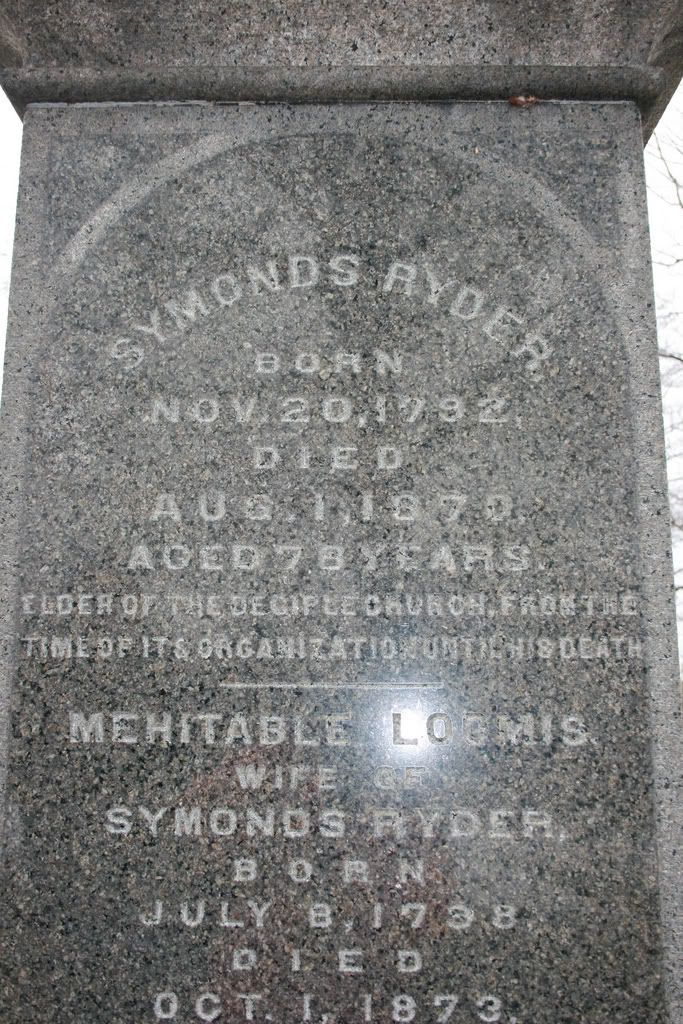
Symonds Ryder was a convert to the Church from the same Disciples of Christ congregation in Mantua, Ohio as Sidney Rigdon, Ezra Booth, and Eliza R. Snow and her family. He was made an Elder and called to serve a mission in a revelation that is now D&C 52. However, in the revelation, his name was spelled wrong. The misspelling of his name is often the only reason cited as the cause of his decision to then leave the church. (see B. H. Roberts in HC 1:260–61; Fawn M. Brodie in No Man Knows My History: The Life of Joseph Smith the Mormon Prophet, 118; Donna Hill in Joseph Smith: The First Mormon, 143; Cannon and Cook in Far West Record, 286; Dean C. Jessee in Papers of Joseph Smith, Volume 1: Autobiographical and Historical Writings, 511.) Probably the origin of this story is his funeral sermon preached in Hiram, Ohio, August 3, 1870, by B.A. Hinsdale.
"Ryder was informed, that by special revelation he had been appointed and commissioned an elder of the Mormon church. His commission came, and he found his name misspelled. Was the Holy Spirit so fallible as to fail even in orthography? Beginning with this challenge, his strong, incisive mind and honest heart were brought to the task of re-examining the ground on which he stood. His friend Booth had been passing through a similar experience, on his pilgrimage to Missouri, and, when they met about the 1st of September, 1831, the first question which sprang from the lips of each was--"How is your faith?" and the first look into each other's faces, gave answer that the spell of enchantment was broken, and the delusion was ended. They turned from the dreams they had followed for a few months, and found more than ever before, that the religion of the New Testament was "the shadow of a great rock in a weary land." (A. S. Hayden, Early History of the Disciples (1875), p. 251.)

Perhaps the misspelling was a bother to Ryder, but this one incident was hardly the sole reason for Ryder's departure. For one thing, spelling was more fluid in the 19th century and earlier. An attempt at standardized spelling in the U.S. did not begin until the appearance of Webster's “American Dictionary of the English Language” in 1828, and for at least a half century many words continued to be vociferously debated. American census-takers varied quite a bit in their reporting of people's names, showing that they were not asking people "How is that spelled?" but rather writing the name as they thought it should appear. Ryder's name appears as following in the U.S. census:

1830 census Hiram, Portage, OH: Simonds Rider
1840 census Hiram, Portage, OH: Symonds Rider
1850 census Hiram, Portage, OH: Simonds Rider, wife Mahitabel
1860 census Hiram, Portage, OH: Symonds Rider, wife Mehitable
1870 census Hiram, Portage, OH: Symands Rider, wife Mahitable


Ryder's commission with the misspelling of his name took place in June 1831 and may account for his not going to Missouri, but as noted he did not leave the church until Ezra Booth's return in September. In the meantime, Ryder became concerned about other developments. In a letter to A.S. Hayden he wrote:
"But when they [Joseph Smith and Sidney Rigdon] went to Missouri to lay the foundation of the splendid city of Zion, and also of the temple, they left their papers behind. This gave their new converts an opportunity to become acquainted with the internal arrangement of their church, which revealed to them the horrid fact that a plot was laid to take their property from them and place it under the control of Joseph Smith the prophet. This was too much for the Hiramites, and they left the Mormonites faster than they had ever joined them, and by fall the Mormon church in Hiram was a very lean concern." (Symonds Ryder, "Letter to A. S. Hayden," February 1, 1868, cited in Hayden, op. cit., pp. 220, 221.)
It seems that the coming threat of enforced consecration might have been more of a problem for Ryder than the misspelling of his name. The influence of his disaffected friend Ezra Booth must have also had an effect upon Symonds.

The Religion 341 Church History manual states:
"From the outset the Church had an unpopular public image that was added to by apostates and nurtured by the circulation of negative stories and articles in the press. People gave many reasons for apostatizing. For example, Norman Brown left the Church because his horse died on the trip to Zion. Joseph Wakefield withdrew after he saw Joseph Smith playing with children upon coming down from his translating room. Symonds Ryder lost faith in Joseph’s inspiration when Ryder’s name was misspelled in his commission to preach. Others left the Church because they experienced economic difficulties."

Such a view boils the disaffection of these individuals down to a single, easily dismissed anecdote rather than acknowledging the difficult and complex issues they faced. This practice encourages members today to dismiss the very real concerns confronted by members who question aspects of the Church. "If you have questions, you must be sinning," the party line goes. In reality, there are multiple tangled and tortuous reasons why someone may develop a crisis of faith. Not only should we look deeper into the available documents to discover the motivations of historical figures, we should listen, and listen, and listen some more to come to a greater understanding of our friends and associates who question.

UPDATE: I've added this picture of Ryder's gravestone, with the name of the "Desciples" church spelled wrong!

He Said: Symonds Ryder An Orthographically Challenged ExMo

During the Ohio years of the Church of Jesus Christ of Latter-day Saints, Symonds Ryder was one of several converts made in Hiram, Ohio in 1831. He was the presiding elder or overseer of the Disciples of Christ Church (Campbellite) in that area before and after his membership in the church. He along with one of his closest friends Ezra Booth and their families were baptized and remained members of the church for a few short months in 1831. Latter-day Saints say he left the church because of a misspelling in his name Simonds Ryder [sic] (See D&C 52:37). As BiV points out in her blog many LDS church historians and scholars attribute this to his leaving the church.

Guy L. Dorius citing the History of the Church says of his leaving the church:

He was baptized that same month, but his enthusiasm was short-lived. He soon received a ministerial call signed by the Prophet Joseph Smith and Sidney Rigdon that stated that it had been given them by the Spirit and that it was the Lord’s will he be called to preach the gospel. In both the informal letter he received and in the official commission to preach, his last name was misspelled Rider, instead of Ryder. He left the Church, claiming that if the “ ‘Spirit’ through which he had been called to preach could err in the matter of spelling his name, it might have erred in calling him to the ministry as well; or, in other words, he was led to doubt if he were called at all by the Spirit of God, because of the [scribal] error in the spelling of his name!” 8
It is interesting to note that at his funeral A.S. Hayden spelled his name Symonds Ryder. In the 1833 Book of Commandments his name is spelled Simonds only with no last name. In the 1835 Doctrine and Covenants it is spelled Simonds Rider. In the 1981 (current edition) his name is spelled Simonds Ryder.

What is even more fascinating is that I am sure his family knew how to spell the man's name as did his parishioners over whom he ministered for fifty years. At no point in the various editions of the scriptures have the Mormon scholars or leaders felt to correct the name if that indeed was the reason he left the church.

It would be about as ridiculous as when I first joined the church and was assigned to home teach a man that joined the church and went inactive over the stake president calling him to bear his testimony during stake conference. When I first went to the man's home I asked him why he no longer attended church. He said that he was offended by the stake president to whom he told that he was shy and never wanted to speak in a large public gathering on at least a few occasions. The stake president laughed whenever he said that and told him not to worry he would get over it. One day he called him impromptu out of the audience and asked him to share his testimony which the man did. The man said he walked out of the stake conference and never returned to church since the stake president disrespected him. I knew the stake president to be a very kind man so I went to see him and told him the story. I asked him to go apologize to the man who said if he did he would return to church. To my surprise the stake president said that wasn't a good enough reason to leave the church and he was prompted by the spirit to call on the man. The man was just using that as an excuse and he should just get over it and come back. He told me to go to the man and tell him he should come back. Needless to say I was between a rock and a hard place since neither man felt that what they had done was morally wrong. The man remained inactive.

I find it incredulous that a man would leave the church over something as stupid as a misspelling of his name but I have seen people leave for dumber reasons than that. You would think after all the printings of the scriptures that we could get Symonds Ryder's name spelled correctly. You would also think that he would suck it up and stay with the church since it was just that a small inconsequential matter.

In Ryder's mind he joined the church on the basis of modern day revelation or that the Spirit speaks to man today. He really didn't realize that the Spirit just puts impressions in the mind of the prophet. The prophet just related the revelation which was recorded. If they had over a hundred years of record keeping like today the recorder or scribe might have checked with the recipient of the blessing like they do today and ask if everything is spelled right. It is easy to add an i where a y is since they both sound the same in English. If you are a hard liner like Ryder was you might doubt the power of the revelation if it is recorded incorrectly.

Speaking to patriarchs in the LDS Church I can understand this as many people even today question the lineage when they declare something like you are the seed of Abraham through Joseph. Since Joseph had two sons Ephraim and Manassah and Ephraim is the royal line he needs to be very precise. A couple of patriarchs told me that they forgot to say Ephraim a few times and went back later and fixed it or they misspelled the person's name on the patriarchal blessing even though the form had the correct spelling that is why the person is given a copy before it is submitted and asked to check it. It is later sent in to the church in Salt Lake City in case you lose it.

I think Symonds Ryder had a bigger problem. His downfall was pride and rationalization. He used the misspelling as a reason not to take a mission that was assigned. If he had gone on his mission he might have had a different trajectory in his life. His buddy Ezra Booth went on a mission but he thought it was a tough mission and got his buddy back home to begin persecuting the Saints particularly the Prophet whom Ryder was mad at.

Without naming names we tell of Ryder's turning on the prophet over his doubting his revelatory power to our children. In the Primary 5 lesson manual on the Doctrine and Covenants (1997) we read about both Booth and Ryder:

Ezra Booth joined the Church in 1831 after seeing the Prophet heal Elsa Johnson’s arm (see lesson 19). Several months later he was called on a mission to Missouri. He was angry because he had to walk the entire journey and because missionary life was not what he had expected. He was disappointed because he did not see any more miracles like the healing of Elsa Johnson. He began to think and say bad things about the leaders of the Church. Because of his improper behavior during his mission, Ezra Booth was excommunicated when he returned to Ohio. This meant that he was no longer a member of the Church. Instead of repenting, Booth began writing letters to a local newspaper, telling lies about Joseph Smith and the Church. These letters influenced many people in Ohio to become suspicious of Church members and to persecute them.

One winter night a group of men who believed Ezra Booth’s letters got drunk and attacked the homes of Joseph Smith and Sidney Rigdon in Hiram, Ohio. Joseph had been up late caring for his adopted son, who had the measles, and had just fallen asleep when the angry mob broke into the house. The men dragged Joseph outside, swearing and threatening to kill him. They choked him, tore off his clothes, and tried to push a paddle of hot tar and a bottle of acid into his mouth. The bottle of acid broke, chipping one of Joseph’s teeth and causing him to speak with a whistle for the rest of his life. The men in the mob also dragged Sidney Rigdon from his home. When Joseph saw Sidney lying on the ground, he thought Sidney was dead. The mob decided not to kill Joseph, but they scratched him severely, spread hot tar all over his body, and covered him with feathers.

The ring leader of the group was according to Joseph Smith none other than Symonds Ryder. A supposedly religious man who certainly didn't turn the other cheek over a supposed slight. It just proved that if a guy is on the road to apostasy he will rationalize his bad behaviors.

Tuesday, June 30, 2009

Is Mental Adultery A Sin?

He Said:
I think that mental adultery is a sin. In fact I believe it usually leads to the loss of trust among married couples when a spouse engages even in something consider harmless like mental adultery. I am sure that many LDS would disagree thinking it a harmless action.

I remember years ago when Jimmy Carter, a devote Christian said in an interview published in the November 1976 issue of Playboy magazine, then-Governor Carter talked about the role of religion in his life. In one part he said:
" I try not to commit a deliberate sin. I recognize that I'm going to do it anyhow, because I'm human and I'm tempted. And Christ set some almost impossible standards for us. Christ said, 'I tell you that anyone who looks on a woman with lust has in his heart already committed adultery.' I've looked on a lot of women with lust. I've committed adultery in my heart many times. This is something that God recognizes I will do--and I have done it--and God forgives me for it."

Even though people made fun of him he was serious that as a good Christian he considered it a sin.

If you talk to most woman they admit to fantasizing about various men sometimes specific men and other times generalized men like a sheik, a movie star, a policeman etc. Many men also indulge in this kind of fantasy thinking about a co-worker or someone they do business with or go to church with.

Jesus Christ was very specific when he said:

Behold, it is written by them of old time, that thou shalt not commit adultery;

But I say unto you, that whosoever looketh on a woman, to lust after her, hath committed adultery already in his heart.

Behold, I give unto you a commandment, that ye suffer none of these things to enter into your heart;

For it is better that ye should deny yourselves of these things, wherein ye will take up your cross, than that ye should be cast into hell. (3 Nephi 12:27-30.)


Just like masturbation many Mormons and Christians justify mental adultery as a victimless sin. No one is harmed so no harm no foul they say. It is just harmless.

Neal A. Maxwell in his book Flood of Wonderful Light denounces such an attitude:

Lest we rationalize the indulging of ourselves, holding on to ungodly things because these seem so private, we have only to look at Sodom and Gomorrah to see what cumulative misery consenting adults caused through their so-called victimless crimes!


He said in his book We Talk of Christ We Rejoice in Christ: "Those who are filled with lust will not only commit mental adultery but may commit actual adultery, fornication, or other things just as bad that are "like unto it." (D&C 59:6.)

On the few occasions when I have let my mind wander and imagine a specific person I know it is demeaning and debasing for me to think of some woman I am not married to as an object for my sexual gratification. I am not sure I would ever have sex with anyone other than my wife.

Some people would say of come on just because you think about having sex with someone doesn't mean it will ever happen. In cognitive studies they find that the mind cannot distinguish between a mental action and a physical action. When we engage in fantasying the mind imprints it on our brain just like we really did it.

I think it weakens our will to remain faithful to a spouse when we are having marital problems if they are fantasying about someone else. Pretty soon they begin to act on those images. It might be a subtle progression like email or chatting with the person on the internet or flirting with them in the workplace or at church.

Even the Lord tells us that our very thoughts will condemn us:

For our words will condemn us, yea, all our works will condemn us; we shall not be found spotless; and our thoughts will also condemn us; and in this awful state we shall not dare to look up to our God; and we would fain be glad if we could command the rocks and the mountains to fall upon us to hide us from his presence. (Alma 12:14.)


I feel that the Church is clear that we should learn to control our thoughts. Personally I believe that even fantasizing can be a destructive thing in that it erodes trust when you spouse is thinking about others. In the LDS Church we promise to have our desire for our spouse alone. I think the Prophet Joseph Smith was wise when he put us under a covenant to do this.

She Said:
I don't think many Mormons would disagree with you on this one.
BUT... let me see if I can say this in a discreet manner... it seems like you are saying that you are against role playing activities within marriage. Should I get rid of that little French Maid costume? Or are you just saying a person shouldn't fantasize about another person who is real?

Monday, June 29, 2009

He Said: Active Members Interacting with Anti-Mormons

Anti-Mormons have always served a inculcating function in the LDS doctrinal and history arena. There has to be an opposition in all things and their desire to disseminate materials has contributed to the LDS research community at BYU. I have had mixed feelings about them. I have not agreed with their purposes or intentions but I would be a hypocrite to say I haven't benefitted from their desire to share material. It was a two-edged sword to associate with them since you had to be firm in the faith but even the institutional church or archives has had dealings with them over the years as manuscripts and other items have come from them. Even my bosses at BYU visited them from time to time when I worked there for seven years.

When I was a graduate assistant at the BYU religion department I worked in an office with four other graduate assistants. One of the assistants was a young man that was excommunicated prior to his coming to BYU. He told me his story as a cautionary warning or tale. He said on his mission he got a hold of Jerald and Sandra Tanner's Mormonism Shadow or Reality. I remember also on my own mission seeing it but I just laughed at it because it employed underlining as a way of pointing out what they considered ridiculous or false Mormon teachings. I never took it too seriously. My desk mate said he also felt the same way and that his intention when he started was to refute all their doctrines which he spent a great deal of mission doing.

When he came home he became obsessed with collecting any and all anti-Mormon writings and had hundreds of them that was why he was such a good researcher and was hired to work later with us in the BYU religion department. He said that he subtly began to lose his faith little by little as he couldn't answer all the objections he began to find. Eventually he lost his faith and began to doubt the church was true and apostatized. He was eventually called in and was excommunicated. Then after he was out of the church he realized what had happened to him and he repented and was able to come back and be reinstated. His most important point that he shared with me was being critical of the church doctrines and leaders leads to personal apostasy.

His story really had an impact on me and sobered me up to the fact that it is easy to lose your way when you begin questioning the doctrines of the church. I vowed in my life in light of his personal example and listening to Elder Boyd K. Packer's talk the Mantle is Far, Far Greater Than the Intellect to not be one of the critical historian types.

I don't go out of my way to associate with anti-Mormon types but I have encountered them anyway. My treatment of them is similar to what I read while on a mission in an address by Mark E. Peterson about Jehovah Witnesses. He said that they are sincere people but sincerely wrong. I have respect for people including anti-Mormons for their sincere desire to enlighten me to the doctrines that they feel are wrong and I have taken their literature and looked at it but for the most part I either see through the distortions or I say it isn't essential to my salvation.

Even when I worked at the BYU religion department I had access to all the papers that Russell Rich had his graduate students do such as visiting every fundamentalist or splinter group and doing an advanced religion or history paper on them. At the Mormon History Association Meetings I listened as an enamored Scott Faulring and Mark Grandstaff had Lawrence Foster in our room for hours telling them about the Millenarian connection of Mormons with Shakers in Ohio or had them force me to befriend Earnest Strack. I never went beyond talking to Earnest but I recognized his sincere desire to unveil what he thought were hidden doctrines of Mormonism. He would stop me on the street as I walked by his shop and say do you want a copy of L. John Nuttall's diary or the Second Anointing compilation or John Taylor's Robes of the Priesthood. I would say thanks Earnest but I don't want to waste my money on it. I don't really want it. He would then said don't worry about money I will give you one free. Me I took whatever I could get free. I even collected hundreds of books every Friday off the Harold B. Lee Library cart when they wouldn't sell and the sign said free. I got a 1790 book and dozens of LDS books off that cart. Sometimes I took Earnest's offering and other times I said no thanks. I always felt a tad uncomfortable with Earnest pushing his stuff on me but most of the other history majors couldn't wait to trade with Earnest. I never once gave him anything but many of my fellow students would do research and feed him their latest finds. I know for a fact even history and religion professors did it by feeding it to their students who feed it to Earnest.

I ended up with them many times later from Faulring or some other history major would manipulate my bosses in the history or religion department to give them copies of legitimate stuff like Wilford Woodruff's potteries diaries and as repayment they would give me to give my boss some other document. I didn't really even look at the stuff for years until I sold my copy collection years later to a book dealer. My wife on the other hand thought it was fascinating and interesting stuff.

I have always seen the anti-Mormons from Ogden Kraut to Jerald and Sandra Tanner to Michael Marquart as being the enemies of the Church. I met the Tanner's once through one of my bosses in the religion department who stopped one time to talk to them and another time on the way to the MHA the guys I was staying with made me stop by and see Sour Kraut and later hooked up with Marquart. I wasn't impressed by either since they brushed off the people I was with. They considered themselves to busy to answer their inquiries. Marquart was fixated on sharing the surreptious temple transcript he made using a recorder.

The interesting thing was that many so-called faithful Mormon students were enamored of these people and others like Gary Bergera and Elbert Peck. From time to time I would run across them since they were contemporaries. I personally didn't get on the worship train or the folk hero syndrome. I recognized that they served a useful purpose in getting out the hidden sources. When Lyndon Cook and Andy Ehat lost their Joseph Smith material right out of an office in the religion department at BYU I had a good clue who took it since one of the underground admitted he got it from the person or church leader who used the office and had taken it. My acquaintance didn't want Ehat to know there were more involved than the one guy. I had nothing to do with it. I tried to tell Ehat about the Kabal but he was in denial at the time and the guy who told me he was involved denied he had taken it to Ehat which was technically correct but also a subtle lie since he had copies of his stuff. It was like the Giadianton robbers as documents in the BYU special collections, the religion department, and the history department were slippery and made their way to the anti-Mormons and scholarly Mormons whose purpose was to blow the lid on sensitive materials and open up the sources or own them secretly.

I have always felt we should limit our interactions with the Anti-Mormons and dissidents. But Russell Rich and other BYU professors have been of a mind that we should get to know them. Reed Benson would say it was better to know the "enemy." When I worked for Lamar Berrett he had copies of all of Rich's students papers. His graduate students went out to every major offshoot or fundamentalist group in the 1960s and 1970s and did graduate religion papers on them. I made copies of them but most of the people are now deceased. My wife threw them and about a ton of paper I had in the landfill in California when I lived there in 2000. The rest of my stuff I sold later to a Utah book dealer. My wife has become enamored with the fundamentalists and wants to know all their secrets. I on the other hand don't think it is worth bothering with.

In the 1970s and 1980s with the excommunication of the September 6 group and others of their ilk. Elder Packer seem to suggest through his hard disciplinarian approach that if we valued our membership we should avoid the critical school. In the 2000s the church developed a kinder and gentler approach as more and more people who weren't around in the Arrington years began to attend conferences like Sunstone etc. Now a days there are more conservatives who have no clue about the the previous decades and attend them. I on the other hand still have a reluctance since I remember my desk mate's warning and have never once attended any of the Anti-Mormon attended conferences or meetings like Counter-point or Sunstone. I just don't feel uplifted by examining a bunch of old chestnuts like Adam-God, Polygamy etc.

She Said: Opening, or Closing Your Mind?

What you're saying in your post sounds dangerously close to closing your mind to new ideas. Neither one of us would have joined the Church in the first place if we had not been willing to listen to and consider new philosophies. That's why I hate to see you mentioning specific religious traditions (such as Jehovah's Witnesses and Fundamentalist Mormons) and saying you would never listen to their ideas. I have talked personally to friends from both of these particular religions and I find they have some interesting ideas that are lacking in my current religious training. For example, many Fundamentalist Mormons have a good understanding of early Mormon history. JW's have some neat insights on the name of God and certain aspects of the Old Testament. I am always willing to listen to people's ideas, no matter where on the religious spectrum they hail. If we are secure about our religion and our beliefs, we ought not to fear considering others' viewpoints.

A scripture in the Book of Mormon advises:
For behold, my brethren, it is given unto you to judge, that ye may know good from evil; and the way to judge is as plain, that ye may know with a perfect knowledge, as the daylight is from the dark night. For behold, the Spirit of Christ is given to every man, that he may know good from evil; wherefore, I show unto you the way to judge; for every thing which inviteth to do good, and to persuade to believe in Christ, is sent forth by the power and gift of Christ; wherefore ye may know with a perfect knowledge it is of God. But whatsoever thing persuadeth men to do evil, and believe not in Christ, and deny him, and serve not God, then ye may know with a perfect knowledge it is of the devil; for after this manner doth the devil work, for he persuadeth no man to do good, no, not one; neither do his angels; neither do they who subject themselves unto him. (Moroni 7:16-17)

It seems to me that if we have such a simple way of judging good from evil, we need not be afraid of considering ideas that come from other religious traditions.

I do understand your hesitation to spend a lot of time with anti-Mormons or their writings. I have found that many of those who are actively working against the Church have become just as closed-minded and dogmatic as ex-Mormons as they were as true-blue, faithful members of the Church. They are unwilling to consider that ANYTHING at all in the Church is good or might lead someone closer to the Divine. It is unfortunate when this happens. However, many of those who have left the Mormon Church continue to have marvelous insights that I can learn and benefit from.

In one of our Conferences, a General Authority suggested to non-members:
"For those who are not yet members of the Church, I suggest you read the testimony of Joseph Smith with an open mind and real intent." (Carlos H. Amado, Some Basic Teachings from the History of Joseph Smith, CR April 2002)

If we are going to ask others to do this, does it not behoove us to do the same when others come to us with ideas they have found valuable?

Hosea Stout recorded a vision that Brigham Young had at Winter Quarters in 1847. He said that he had been to the world of spirits and seen Joseph Smith in vision. Joseph told Brigham the following. I wonder what it means.
Joseph said; do you be sure and tell the people one thing.

Do you be sure and tell the brethren that it is all important for them to keep the spirit of the Lord, To keep the quiet spirit of Jesus, and he explained how the spirit of the Lord reflected on the spirit of man and set him to pondering on any subject, and also explained how to know the spirit of the Lord from the spirit of the enemy.

He said the mind of man must be open to receive all spirits, in order to be prepared, to receive the spirit of the Lord; otherwise it might be barred so as not to receive the spirit of the Lord, which always brings peace and makes one happy and takes away every other spirit.

I'm not sure that we can have peace if we are continually letting things into our minds that are confusing, or negative, or mean-spirited. I know we must guard against certain things. But let's not go overboard. I hope Mormons will not be known as a people who close themselves off from others.

Sunday, June 28, 2009

Get Your Teeth Into the Niblets


Bloggernacle Niblets awards for 2008 are going on right now at Mormon Matters! Of course, He Said/She Said didn't start until last month, so we'll have to wait till next time around to get any awards :). But you can nominate BiV at Hieing to Kolob or Dr. B. at Prepare Ye the Way of the Lord if you are so inclined. Go and join the fun!

Saturday, June 27, 2009

She Said: A Soul Mate for the South Carolinian

South Carolina Governor Mark Sanford's affair with an Argentinian woman is only the most recent to hit the news lately. But his story is just a bit different than the usual. Unlike other cheating politicians, Sanford actually admits to having feelings for "the other woman." Clinton, Edwards, Spitzer, Vittner, and others all averred that the dalliance meant nothing, but Sanford had deep feelings for his paramour, María Belén Chapur. Is it worse to cheat because you are in love, or because you succumbed to the desire for physical gratification?

How embarrassing for Sanford that the emails to his Latin lover have been splashed all over the media. Robert Browning he is not, but it is titillating to read his passionate words. He calls her his "soul-mate" and laments transgressing a code of honor he has lived by all his life. But "despite the best efforts of my head my heart cries out for you, your voice, your body, the touch of your lips, the touch of your finger tips and an even deeper connection to your soul. I love you..." Sanford describes searching for answers in the scriptures (1 Corinthians 13) and retains a curious prudish reticence despite his passion:

“I could digress and say that you have the ability to give magnificently gentle kisses, or that I love your tan lines or that I love the curves of your hips, the erotic beauty of you holding yourself (or two magnificent parts of yourself) in the faded glow of night’s light — but hey, that would be going into the sexual details ...”

Other situations of this caliber have filled me with righteous indignation -- especially John Edwards' betrayal of his wife who was valiantly battling cancer. So I'm surprised to find that I have a teeny bit of sympathy for this Lothario. Am I too susceptible to a tragic love story?

Guy Murray and Kaimi had an interesting conversation about the affair on Facebook. Compare the two viewpoints on the political implications of this. Guy is of the opinion that "one can judge a man's character by the way he keeps vows and commitments to his wife and children. One who cannot be faithful to his own wife and children has serious character flaws that should be examined before assuming the national stage." He is also concerned that Sanford is "not the caliber of man I want leading a country designated as a land of promise, where if we keep the commandments we will prosper, but if we do not, will be swept from off its face."

On the other hand, Kaimi makes the point that personal issues are not as important as a political leader who has intelligence and skill. The qualities of intelligence, charisma, understanding of economics and geopolitics are not always correlated with moral value. "I mean, Michael Jordan was the best basketball player ever, despite his personal issues. Victor Hugo wrote enduring works (oft quoted by church leaders for their moral lessons), regardless of his own many affairs. I'd rather watch a game with Jordan than with a non-cheating but non-skilled player; and I'd rather read Les Mis than many other works which may have been written by folks who didn't cheat."

In reporting Sanford's infidelity, the Wall Street Journal notes:
For the Europeans, especially those of a Latin provenance, the sexual antics of politicians are of no more consideration in the judgment of their suitability for office than is what they eat for breakfast.

Examples include Silvio Berlusconi, the Italian prime minister; and the president of Paraguay, Fernando Lugo. Neither has found his political career to suffer due to his indiscretions.

So what do you think? Would you vote for or support a political leader who had an affair?

He Said: Can Sanford Recognize His True Soul-mate?

When Jesus told us that no person should put away their spouse except for adultery he didn't say that a man or woman should put away their spouse even if they met their perceived soul mate. In Matthew couples are told in the earthly marriage vow: “Therefore what God hath joined together, let no MAN put asunder [ apart ]” (Matthew 19:6). In the case of Governor Mark Sanford he was plain and simply gratifying his self in sleeping with María Belén Chapur.

Declaring Ms. Chapur his soul mate does not exculpate Mr. Sanford. Mr Sanford entered in to a binding agreement with his current wife by who he had four sons. Perhaps he told her somewhere in their two decades of marriage that she he loved her and she was the only one for him. Just because a man uses a few lines like you are my soul mate should we all of a sudden feel sympathy for his adulterous and dishonorable behavior.

Not only did Sanford dishonor his wedding vows but he dishonored his political trust as a public official when he used $8,000 of the state's money to have sex with his girlfriend. People forget that he did not come forward willingly to make a confession. He was caught in the act and only did so because he was forced to. He is no better than Bill Clinton. At least President Clinton wasn't seen in a bar making out with Monica Lewinsky. Adultery is adultery and those who engage in it are weak human beings not romantic heroes. Mark Sanford is a hypocrite in that he condemned Clinton on moral grounds then succumbed to the same behavior.

Mr. Sanford does not understand the American public very well. We are willing to forgive public celebrities their indiscretions but not their hypocrisy. Right-wing politicians who trumpet their family values and then betray their families are never trusted. Jenny Sanford is willing to forgive her husband if he genuinely wishes to stay in their marriage and work on fixing it -- but will his constituents?

Today in Sex Americana in the Wall Street Journal Gerard Baker hit the nail on the head about Sanford when he said:

The evidence of recent years in fact appears seems to be that straight (in every sense of the term) adultery is no longer a political disqualification for office, not even in Bible Belt states, and not even for Bible-wielding Republican politicians.

Instead the role that sex plays in politics is more nuanced.

The common view is that hypocrisy is a bigger career-killer than actual sexual misconduct; that if you’re a finger-wagging, family-preserving conservative, you’re going to have a harder time sustaining a career after revelations that you strayed than if you’re a permissive liberal.

There’s clearly something to this. Certainly part of the secret of Bill Clinton’s survival, one assumes, was that no one ever imagined that the former president was trying to tell people how to be a good married man. When Arnold Schwarzenegger ran for governor of California, highly plausible claims that he had made unwelcome advances towards a number of women scarcely dinted his election prospects. And Eliot Spitzer, the former New York governor whose career was cut short by an expensive prostitute habit, seems to be on course for an improbable comeback....

But it ought to be clear that even among supposedly character-obsessed Anglo-Saxons there is an asymmetry to this relationship. Voters have shown a marked willingness to forgive a politically effective rogue. They can never be expected to extend the same forbearance to a morally perfect fool.


Sanford is not making much of an effort to save his marriage. In reading of his supposed breakup with Ms. Chapur in the Wall Street Journal this week he was seen in a bar canoodling with her. I guess he was letting her down gentle being he is such a great guy. He also failed to tell his wife he was breaking up in person as she had no clue where he was.

Jenny Sanford was in my opinion on the moral high ground when she said showing her strong belief in her commitment to God and her husband despite the humiliation:

Psalm 127 states that sons are a gift from the Lord and children a reward from Him. I will continue to pour my energy into raising our sons to be honorable young men. I remain willing to forgive Mark completely for his indiscretions and to welcome him back, in time, if he continues to work toward reconciliation with a true spirit of humility and repentance.

This is a very painful time for us and I would humbly request now that members of the media respect the privacy of my boys and me as we struggle together to continue on with our lives and as I seek the wisdom of Solomon, the strength and patience of Job and the grace of God in helping to heal my family.


Mark Sanford on the other hand was not very penitent when he said:

And in this regard, let me throw one more apology out there, and that is to people of faith across South Carolina, or for that matter, across the nation, because I think that one of the big disappointments when, believe it or not, I've been a person of faith all my life, if somebody falls within the -- the fellowship of believers or the walk of faith, I think it makes it that much harder for believers to say, "Well, where was that person coming from?" Or folks that weren't believers to say, "Where, indeed, was that person coming from?" So one more apology in there.


I personally think that where Mr. Sanford was coming from is that he was one randy dude that like every other adulterer was just justifying his bad behavior. His foolishness is not just that he carried on an illicit affair but that his real soul mate Jenny was standing ready to welcome him back with open arms. In my mind Jenny to whom he is legally and lawfully married is his real soulmate.