Monday, June 15, 2009

She Said: Baptism for the Dead

FYI, Dr. B.--I looked on the IGI and the temple work for Julius Scaliger was done in Provo in 1993--so Hugh Nibley could very well have done these ordinances for his hero.


I enjoyed reading Dr. B.'s article on Helen Radke and the LDS practice of Baptism for the Dead. Because I am LDS, I see quite clearly the rationale behind the desire of members of the Church not only to provide ordinances for their own deceased relatives, but for everyone who has lived on the earth. I do sympathize with non-members who have requested that we refrain from associating their family members with our Church, but I have to confess that I have no strong feelings on this issue. It seems to me that if someone does not believe in the Mormon Church, these actions might easily be dismissed. If someone baptized my grandmother into the Church of the Flying Spaghetti Monster, I would scarcely take notice, other than to laugh. But I have no wish to offend. If the following joke makes you cringe, then you will probably be able to appreciate, better than I, the affront that non-members take at our practice of vicarious baptism:
"I cannot condemn the Mormons’ posthumous baptisms, because I myself have been tasked by God Herself to baptize dead Mormons into my church and then bless them with posthumous plural interracial gay marriages. In fact, here comes another marriage right now…

*blink*

Ladies and Gentlemen, I present to Mr. Joseph Smith, Mr. Brigham Young, Mr. Idi Amin, and Mr. Pol Pot. What God has joined together let no man put asunder!"

The Church's current policy attempts to straddle that fine line between avoiding offense to others and following religious dictates of our own. Publicly the Church tells members to submit only their own family names to the temple, but because there is no formal restriction on names that are submitted, in practice anyone can submit any name they would like.[1] With the new family search program, a member can clear names for temple work on their own home computer. Though the program warns the member to check for duplicates, or to have certain names cleared, members can choose to override these cautions and submit the name nonetheless. The names are printed out on a sheet of paper and taken to a desk at the temple, where it is a mere formality to prepare the pink or blue name slips which will allow the ordinances to be completed.[2]

Even with the attention that Helen Radke and others have brought to this practice, I see no change contemplated for the procedure of submitting names to the temple. And other religions are becoming increasingly aware of this. In response, the Catholic Church has instructed parish priests to discontinue the microfilming of parish registers by the LDS. This was freely allowed in the past. And Jewish leaders have issued statements protesting the "wrongful practice of baptizing the Jewish dead," noting their reasons that they believe it is disrespectful and harmful.

There will likely be continued tension between those who feel that the receipt of LDS ordinances is vital to the salvation of all mankind, and those who are offended by the suggestion that their family members' chosen religion or lack of religion was not good enough.


_____________________________________________
[1] Church policy states: "Please do not submit the names of deceased celebrities and historical personalities, including those of royal or noble lineage or early LDS Church leaders and their families, or of persons born in European countries prior to A.D. 1500, regardless of your relationship to them. Though the names may not yet appear on the Ordinance Index, temple work for most of the people in these categories has already been done. Sometimes when we study about such people, we feel a spiritual affinity to them, but we should not submit their names for temple work. If names are sent in counter to this policy, they must be cleared by the Temple Department. The Medieval Family Unit (1-800-346-6044) can help you avoid duplicating ordinances for those born before A.D. 1500."

[2] Because the formal "clearance" by higher Church authorities is not always sought before the name is presented at the temple, individuals such as Adolph Hitler and Ervil LeBaron have been baptized posthumously. It does not follow that a General Authority approved of the ordinance.

Take the Poll: Baptisms for the Dead


Saturday, June 13, 2009

Follow Up: Supporting Evidence for the King James Version

King James Version Bible Song


The Horrible Dangers of Using the NIV

Follow Up: The KJV vs. the NIV

Friday, June 12, 2009

She Said: Excommunication

I'm going to make this short and sweet.

In the scriptures the Lord has said that he will cut off those who do not keep the commandments. He has also said that He is our judge and our lawgiver. When humankind are given the ability to judge, it is for the purpose of knowing good from evil (see Moroni 7). We are told:
...seeing that ye know the light by which ye may judge, which light is the light of Christ, see that ye do not judge wrongfully; for with that same judgment which ye judge ye shall also be judged.
If our leaders want to hold "courts of love," they should be places where the concerns of both parties are laid on the table. Discussions can be held, compromises can be made, help can be extended, I'd say even warnings could be given. I like to think of a Bishop as a judge in Israel in the sense that Moses put it in Exodus 18:
When they have a matter, they come unto me; and I judge between one and another, and I do make them know the statutes of God, and his laws.

But as for excommunication--as for punishment--cutting someone off from God and the fellowship of believers--

I say we leave that to the Lord and to the individual themselves.

He Said: Excommunication

The most dread word that any Latter-day Saint fears is excommunication. Most Latter-day Saints hope that they will one day dwell in the celestial kingdom with Christ and our Heavenly Father and Heavenly Mother so being excommunicated is tantamount to a Mormon as the ultimate punishment since an excommunicated person will no longer be considered part of the church or body of believers and will be cut off from God. Damnation means not being in the presence of God and excommunication is the church's way of saying that you are cut out of the Lamb's Book of Life.

The Church says that the process is a court of love. I questioned that for many years until I was involved at the stake level in receiving a person back in to the fold in 2005. Some members believe that it is only between the Lord and the person and that the church should not get involved. I feel that the church can exert an influence in helping a person to repent and return to the fold. Ultimately it requires inspired judgment in order to determine the status of a person. In LDS belief there is a series of judgments which lead up to the final judgment and that the Lord will consider in making his final determination. I also think that the church does need to protect itself from unscrupulous members who could bring about damage and lead others away from the church for apostasy.

Acccording to Wikipedia excommunication is a penalty "for those who commit serious sins or for those that significantly impair the name or moral influence of the church."

According to the Church Handbook of Instructions, The purposes of church discipline are (1) to save the souls of transgressors, (2) to protect the innocent, and (3) to safeguard the purity, integrity, and good name of the church. Excommunication is generally reserved for what are seen as the most serious sins, including committing serious crimes; committing adultery, polygamy, or homosexual conduct; apostasy, teaching false doctrines, or openly criticizing LDS leaders. A 2006 revision to the Church Handbook of Instructions states that joining another church is also an excommunicable offense, however merely attending another church does not constitute apostasy.

Excommunication for a Melchizedek Priesthood holder (all adult males over eighteen who are living LDS standards are usually ordained to the priesthood) must be done at the stake level. The stake presidency (made up of a stake president, two counselors, a stake clerk, and an executive secretary) and High Council act as a disciplinary council like a court. The High Council is made up of twelve members who act as the defense and prosecution. Six speak for the person and six speak against the person. The person committing the offense is excused to the hallway to await the decision. After hearing all the testimony the stake presidency then return to his office and consult in private. The stake president then invited the smaller group to pray and then comes to a decision on what discipline to impose. He then tells the small group his decision and they return to the high council room where the stake president announces the decision to the combined group. The person being disciplined is asked to come back in and told the final outcome and a few words of counsel on the appeals process and the conditions of their discipline and a some words on how to return to full fellowship later. If the person is not present a letter is sent to them informing him of the decision of the stake president. A person can appeal to the First Presidency in Salt Lake City.

Females and adolescent males or adult Aaronic priesthood males are disciplined by the bishop and his two counselors with the bishop making the final determination. The decision can be appealed to the stake president and the First Presidency.

When a person is excommunicated they can still attend church but they can't partake of the sacrament, hold a calling, pay tithing nor attend the LDS temple. An endowed member needs clearance from the leaders in Salt Lake City before they are allowed to have their blessings restored. The matter is kept private today without other members being told so not to embarrass the person nor his/her family. When I first joined the church it was announced publicly. An excommunicated person can ask for reinstatement after one year. Depending on the severity of the sin it may take several years and requires them to follow a plan for correcting their behavior.

I attended a disciplinary council when I was an executive secretary in a stake. The man had committed some grievous sexual sin which included adultery. He had been excommunicated. He worked with his bishop in overcoming his sexual addictions which included pornography. After about a year and a half with the recommendation of his bishop the First Presidency agreed he could be reconsidered for reinstatement. The stake president told us the decision to reinstate was approved by Salt Lake City and we could proceed if everyone was in agreement. We meet as a stake presidency with the High Council and heard the person's statement and the bishop's statement that he had counseled with him and felt him ready to be reinstated to full fellowship. A few High Council members spoke for the man and a one or two spoke about what had caused the problem in the first place but not too adamantly. We as a stake presidency then left the room and had a short discussion on whether the person was ready to be received in full fellowship again. All five members of the stake presidency gave their views. We prayed as a group. The stake president then pronounced that he felt the Holy Spirit and felt we should accept the person in full fellowship. We returned to the room and the stake president told the high council that he felt the person should be welcomed back in full fellowship.

The person was invited in to the room again. The stake president told him how proud he was of the person and their desire to live the gospel and correct his behavior and that the group felt that the person should be received in full fellowship. Every person in the room shook the person's hand and a few embraced the person warmly welcoming the person back in to the full fellowship of the church. I wasn't involved in the restoration of blessings or any of those details since the stake president handled that part personally between him, the person and Salt Lake City. We were only involved in the process of welcoming him back.

I can't to this day remember who the person is but I do know that the person involved felt dignity and compassion and love in the process. It was a very moving experience for me to welcome the person back in to full fellowship and to see his joy in coming back. On that day I discovered that when handled the way the church outlines that it was indeed a council of love.

Take the Poll: Excommunication


Thursday, June 11, 2009

He Said: Retreats and Symposia

During the course of the past ten years I have grappled with the fact that despite my discouragement my wife Bored in Vernal has chosen to associate herself with some pretty ultra-liberal symposia which includes Counterpoint, Rosewood Retreat, and Sunstone Symposium. It isn't that I am anti-intellectual that I don't like her going it is because in terms of faithfulness they have had a decided affect on her formerly orthodox beliefs in the teachings of the Church.

When I first courted and married BiV I had recruited her as a fresh returned sister missionary in my BYU student ward to help me extract quotes voluntarily from talks by Spencer W. Kimball in to a compilation by Yoshihiko Kikuchi on Proclaiming the Gospel: Spencer W. Kimball Speaks on Missionary Work. When I first met her she was far from the bleeding-heart liberal she is today. Then she was an ultraconservative who didn't believe in worldly music, television, or doctrinal theories. Her idea of a great time was going to the Sperry Symposium and she looked forward to attending BYU Education Week.

During this time early in my married life I was working for Richard O. Cowan in the BYU Religion Department. I attended many Church-supported seminars including the Mormon History Association, the Sperry Symposium, and the CES firesides. Brother Cowan was personally involved in all the accepted LDS symposium, forums, and associations and I went to help him whenever he gave a presentation. A couple of times later in my life I was a respondent to his papers.

I personally met Elder Boyd K. Packer a couple of times while working for Brother Cowan who encouraged me to emulate my boss who he said was "a trusted historian" and that he heard good things about me and that I was also trusted. Being as Elder Packer was one of my heroes I wanted to follow his advice since I know there is safety in staying close to the leaders' guidance. Elder Packer during the time I was a student at BYU for seven years discouraged members of the religion department and the CES from associating with the Seventh East Press types and specifically the Sunstone Symposium. Being as my desire was to work in the institute of the Church and eventually become a BYU religion professor I aligned myself to him.

His talk the Mantle is Far, Far Greater had a very decided influence on me particularly in relation to LDS history and influenced my desire not to associate with those who demeaned or tried to put down church leaders:

That historian or scholar who delights in pointing out the weaknesses and frailties of present or past leaders destroys faith--A destroyer of faith--particularly one within the Church, and more particularly one who is employed specifically to build faith--places himself in great spiritual jeopardy. He is serving the wrong master, and unless he repents, he will not be among the faithful in the eternities.
I personally knew all of the members of the September 6 group that ended up being excommunicated. After their leaving the church they began attending the more liberal symposia to raise the awareness of others to their mistreatment by Elder Packer and other church leaders. I particularly did not want to put myself in proximity to people who questioned the church nor its leaders. I vowed to never attend such conferences while my leaders discouraged it.

Over the years including in 1993 Elder Packer has consistently come out reaffirming his stand on liberals and their forums:
three areas where members of the Church, influenced by social and political unrest, are being caught up and led away. . . . In each [area], the temptation is for us to turn about and face the wrong way, and it is hard to resist, for doing seems so reasonably right.

The dangers I speak of come from the gay-lesbian movement, the feminist movement (both of which are relatively new), and the ever-present challenge from the so-called scholars or intellectuals. Our local leaders must deal with all three of them with ever-increasing frequency. In each case, the members who are hurting have the conviction that the Church is somehow doing something wrong to members or that the Church is not doing enough for them.
In our married student ward I was asked to talk about Mother in Heaven and had BiV help me to collect statements. At first she was satisfied with the concepts that we found particularly the one by Lorenzo Snow that said women who gave birth would be saved in the kingdom of heaven. Little by little over the years she began to lose her fervor and to become bored hence her name Bored in Vernal. When she heard about the September 6 group particularly Janice Allred and Margaret Toscano she felt it was unfair that they were excommunicated. She didn't press the issue for many years until about nine years ago.

One of her close friends who was married and had four children decided she would leave her husband of twenty-five years and become a lesbian. The two had known each other as young mothers in La Leche League and networked together. I recognized her propensity for becoming gay right from the beginning when one of her friends or relatives was receiving shock therapy for being gay and she spoke out harshly against the Church psychologists who were helping him. I also saw a note once lying on a dresser in her parents' home where we were visiting where she apologized for kissing another woman after that I was not comfortable being around her. In addition she never treated her husband with much respect and constantly badmouthed him as being weak and less active. I knew that her marriage was in trouble and I didn't want her to influence BiV in those ways.

In about 2002 after the friend left her husband she convinced BiV to go with her as a roommate to the Rosewood Retreat. BiV wasn't very forthright about her attending this conference nor going and staying with the friend later. She actually lied to me since she knew I was opposed to liberal conferences and symposiums and just said she was going to visit. I didn't know where she was going until after the fact. I also felt very uncomfortable with her friendship with the woman at first because I didn't know if she would put a move on my wife. My fears later proved unfounded as BiV wasn't her type. I am not totally homophobic having had several gay employees but I watched the woman talk for hours to my wife calling her sweetie and professing her love.

When BiV returned from the her first Rosewood conference and began attending on a regular basis I was concerned. At one of the Rosewood Retreat they all dance under the stars and talk about Mormon feminist issues. They had a native American female shaman who taught them about practices and how they could apply to the church. My wife really became involved in the conference and tried to keep it going. Rosewood Retreat started out with some connections to the Exponent Retreat and even the LDS Relief Society but later became more liberal. Although it filled a need in my wife I wasn't totally sad to see it end.

When we moved up to Utah in 2005 and after she met a few people like Janice Allred, Carol Lynn Pearson, and Margaret Toscano she decided to get involved by writing a chapter in Pearson's book on how homophobic I was, and she represented the conservative element on a panel at the Counterpoint Conference about what it is like to have eight children and being a temple going Mormon. I began to fight less over her attendance and dropped her off at the University of Utah and went down to the LDS Family History Library to do genealogical research.

Eventually she started going to Sunstone Symposiums about this same time. Compared to the other two conferences Sunstone was pretty tame. At least at Sunstone you get all kinds from conservatives to liberals to ultra-liberals. My daughter who attended with my wife told me that even though some of the speakers have ax to grind with the church and depresses her when they are so negative that at least there is a mix of different talks. BiV began presenting there after being on a Counterpoint panel and has become a presenter, panelist and now even edits their "Touchstone" column.

I don't know why there needs to be liberal conferences with so many new sponsored conferences like the Society for Mormon Philosophy & Theology Conference. I would prefer she or I attended places that are sanctioned by our leaders. Since the main concern of belonging to groups like Sunstone are intellectual stimulation I feel such conference should meet their needs.

I recently counseled with Elder M. Russell Ballard about my uncomfortableness with my wife being at Sunstone and he told me he doubted she was an apostate and would ever leave the Church. Even though neither he nor I might like the liberal philosophies or negative talks given there that I should be encouraging of her intellectual pursuits. I was recently asked by her to be a respondent at the Sunstone Symposium since I am so conservative. I actually thought for a few minutes about going and might have gone had I had any vacation nor the money to afford the Sheraton Hotel. With a kid on a mission I even had to tell BiV she had to sleep on a couch at my daughter's apartment at BYU. Now that Elder Ballard tells me to support BiV I am blogging on this blog which is as close as I really want to get to liberals.

She Said: Retreats and Symposia

Well! I didn't realize this subject would get quite so personal. But I'm a seeker, I'm a questioner, I have been all my life, even in those early days of marriage described by Dr. B. Had I not been, I wouldn't have investigated the Mormon Church as a 19-year-old college student. And I wouldn't have been open to depart so far from my liberal Protestant roots as to marry in the temple, bear eight children, and forego a career to raise them.

In the past several years, now that my children are a bit older and more self-sufficient, I have enjoyed attending a few unofficial Mormon retreats and symposia. The ones I attend are not encouraged by the Church nor by Dr. B. I wonder why there has been so much controversy over them. Dallin H. Oaks has attempted to explain the reasoning in a talk given in 1989 titled Alternate Voices. Elder Oaks explains:
My remarks will refer to those voices that speak of God, of his commandments, and of the doctrines, ordinances, and practices of his church. Some of those who speak on these subjects have been called and given divine authority to do so. Others, whom I choose to call alternate voices, speak on these subjects without calling or authority.
Elder Oaks distinguishes between the two by saying that both official voices from the Church and "alternate voices" use similar means to promulgate their messages. The Church, he says, has magazines and other official publications, a newspaper supplement, letters from Church leaders, general conferences, and regular meetings and conferences in local units. Similarly, alternate voices are heard in magazines, journals, and newspapers and at lectures, symposia, and conferences. Elder Oaks is very careful in his recommendations regarding these fora--"Members of the Church are free to participate or to listen to any alternate voices they choose, but Church leaders should avoid official involvement, directly or indirectly." He reasons that there are procedures which are used by the Church to ensure approved content for materials published in the name of the Church or used for instruction in its classes. "They provide a spiritual quality control," he says, "that allows members to rely on the truth of what is said. Members who listen to the voice of the Church need not be on guard against being misled. They have no such assurance for what they hear from alternate voices."

Nevertheless, certain symposia, none of which are controlled by Church correlation, enjoy the favor of mainstream members like Dr. B. These include the Mormon History Association, the FAIR Conference, The Sperry Symposium, the recent Sacred Space Symposium at BYU, and many others. Even liberal speakers such as were heard at the recent SMPT conference at Claremont seemed above reproach, perhaps because of their prestigious Howard W. Hunter Mormon Studies Chair they have recently added to their religion program. I think it's strange that some "so-called intellectuals" are tacitly approved in Church circles, while others are not.

I do find it stimulating to attend Mormon-themed conferences and symposia. Different religious styles appeal to different people. Some find a questioning approach exhilarating, while others find it threatening and exhausting. There are a large group of LDS members in the mainstream who prefer an approved, correlated, "answer-based" curriculum. I find this boring. Hopefully we can learn to respect each other's styles.

Finally, retreats seem to fulfill a desire for social interaction with like-minded people. The few retreats that I have attended I have searched out for their open-minded approach to Mormonism. I do not feel the need to accept every perspective which is held by these varied groups of people, but I am enriched by hearing their stories and seeing how they are able to integrate their unconventional styles into the LDS Church.

I'd love to hear about some of the conferences and retreats that our readers have experienced. Which ones have you attended? Are there any of these gatherings which you would avoid, and why?? Tell us about it!

Wednesday, June 10, 2009

He Said: The King James Version

The LDS Church is into standardization and chooses to use the King James Version of the Bible despite newer translations that might be closer translations. One of the main reasons is that Joseph Smith did a revision of this edition of the Bible and they have integrated his revelatory changes in to the footnotes and in a section in the back of their printed Bibles.

In Guide to the Scriptures: Joseph Smith Translation (JST) we read:

A revision or translation of the King James Version of the Bible in English, which the Prophet Joseph Smith began in June 1830. He was commanded by God to make the translation and regarded it as part of his calling as a prophet.

Although Joseph completed most of the translation by July 1833, he continued until his death in 1844 to make modifications while preparing a manuscript for publication. Though he published some parts of the translation during his lifetime, it is possible that he would have made additional changes had he lived to publish the entire work. The Reorganized Church of Jesus Christ of Latter Day Saints published the first edition of Joseph Smith’s inspired translation in 1867. They have published several editions since that time.
They have a very lucrative practice selling their own editions to members of the LDS Church. In addition it would be hard to have other publishers include the JST inclusions. I think that is the main reason they stick to using the KJV since Joseph Smith's changes wouldn't lend themselves to any other edition.

In the Mormonism Unveiled blog we learn:

The LDS edition of the King James Version of the Bible is identical to the normal King James Version, except that it has cross-references to other LDS standard works. Some excerpts from the JST are included in the newest LDS edition of the King James Version. Expert LDS blogger Jeff Lindsay also presents Q & A about LDS usage of scriptures HERE.
Jeff Lindsay says Hugh Nibley throws a little bit of light on the subject of why we stick with the KJV:

Until the Dead Sea Scrolls were discovered, the oldest manuscript we had of the books of Moses (the first five books) was from the ninth century A.D., the Ben Asher Codex. There are eight thousand different old manuscripts of the New Testament, no two alike. So there is a lot of collating, comparing, and arguing about which passages are which and what order they come in. Then when you have translation, there is no agreement about that. Year after year there are new revised translations coming forth. Well, if the last translation is reliable, why the new revised, improved Cambridge, or Anchor, or whatever it is, edition of the Bible? It's processing all the time. The Bible is a very human document, of course it is. So is the Book of Mormon. It covers thousands of years. It has many authors; it was edited, etc. But it was handed to us in a single passage. Bang, just like that, the whole thing - all edited, all in order, all translated. We don't have to argue about any of that stuff. If it is true, it comes to us whole, and there is nothing to slow us down on it - nothing to hold us up until we have decided what this passage means, or what that is. It was translated directly by the gift and power of God. There is no need to argue about it.
I guess it doesn't really matter which edition you use if they are all riddled with errors and differ in what they consider canonical writings.

She Said: The King James Version

I'm a waffler when it comes to the official use by the Church of the King James Version of the Bible. I think there are two main considerations one must take into account when discussing which translation of the Bible to use: One is its language and style, and the other is doctrinal accuracy.

Language and Style:

I personally love the King James Version, I love its elegance, and I am comfortable speaking and reading the pre-Jacobean form of English it employs. But I realize that I may be different than the general Bible reader since I was weaned on the KJV. For almost half a century I have been listening to its cadences and idiosyncrasies. I am familiar with the use of "thee"s and "thou"s and Shakespearean-era conventions. Unfortunately, the language of the King James Version keeps many modern readers from understanding what it is saying, which is unfortunate. I particularly recall teaching the 23rd Psalm to a group of 9-year-olds in Primary. I didn't even realize that the phrase "The Lord is my Shepherd, I shall not want" would sound to them as if the author did not want the Lord as his shepherd. Some modern versions translate the phrase as follows:
  • The Lord is my Shepherd, I shall not lack, (Amplified Bible)

  • You, LORD, are my shepherd. I will never be in need. (Contemporary English Version)

  • The Lord is my shepherd; I have everything I need. (Good News Translation)

  • Jehovah [is] my shepherd, I do not lack, (Young's Literal Translation)

  • The Lord is my shepherd. He gives me everything I need. (New International Reader's Version)

  • The LORD is my shepherd, I shall not be in want. (New International Version--UK)

  • God, my shepherd! I don't need a thing. (The Message)

None of these sounds as beautiful to my ear as the King James Version, and I find this to be true in numerous passages, especially the poetic ones. But to my 9-year-old students, and indeed, many others, any of these would be more understandable. Should more of an emphasis be placed on trying to educate its readers into an appreciation of scriptural-sounding language, or in providing the Word of God to readers wherever they are? I'm not sure.

I also think it is interesting to consider that different parts of the Bible likely were written in different types of language originally. Isaiah was written in a high, intellectual, poetic form, while much of the New Testament was in the common vernacular.

Doctrinal Accuracy:


Every translator of the scriptures brings his own unique bias to the translation, no matter how hard he or she tries to be impartial. (And many are not trying to be impartial.) One must keep this in mind when deciding upon a version of the scriptures to use. Bible scholar Fred P. Miller explains why he thinks the KJV is superior in this regard:
...there are good reasons for retaining the King James Version as a base instead of the translations from texts that more modern translators have used. The more modern translators are gifted linguists and their forte is in nuances of language. The earlier KJV translators and those on whom they based their revision (Tyndale and Coverdale) were careful students of the Word of God. This is of particular importance since understanding much of Hebrew syntax is dependent on contextual ideas that are a part of a continuing flow of thought.

King James scholars are recognized by conservative leaning churches to have had a better understanding of the total Biblical context than the more modern translators. Thus churches such as the LDS trust the doctrinal positions available in the KJV more than the others.

For the most part I, too, trust the doctrinal understanding of the King James translators. I do think it is useful for Bible study to compare some of the other versions, especially when you hit a passage where the language is particularly unclear. For example, here's a verse in Isaiah that I puzzled over for quite some time:
But yet in it [shall be] a tenth, and [it] shall return, and shall be eaten: as a teil tree, and as an oak, whose substance [is] in them, when they cast [their leaves: so] the holy seed [shall be] the substance thereof. (Isaiah 6:13, KJV)

For those who do not have the language skills to go back to the original Hebrew, it is helpful to take a look at how some of the other versions have translated the same verse. Here is one that makes the wording a little more clear:
Even if only a tenth--a remnant--survive, it will be invaded again and burned. Israel will remain a stump, like a tree that is cut down, but the stump will be a holy seed that will grow again. (New Living Translation)

I would compare this with a version that attempts to translate each Hebrew word very literally, such as the following, to see if I could agree with the translators' doctrinal implications:
And yet in it a tenth, and it hath turned, And hath been for a burning, As a teil-tree, and as an oak, that in falling, Have substance in them, The holy seed [is] its substance! (Young's Literal Translation)


Thus the different translations can be extremely helpful for deeper doctrinal study as well as for those students who do not have the background to understand the English of the King James Bible. I would not recommend a change in the LDS practice of using the KJV in their classes, sermons, and regular study. I think it stretches the student to learn and ponder the archaic language in a way that is conducive to Biblical study. But I would urge a more relaxed position with regard to the use of other translations. With the easy availability of many places online to compare the different versions (see below), there is no reason not to make use of them.

Bible Gateway
Blue Letter Bible

Take the Poll: King James Version


Stolen Innocence: Update

Elissa Wall is now offering to settle a multi-million dollar lawsuit against the FLDS.

Elissa sued over her forced marriage at age 14 to her 19-year-old cousin. She named the FLDS Church, its leader, Warren Jeffs, and the United Effort Plan (UEP) Trust as defendants. The proposed settlement was filed in Salt Lake City's 3rd District Court last week in the ongoing litigation over the UEP Trust, which controls property in the FLDS communities of Hildale, Utah, and Colorado City, Ariz.

In the settlement, Wall asks for about $308,000 in compensation and a monetary judgment to be awarded in mediation or a damages-only trial. She also wants some undeveloped trust land as well as the properties that her family lives on.

"(Elissa Wall) will personally receive no further compensation, but will execute on her remaining judgment to facilitate the UEP Trust's goal of conveying the homes built on UEP Trust land to Trust Participants," her attorney, Roger Hoole, wrote in a copy of the settlement obtained by KSL NewsRadio.

Wall is apparently seeking to exert some influence on subdividing the land currently held by the trust, which was originally based upon the early-Mormon concept of a "United Order," where everything was placed in a common pot and doled out according to just wants and needs.

The interesting thing about this is that the FLDS no longer have control over the UEP, as the UEP Trust was taken over by the courts in 2005 amid allegations that FLDS leadership mismanaged it. Right now the Trust is trying to sell land that the FLDS had set aside for a temple to pay some of the outstanding lawsuits. The reformed UEP Trust does away with the communal "united order" concept and paves the way for private property ownership. Elissa Wall seems to be attempting to assist with this dismantling of the FLDS United Order.

Monday, June 8, 2009

He Said: Book Review: Stolen Innocence

Elissa Wall with Lisa Pulitzer, Stolen Innocence: My Story of Growing Up in a Polygamous Sect, Becoming a Teenage Bride, and Triumphing over Warren Jeffs. New York: William Morrow, 2008.


Elissa Wall with the help of Lisa Pulitzer does a good job painting the FLDS as a very repressive people with some very controlling behaviors and Warren Jeffs as a scum ball. I have never had the respect that my wife BiV has for fundamentalists and her romanticized view that they are just good religious people trying to live the "principle." Wall reinforced my viewpoint that living polygamy is almost impossible due to the selfish behavior of the participants to control one another. I think if I were a member of the FLDS Church in my current maritial condition that I would have ended up much like Wall's father with my original wife in the end. My own children might have very well gone down the road that Wall's siblings did--or end up the opposite, as very gungho FLDS.

The premise behind this book is that fourteen is too young to lose your innocence, with which most of us in the United States or Canada that are not FLDS would have to agree. Being the parent of seven daughters I personally would not have allowed Wall to be married at such a young age. Even if I were a member of the FLDS faith I wouldn't have let any of my children go anywhere without my keeping in contact on a weekly or monthly basis even if I had been stripped of the priesthood like Wall's father. If anything I would have been more determined to regain my children. I would have known if anyone was trying to coerce a daughter of mine into a marriage that wasn't mutually agreed on by all parties that it just wouldn't happen. Her father is not totally blameless here since he was an absent caregiver out of choice. I read constantly how Wall was talking to different people by cell phone so why not call her dad from time to time. The FLDS are not like the Amish--they drive cars, play in the symphony orchestra and have telephones. They aren't totally as shut off from the world as Wall portrays in her book. She did after all work at the Mark Twain where I am sure even outside truckers frequented for a good home-cooked meal and where she got to know her future lover and current husband.

Wall paints a picture of her family being tragically broken apart by the FLDS leaders for their inability to get along with one another. The FLDS leaders were just trying to help, as I see it, the father being a weak leader and unable to control his family. I saw something even more ominous in that her own mother destroyed her father's family. The mother is very controlling and comes from a fundamentalist family that is well-connected while the father is a convert and has little influence.

Wall and Pulitzer paint a picture of passivity for the mother but from the readings I see that she was quite forceful when she wanted to be particularly in dissolving her marriage from Wall's father. When the mother can't get her own way she takes down the whole family so she can get herself married to a high ranking FLDS leader who is some old guy close to death. The mother seems happy when she remarries now that she is near to the action again. The mother was very manipulative and Wall downplays her own mother's role as being passive when in reality she probably had a great deal of input in to what happened in Wall's life including the marriage that toppled the FLDS leadership.

We learn in the end of the book that Fred Jessop rather than Warren Jeffs orchestrated the marriage. The mother had direct access to Jessop since she occasionally slept with him. She could have suggested when the daughter should be married or even the timing. I find it hard to believe she didn't say something to Jessop in a tender moment. Even after Wall is married the mother is always encouraging Wall to get along with her new husband. Wall never really makes much of an effort to get along but rather goes out of her way to be disobedient. It makes you feel sorry for the husband who is just some teenager without much social skills. She is constantly denigrating him including when he testifies near the end of the book. She never gives the guy a break as you paints him as a buffoon who is weak and spineless. I mean when her boyfriend goes out with a larger group and tells him to buzz off he goes quietly. Then he testifies he would have stayed married to her.

Then when the family members leave the FLDS faith one by one she paints it as if they are merely victims of a bad system when in reality it is their desire to live their lives differently than the what mainstream FLDS follow. Her sisters run off with men they fall in love with as do many of her friends. The truth is that they all left because they wanted to and wanted to follow their own lifestyles. Walls could have left sooner if she really had wanted to since she went away at least twice to Oregon and Canada. I think her staying with her former husband was more complex than simply wanting to remain "sweet."

In the end she leaves the very same way committing adultery, divorcing someone she married for time and all eternity and taking down Warren Jeffs. I agree that she lost her innocence involuntarily when she was forced in to marriage at fourteen but I disagree that the sequence of events had to transpire the way they did after that point. I think she could have adhered to her beliefs and still have broken free. Being a fundamentalist didn't help her live a very moral life in the end. Elissa Walls voluntarily lost the rest of her innocence by her choices from sixteen through eighteen. If Wall were really the good faithful Saint that she portrays herself as being, she certainly wouldn't have been out there listening to Bon Jovi, questioning her religious beliefs, drinking beer in the deseret, fighting with her husband, not having children with him nor sleeping with Lamont Barlow. I give her the benefit of the doubt that she was immature but there are literally hundreds of FLDS youth and tens of thousands of LDS youth who wouldn't have done any of those things particularly committing adultery when they are sealed to another man for time and all eternity.

I don't fault her for taking down Warren Jeffs for that she should be commended. I think she was hypocritical for absolving her father and mother who in my opinion caused the situation when they converted to the FLDS faith. To be fair Wall should have also taken down her own father for getting her in the mess in the first place as well as Fred Jessops (if he had lived longer), and any and all FLDS men who pressure girls under eighteen in to forced marriages.

Warren Jeffs only had the power that Wall and the other believers gave to him. The group had a few opportunities to stop him and looked the other way. The Centennial group proved that when their feet did the walking. If the FLDS had stood up to Jeffs he would have had to back down. Even today they are feeling the heat from the Texas debacle. Now that outside forces are putting pressure on them they are finally able to say we won't be bad anymore. Now they have a revisionist mentality we don't engage in girls under eighteen being married is their public statement.

I think from my reading that most FLDS are pretty spineless people including the heroine of the story. For one thing I think the whole concept of letting people out of marriages and giving them to other people is against what Jesus taught except for the cause of fornication or adultery no divorces should be given. If polygamous preached there will be no divorce except for physical abuse or adultery there would be fewer broken homes like Wall's parents had. The father would then have been put to the test since he was let off as an absent parent.

The problem with polygamy is that anyone can get out of a bad marriage if they want it bad enough and complain hard enough. Wall wants to say she tried a couple of times but when she had Allen in the position where she could have delivered the death blow to her marriage she slept in her car and avoided him while messing around with Lamont. If she had gone every other week to Jeffs and said I am going to run off with Barlow he would have whisked her off some place else and gotten her out of the marriage. Of course she would have been married to who Jeffs and the leading elders wanted not Barlow perhaps. She got the same effect in the end she was free but she and Barlow are now on the outside looking in. The truth is she wanted to be with Lamont Barlow not whoever Jeffs would have chosen.

I think Wall and the Utah court case and the recent events in Texas have started to reform their practices. Will they completely adhere to this practice of only marrying legal age wives? I doubt it. I mean after all they are breaking the U.S. law by entering in to polygamy in the first place. I think if they were smart and didn't want the United States government to crack down on all fundamentalist like they did one hundred years ago they would agree among all independent groups and FLDS groups to only marry legal age wives and stick to that practice. Otherwise I think they should suffer the full extent of the law and should be prosecuted.

I don't deny Warren Jeffs got what he had coming and he did what she probably said. But her mother who was her legal guardian gave permission and she should also be prosecuted. She knew full well what was going on. Her mother is no more the dupe of the FLDS than other FLDS woman. Unlike a bunch of innocent women in the Texas compound who didn't have underaged daughters married off Wall's mother did and in my opinion should have her remaining children given to non-FLDS family members or placed in protective services.

In the end the principles Wall purported to believe in didn't keep her on the moral path. Her victory is that she took down a bad man in a very screwed up cult. I admire her for getting out of a bad situation but she could have done it a little more nobly. She would have had a greater victory if she had taken Jeffs down while remaining true to her moral compass.

She Said Book Review: Stolen Innocence

As you can see, Dr. B. and I have decided to include book reviews on our blog. Occasionally we will read the same book, and I think you might find our discussions interesting. Case in point: Stolen Innocence by Elissa Wall and Lisa Pulitzer. I think Dr. B.'s review may show more about him than it does about the book. I am sure my review will do the same.

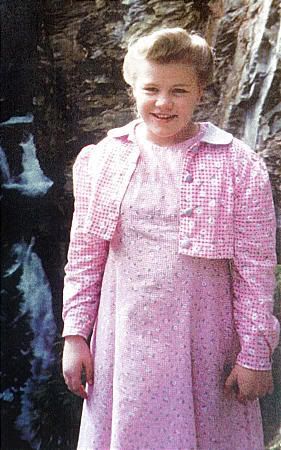
Just looking at this photograph of Elissa Wall at age 14, the age at which she was constrained to marry her 19-year-old FLDS cousin, one can see that the title of Elissa's memoir is apt. This child was much too young for marriage, and the story she tells in her book is tragic. There are many reviews available for this particular book, so I won't try to summarize or duplicate what's already been said. Instead, I'd like to look at the polarization caused by the FLDS practice of arranged marriages. Elissa introduces us to the heartbreak caused by this practice when she describes how her father, Douglas was found by Warren Jeffs to be unworthy of the Priesthood and unable to control his family. This was evidenced by physical fighting between father and sons, and complaining on the part of the wives. Warren decided to solve the problem by "assigning" Elissa's mom, Sharon, to another man. Now I realize that it is a very flat pancake that doesn't have two sides. Warren may have felt that Sharon truly was not happy in the situation she was in, and that the family problems could be solved in this manner. But in Stolen Innocence, we see the turmoil this decision brought to the family members, especially the children, as they were torn between the teachings of their religion to follow the prophet's counsel in all things and their attempts to keep a troubled family together. I agree with Dr. B. that this could have been our family. We're not a perfect model of good LDS teachings, but the Church is deeply ingrained within us, and we are more than willing to follow our leaders' well-meaning advice. So I can see how some of the problems the Walls encountered happened, and I'm hesitant to blame either Sharon, Doug, or Warren Jeffs. But I think the breaking up of the family caused many problems later, including the horrible marriage into which Elissa was pressured.

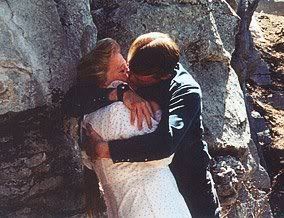
In the book, Elissa insists that she made her objections to her marriage to Allen Steed known to her mother, her mother's new husband, Fred Jessop, to Warren Jeffs, and to Allen. This picture I found of Elissa and Allen seems to me to be a perfect illustration of the reluctance that she describes. While Allen looks happy to be married, Elissa is turned away, stiff, she even looks frightened. He looks straight into the camera, while Elissa's gaze is elsewhere, embarrassed. At 14 years of age, the FLDS girls knew nothing of what was expected in marriage. I feel sorry for her that she had to endure the trauma that she did. In addition, I feel a lot of sympathy for the 19-year-old Allen.

Even through Elissa's story, one can see that Allen was really trying to make the marriage work. The marriage was not consummated for some time. Allen seemed to be patiently trying to figure out how to win Alissa's love. He wrote her love notes, took her on trips, and stumblingly attempted to teach her the ways of marriage. No wonder that it was less than a success. Some commenters have opined that Allen should have been tried for rape, and was as guilty as Warren Jeffs for this crime, but I am not so sure. Allen himself was young, and had been taught that his marriage to Elissa was proper, and seemed to show great restraint for someone in his situation. Elissa writes that she was forced to have sex, but fails to support that Allen raped her by her own descriptions of what happened. She instead portrays herself as reluctantly submitting to Allen's pressure, as in the following paragraph:
“I’m doing it out of love,” Allen declared. Everything he did was a contradiction, and before I knew it he was playing the guilt card again. As he continued to put his hands all over me, I just froze.

“Okay, fine,” I uttered. “Get it over with.”

In her description of their sex life, Elissa betrays a lack of understanding of the consideration that the newly-married, passionate young Allen was extending her:
It felt like we were having marital relations all the time, at least once or twice a week.

As I read on, I found the story more and more heartbreaking, as Elissa continued to search for love and friendship outside the boundaries which her family and religion would find acceptable. The conclusion of her tale brought forth a mix of emotions in me. I was relieved that she was able to find strength within, enough to find her own voice and to escape the bondage of Warren Jeffs. I was happy to see her reunite with her siblings and her father. I am glad she has found joy with her new husband, Lamont Barlow. But I ached for Allen and for her mother, both of whom endured great hardship to remain true to their faith and the things they had been taught.

I think it is incumbent upon us to read this book with compassion toward all who are involved. There is a great temptation to blame Elissa Wall's situation, and other failures in FLDS family life on Warren Jeffs and the practice of arranged marriages. As far as I am able to tell, the strict control of a prophet over the marriages of the people of a Mormon-based religion is limited to Warren Jeffs. Jeffs' father and previous leaders of the FLDS did not require this, and neither do other fundamentalist groups of which I am cognizant. Now that Jeffs is in prison, it seems clear that he was at fault. I feel no compunction to defend him. But I feel that it is important to be aware that there is another side of the FLDS story that I wish I knew better. We have Elissa Wall's and others' depictions of Jeffs as a fearsome, controlling, dictatorial leader. But I have seen pictures of a slight, gangly, geeky-looking Warren. I've heard tapes of his soft-spoken voice. I've heard the testimonies of those who have met him of his unassuming character. As Dr. B. has said, I think Warren Jeffs had power because his people gave him respect and authority over their lives. They believed the words he spoke to them.

There's a blog I read sometimes that is written by a man in Douglas Wall's situation--his wife and children were taken away from him by Jeffs because he was deemed unworthy. This man continues to defend the faith and to strive to one day be worthy to get his blessings back. He has a different way of looking at all of this. My heart hurts when I read about him and I wish I could hear more of his thoughts. He joins the ranks of Sharon Wall, of Lamont Barlow's grandfather, and many other faithful FLDS. Where do they find their faith? I'd like to read their stories too.

Saturday, June 6, 2009

She Said: How to Combat Chloroform

I hate to say this, but Church meetings are sometimes downright BORING. One Sunday I found myself staring at the clock on the wall, willing that big hand to move, and chewing my hair wondering if I could possibly sit in the room for one more minute.

I'm not quite sure how things have changed since my young adulthood in the Church, when I attended two ward's full meeting schedules and firesides, often for a total of 10 hours in Church on a Sunday. And I loved every minute of it.

Was it the rollicking fun of Relief Society, as we discussed mother education, cultural refinement, spiritual living and social relations, topics and lessons which had been selected and written by women for women? Was it the disregard of teachers for prepared lesson materials when they felt inspired to delve into the off-topic comments of interest to their students? Was it the class participation, the innovative sermons which were never expected to be based on General Conference talks?

Back then the jokes told about Gospel Doctrine class didn't revolve around "Sunday School answers," they invoked the amusing speculative comments in which the High Priests indulged. I'm afraid that by encouraging correlation and doctrinal conformity, we have only succeeded in boring our members to death. What can be done?

In a previous ward, I attempted to enliven Sunday School by heavily researching the topic to be discussed, then bringing up interesting and controversial points for which I was certain the teacher would not be prepared. This added a bit of amusement to my day. But I soon repented of my folly. Unfortunately now I find myself retreating into extra-curricular literature. A couple of weeks ago I went out to the car during a particularly boring lesson, and emerged with the only bit of reading material to be found: my 10-year-old daughter's novel on dragon magic. It got me through the rest of SS as well as a 5th-Sunday combined meeting on preparedness.

I haven't yet succumbed to texting, to games of tetris, or to surfing the internet on my iphone yet. But I have seen plenty of other members surreptitiously using these methods of entertainment to relieve their agony. I can't say I blame them, but I want to resist surrendering my expectation of powerful, interesting, affirming, spiritually motivating LDS meetings. What is to be done? Is my angst over this issue simply a function of my age and having been through the four-year cycle of Church curriculum one too many times?

Recently I read an ad campaign for the United Methodist Church which read: "What if church wasn’t just a building, but thousands of doors? Each of them opening to a different concept or experience of church. So that whoever knocks might find a journey to call their own. Would you come?" For some reason that paragraph reminded me of Joseph Smith. I like to imagine that each of his sermons opened the doors of thousands of possibilities for his listeners. He showed us a new way of looking at so many things. How can we reclaim that excitement of the early days of the Church, when there were tongues of fire in the Kirtland temple, handkerchiefs bringing healings, and thousands of people willing to die on the plains for a religion that had captured their souls?

What if Church was more like Dentyne??


What if Church was more like milk?


What if Church was more like Starbucks??


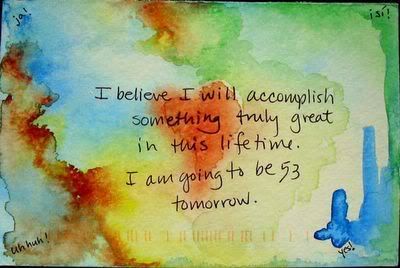
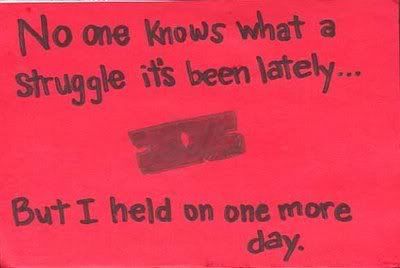
What if Church was more like PostSecret?


He Said: How to Combat Chloroform

Recently my daughter and I discussed the concept of whether or not church is boring. Since she is a recently returned missionary she still glows with a missionary's zeal for the gospel. She said she really couldn't understand how anyone who was truly converted to the gospel could find the messages taught each week as being repetitive since every time she hears it she gains a fresh insight and renewed testimony of the truth of the gospel message.

She said she agreed with what a young Henry B. Eyring as a bored teen was told by his father when he wisely instructed him to become involved in the subject even when we think the speaker is boring:

"I finally got up enough courage to ask him what he thought of the meeting. He said it was wonderful... Like all good fathers, he must have read my mind, because he started to laugh. He said: 'Hal, let me tell you something. Since I was a very young man, I have taught myself to do something in a church meeting. When the speaker begins, I listen carefully and ask myself what it is he is trying to say. Then, once I think I know what he is trying to accomplish, I give myself a sermon on that subject.' He let that sink in for a moment as we walked along. Then with that special self-depreciating chuckle of his, he said, 'Hal, since then I have never been to a bad meeting'" (To Draw Closer to God [Desert Book: Salt Lake City, 1997], 23).

My daughter tells me the gospel is so filled with truth that every time she listens to the same topic over the teacher or speaker or students say things that she finds profound.

I have often heard in the church as an argument that only boring people get bored. A wise person once said "YOU are responsible for motivating yourself to find meaning and purpose in what you do. Life is not there to entertain you."

I have to admit that in my ward I am a member of the Sunday School presidency and that every now and then we get a teacher who doesn't really understand pedagogical variety and could use a stint in the Teacher Development course.

I find the manual Teaching No Greater Calling manual one of my most favorite ones since it has some great insights in to making the gospel relevant in our lives. If lessons are relevant than the Spirit is there and makes up for the deficiency of the teacher. Many times teachers follow in to monotonous patterns and need variety. Both the teacher and the students need to be engaged in the gospel discussion.

In the Teaching manual it emphasizes: "The gospel can likewise be presented in a number of different ways. No teacher should fall into a monotonous pattern of presenting the same kind of lesson week after week. When you use a variety of learning activities, learners tend to understand gospel principles better and retain more. A carefully selected method can make a principle clearer, more interesting, and more memorable." Like they say variety is the spice of life.

It also says:

Just as we need nourishing food to survive physically, we need the gospel of Jesus Christ to survive spiritually. Our souls are nourished by whatever speaks of Christ and leads us to Him, whether it is written in the scriptures, spoken by latter-day prophets, or taught by other humble servants of God. The Savior Himself said, “I am the bread of life: he that cometh to me shall never hunger; and he that believeth on me shall never thirst” (John 6:35).

Teaching that is nourishing to the soul uplifts others, builds their faith, and gives them confidence to meet life’s challenges. It motivates them to forsake sin and to come to Christ, call on His name, obey His commandments, and abide in His love (see D&C 93:1; John 15:10).

Many topics are interesting, important, and even relevant to life and yet not nourishing to the soul. It is not our commission to teach such topics. Instead, we are to edify others and teach them principles that pertain to the kingdom of God and the salvation of mankind.

Teaching that stimulates the intellect without speaking to the spirit cannot nourish. Nor can anything that raises doubts about the truth of the restored gospel or the need to commit ourselves to it with all our heart, might, mind, and strength.

Elder Bruce R. McConkie counseled: “Teach the doctrines of salvation; supply spiritual food; bear testimony of our Lord’s divine Sonship—anything short of such a course is unworthy of a true minister who has been called by revelation. Only when the Church is fed the bread of life are its members kept in paths of righteousness” (Doctrinal New Testament Commentary, 3 vols. [1966–73], 2:178).


In conclusion: Our mental attitude can really affect our participation in listening to a sermon or participating in a class. Teachers need to have the Spirit when teaching and students need to seek the Spirit when in class. The Spirit brings the gospel down into our heart like fire and drives boredom away.

Take the Poll: Do Your LDS Church Meetings Bore You?


Friday, June 5, 2009

He Said: Caffeine!

When I joined the church 35 years ago the only bad habit I had to give up was drinking Pepsi cola. At time the person interviewing me suggested that my drinking four or five cans a day was a violation in their opinion of the Word of Wisdom. Not knowing any better and wanting to conform my life closer to the teachings of the Gospel I switched to drinking 7-Up or Sprite which I have continued to this day.

When I went on my mission one of my more experienced companions who was a convert to the church explained to me that drinking colas was an individual discretionary matter and that his bishop and stake president drank them. Most of the missionaries were evenly split on the subject but none of us drank them since our mission president asked us not to for a couple of reason: one he didn't want to confuse investigators who were struggling with coffee or tea and second he thought soda pop was a waste of the little money his missionaries received each month. He felt there were more nutritious things for us to eat or drink. After my mission I just continued the practice of not drinking caffeinated beverages. I rarely even drank hot cocoa although I do admit eating chocolate candy bars which has its own baggage.

About fifteen years ago I switched to drinking decaffeinated Pepsi Free on special occasions. Since I consumed too much soda pop I have diabetic tendencies. My wife has forced me to switch to diet soda pop which in the Pepsi or Coke decaffeinated versions is not even close to the original taste. On Father's Day, my birthday, and Christmas my family have an inside joke of giving one bottle of Pepsi Free (sugared) and a bag of Fritos.

I have had a few minor lapses this past couple of years when I discovered my wife drinking Diet Coke and Mountain Dew. She insists that she is only a social drinker of the suspect beverages and drinks them to get along with other social caffeinated drinkers who are a majority of her family and friends. The first few times she drank them in the presence our eight children she scandalized them since we both adamantly taught them over the years that consuming them was the height of hypocrisy.

One of our daughters picked up this bad habit on her mission to a foreign country which saddened me. In a blog post that I entitled Maté, Kava, Coca-Cola and LDS Missionaries I tracked down all the major statements I could find by Mormon authorities and concluded that
I don't really have an answer to whether you should or should not drink these beverages. There are conflicting guidelines and statements. Maybe they are intentional or maybe they are there so we can have our free will. I do know some former leaders have spoken out against them. I haven't heard anything in about twenty years though.
Personally I come down on the side of not drinking caffeinated soda. There are a few reasons I am opposed to it. I believe I am addicted to soda pop and think any kind brings health problems such as diabetes, kidney stones, etc. I feel guilt every time I pop the lid on one which is once or twice a day. Another reason is that caffeinated beverages including new energy drinks have as much caffeine in them as coffee or tea, in some cases, more. Even Sobe drinks which have vitamins and herbs can contain a great deal of caffeine. I recently saw a commercial that said drinking soda pop erodes enamel on teeth and that you can't replace hard enamel once it dissolves.

Despite my feelings many LDS members including my wife and Church leaders including mission presidents, bishops, stake presidents and even a few general authorities still drink colas. One of the contentions about drinking cola beverages is that there is just as much caffeine in them as in coffee or tea. A few members tell me that it is hypocritical to refrain from coffee and teas and drink the other substances. Many times uber-righteous non-caffeine drinker members tell cola drinkers to their face that they are just plain wrong in giving in to their natural cravings and consuming them.

I cringe every time I see my wife pop the top on a diet Coke. But lately I have moved across the line and bought her one on a recent trip. I do draw the line at Mountain Dew which is hard core stuff. I even drank one of her diet cokes when she wasn't looking a few months back when I was unusually thirsty. It was left over from a retreat with a bunch of feminist liberal women from Open Mormon. I didn't have the money or the inclination to go get a diet sugar free Root Beer at the local grocery store and couldn't stand my craving for the carbonated cool beverage when I was hot. I just hope I don't go to hell in the end for compromising on something that doesn't feel right to me and causes me such guilt and remorse.


She Said: Caffeine!

It's true--at one time I was a Nazi Word of Wisdom follower.

There are many issues which surround D&C 89, but today Dr. B. and I want to narrow the discussion down and talk about caffeine. One might well wonder why Mormons are known for not drinking Coca-Cola when the relevant statement from our "health code" states:
And again, hot drinks are not for the body or belly.

We all know that "hot drinks" has been interpreted to mean coffee and tea beverages. This interpretation developed from a statement made by Hyrum Smith in 1842.
And again "hot drinks are not for the body, or belly;" there are many who wonder what this can mean; whether it refers to tea, or coffee, or not. I say it does refer to tea, and coffee. (Hyrum Smith, "The Word of Wisdom", Times and Seasons, 1842-06-01, vol. 3, p. 800.)

By 1881 it was being taught that "hot drinks" should be understood as tea and coffee, no matter what form, hot or cold.
I understand that some of the people are excusing themselves in using tea and coffee, because the Lord only said "hot drinks" in the revelation of the Word of Wisdom .... Tea and coffee ... are what the Lord meant when He said "hot drinks." (In Joel H. Johnson (1881). Voice from the Mountains (Salt Lake City: Juvenile Instructor Office) p. 12; cited in Church Educational System (2001). Doctrine and Covenants Student Manual: Religion 324 and 325 (Salt Lake City: LDS Church) p. 209.)

From there, the prohibition developed to mean coffee and tea only. Modern Latter-day Saints will readily drink hot beverages such as hot chocolate, spiced cider, and even herbal teas. It's instructive to track the evolution of this. With "hot drinks" narrowed down to coffee and tea, one might reason that they are restricted because they both contain caffeine. So in the early 1900's, when caffeinated soft drinks became readily available, many members figured that they should also abstain from these drinks. Elder John A. Widtsoe taught:
Whenever a drink is advertised to "give you a lift," the "lift" is likely to be caused by the drug which it contains. Such soft drinks are decidedly harmful and habit-forming, even though sold by the millions. Such caffeine-containing drinks, offered by every soda fountain and most eating places, and consumed in large quantities, should be known and avoided. (The Word of Wisdom: A Modern Interpretation, p.97)

With this in mind, President Heber J. Grant in April 1922 General Conference asked the Saints as a personal favor to him not to drink Coca-Cola. Two years later, after meeting with representatives from the Coca-Cola company, he became convinced that the amount of caffeine in the beverage was harmless and stated that he would no longer speak out against the use of cola drinks. Many other General Authorities since that time have cautioned against caffeinated soft drinks. But they are generally very careful to note that these drinks are not specifically contrary to the Word of Wisdom, because there are just as many GA's who do partake!

I think it is interesting to analyze motivations for members who have decided it is important to abstain from caffeinated soft drinks. It is recognized that it is not specifically caffeine which is against the Word of Wisdom. So why are some members determined not to partake? Those who cite the health risks often consume foods such as jello with food dyes, soups with MSG, processed meats with nitrates or chocolate, which contains mood-altering and addictive substances. They are also apt to ignore the health benefits of eating more grains and fruits in season and limiting meats, which is suggested in the Word of Wisdom.

I often wonder if those members who eschew caffeinated soft drinks are using this relatively simple religious behavior as an identifier to signify their level of "Mormon-ness." Cutting out the Coke is an easy thing to do, and it immediately brands you as a committed LDS Church member.

On the flip side, what does that say about those of us who love our Diet Dr. Pepper? Do we enjoy flouting outward convention? Is it a "safe" way to be just a little bit rebellious?


Take the Poll: Caffeine!


Thursday, June 4, 2009

She Said: Mormons and Civil Disobedience


The concept of civil disobedience has been around for centuries--we see it as far back as ancient Greece. But the term coined as "civil disobedience" is a lot more modern. American author Henry David Thoreau popularized it in an 1849 essay, Civil Disobedience, dramatically urging that although one does not necessarily have to physically fight the government, it should not be supported if the disagreement is urgent enough. The essay had a wide influence on many later practitioners of civil disobedience. In it, Thoreau explained his reasons for having refused to pay taxes as an act of protest against slavery and against the Mexican-American War.

Civil disobedience, then, consists in publicly announced defiance of specific laws and policies which an individual or group believes to be unjust. The defiance must be publicly announced, since the point of it is to bring the injustice to the attention of the public and to effect change. The perpetrator must understand that this defiance is illegal and carries prescribed penalties. Willingness to accept such penalties is a crucial part of civil disobedience.

Modern civil disobedience theory began to take shape in the mid-1800's. This was precisely the time when Mormon settlers in Utah were faced with a conflict of conscience of their own against the government of the United States. Early Church leaders preached unequivocally that members of the Church must practice the principle of plural marriage in order to attain the highest degree of the celestial kingdom. At the same time, polygamy was illegal in the Territory of Utah.

Approximately twenty to thirty percent of the Mormons then living in Utah followed civil disobedience by contracting marriages which were against laws they felt were unjust. Although most of them attempted to conceal their marital arrangements, Church policy and publications openly and publicly defended the practice. Members understood that there would be penalties, and many served jail sentences for their illegal practices.
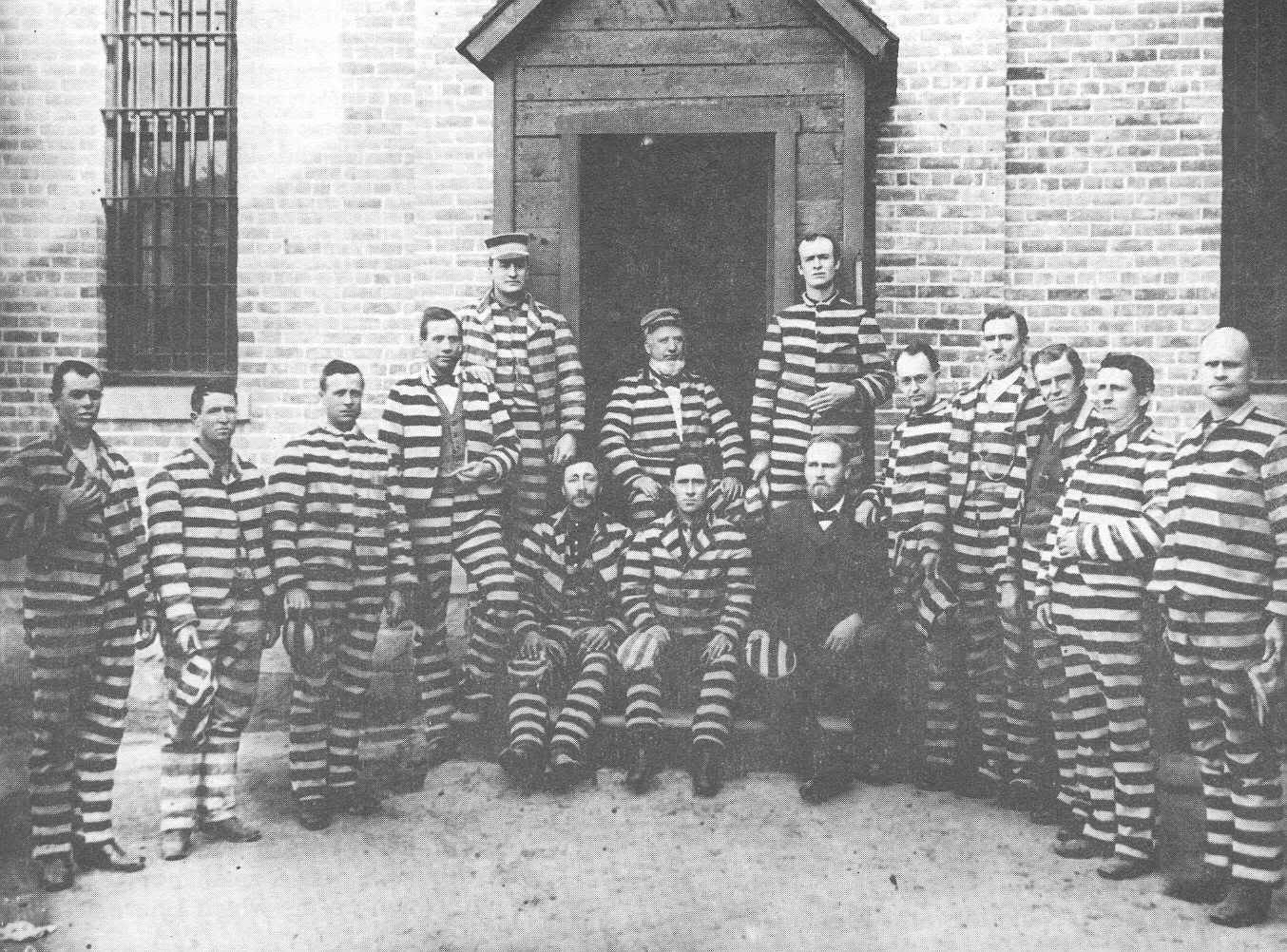


Under the United States government's constitutional power to enact laws governing territories, Congress enacted the Morrill Act (1862), making bigamy in a territory a crime punishable by a fine and five years in prison. The statute was upheld in Reynolds v. United States (1879), although the defendant argued that the law violated the First Amendment guarantee of the free exercise of religion. The Edmunds Act (1882), made bigamous cohabitation a misdemeanor and barred persons living in polygamy from jury service, public office, and voting. Over 1,300 Latter-day Saints were jailed as a result of the Edmunds Act. The Edmunds-Tucker Act (1887) disincorporated both the Church and the Perpetual Emigrating Fund, authorized seizure of Church real estate, disenfranchised women, and annulled Territorial laws allowing illegitimate children to inherit.
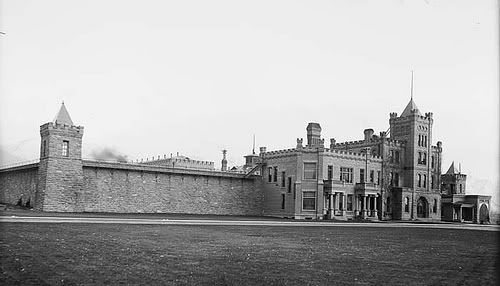


In 1890, after 40 years of Mormon civil disobedience, it became clear that plural marriage was leading toward the economic and political destruction of the Church. President Wilford Woodruff then withdrew the requirement for worthy males to take plural wives and announced a manifesto formally stating his counsel to Latter-day Saints to abide by antibigamy laws (D&C Official Declaration—1). The Manifesto was intended to end the legal confrontation between the U.S. government and the Church.

For several reasons, it took many years for the LDS Church to completely end the practice of plural marriage. The Manifesto was couched in what, for Mormons, was ambiguous language. Instead of a "thus saith the Lord" type of revelation, Wilford Woodruff instead publicly declared "that my advice to the Latter-day Saints is to refrain from contracting any marriage forbidden by the law of the land." In an address in Logan, Utah, he asked:
The question is this: Which is the wisest course for the Latter-day Saints to pursue—to continue to attempt to practice plural marriage, with the laws of the nation against it and the opposition of sixty millions of people, and at the cost of the confiscation and loss of all the Temples, and the stopping of all the ordinances therein, both for the living and the dead, and the imprisonment of the First Presidency and Twelve and the heads of families in the Church, and the confiscation of personal property of the people (all of which of themselves would stop the practice); or, after doing and suffering what we have through our adherence to this principle to cease the practice and submit to the law, and through doing so leave the Prophets, Apostles and fathers at home, so that they can instruct the people and attend to the duties of the Church, and also leave the Temples in the hands of the Saints, so that they can attend to the ordinances of the Gospel, both for the living and the dead?

Some apparently felt that the "wisest course" was to continue to live the fundamental spiritual principles they had been taught by the early leaders of the Church. Priesthood holders in top leadership positions continued to solemnize plural marriages, and much confusion ensued. Nonetheless, with the issuance of the Manifesto, Mormon civil disobedience had effectively ended. No longer was the Church attempting to change the laws of the land to align with conscience, but to comply in order to gain Statehood.

Never again would the LDS Church participate to such a degree in civil disobedience. Instead, members are urged to follow the laws of the land strictly, wherever they live. They feel that through proper legal conduct, they can gain the good graces of political authorities and thereby advance other Church objectives. For example, Blogger Silver Rain recently wrote:
"Because we are painstakingly compliant to local laws wherever we go, the LDS church has been granted many freedoms that other religions have not always enjoyed. Countries in the Middle and Far East have welcomed us in as service missionaries when we were not allowed to proselyte. We were one of few religions allowed practice in Cold War East Germany. Doors have opened to us multiple times in multiple places because we show respect to the law."

There's something in me that rather respects the willingness of those early members, and even Mormon offshoots today, who will take the risks of civil disobedience to take a stand for what they believe. Mainstream members are now urged to show caution, sometimes to the detriment of conscience. This quotation is a case in point:
“Our participation in life’s important events may be jeopardized if we fail to follow the rules contained in our Father in Heaven’s commands. Involvement in sexual sin, illegal drugs, civil disobedience, or abuse could keep us on the sidelines at key times.” (Bishop David Burton, ”And That’s The Way It Is,” Ensign, May 2003)

I disagree with Bishop Burton that civil disobedience should be included in that list of foibles. For, as Thoreau put it:
"Indeed, you serve your country poorly if you do so by suppressing your conscience in favor of the law — your country needs consciences more than it needs conscienceless robots."


________________________________________________

Picture (1): In the Utah penitentiary in 1885 are (L-R) Francis A. Brown, Freddy Self, Moroni Brown, Amos Milton Musser, George H. Kellogg, Parley P. Pratt, Jr., Rudger Clawson, and Job Pingree. Photographer: John P. Soule.

Picture (2): Utah Territorial Penitentiary 1888-9, located at the Sugarhouse site, now the northwest corner of Sugarhouse Park on 21st South & 13th East of Salt Lake City, Utah. Standing(L-R): Sylvester Frazer Jones, Simon Topham, Joseph S. Barney, Lorenzo D. Watson, Thomas Chamberlain, Henry Langford, Samuel Wooley, Nephi J. Bates, Frances Webster, Cornelius Mc Greavy, Jonathan Covington. Sitting on Step in center: Benjamin Perkins, William Butler, Francis M. Lyman. Doorway: George Q. Cannon.

Picture (3): The site of the Utah Penitentiary, selected by Brigham Young in October 1853, then a safe six miles from the center of the city. The first buildings of adobe brick, surrounded by a twelve foot wall, were occupied in January 1855. Early accounts indicate that escapes were frequent because of poor facilities and the lack of guards. In 1866 the penitentiary was renovated. The three buildings, wall and the guard houses were upgraded to stone. Later a dining hall, hospital and women's quarters were added. By 1882 the penitentiary included 244 steel cells and 250 capacity chapel. A new 19 foot wall enclosed 2 acres. A large area surrounding the prison was used by inmates to farm and raise livestock for inmate consumption.
He Said: Mormons and Civil Disobedience

As a conservative member of the LDS Church I have always been taught in Article of Faith 12 "We believe in being subject to kings, presidents, rulers, and magistrates, in obeying, honoring, and sustaining the law." For the most part I have always strictly adhered to the laws of the land except occasionally speeding.

As a history major at BYU I learned that we as Latter-day Saints try to adhere to the laws of the land except on occasion when religious principle clashes with the law.

Bored in Vernal covers the historical roots of plural marriages for the living, but I say that a spiritual form of the practice remains.

Even though polygamy was officially abolished by 1904, LDS leaders still practiced a limited form of civil disobedience in that they continued the practice of spiritual polygamy. I am aware of Ezra Taft Benson being sealed to a deceased distant cousin in the 1940's. I suspect he wasn't the only one to receive that honor. So vicariously apostles and other high ranking church leaders participated in a religious ceremony which did not require a marriage license and entered into spiritual polygamy. Apostles and other worthy priesthood holders whose wives died naturally could also remarry and be sealed to other spouses one at a time since they were not in violation of the laws of the land. Despite fundamentalists' contention that the church fell we have an unbroken chain back to Joseph Smith that does not violate the law in the strictest sense. An interesting aside is that recently some of the more well-known Fundamentalists such as the LeBaron brothers are now being baptized for the dead in our temples. I would consider the continuation of polygamy a form of civil disobedience skirting on the edge but adhering religiously to both the law and religious principle. Plural spiritual marriage is a way to keep the practice alive while still adhering to the law.

In fact, this is the way that I would say civil disobedience continues to be practiced in the Church. In studying LDS history there have been many examples of civil disobedience or just plain not following the law when it comes to Latter-day Saints worshiping according to the dictates of their own conscience.

As early as the late 1930s and early 1940s totalitarian regimes like the Nazis, Facists and Communists resisted the Church's efforts to gain official sanction to worship or send missionaries in to their countries. During the Nazi regime our efforts were opposed. Kahlile Mehr wrote about mission president Wallace Toronto's failed attempts for 29 years to gain official recognition in Czechloslovakia under both the Nazis and later the Communists (See “Czech Saints: A Brighter Day,” Liahona, Sep 1997, 10). Mehr described Toronto's experiences:

In 1949 the Communist government began to restrict the missionaries. Still, baptisms rose from 28 in 1948 to 70 in 1949. (see “JirĂ­ and Olga Snederfler: A Closer Look at Two Czech Pioneers,” page 16).

Late in January 1950, two missionaries disappeared. No word of their fate was received until 11 days later. They had been arrested for entering a restricted border zone and were accused of spying. The Communist authorities released the two elders in prison on the condition that all the missionaries would be evacuated. A Czech governmental decree liquidated the mission on 6 April 1950.

For the next 14 years, Czech members kept their faith in silence, unable to worship publicly or to enjoy any regular contact with the Church beyond Czech borders. From his home in Utah, President Toronto continued to provide what assistance he could. When possible, he corresponded and sent financial aid, clothing, medicine, and Church publications. During those years, he applied nine times for a Czech visa—and received nine refusals.

It was not until 1964 that the official presence of the Church once again entered the nation. President John Russon of the Swiss Mission and Lynn Pettit, an early missionary in Czechoslovakia, arrived in Prague. Word of their arrival spread, and a small group met at a member’s home for a celebratory testimony meeting.

Meanwhile, President David O. McKay advised Wallace Toronto to apply again for a visa, saying, “[The members] have been carrying on underground long enough. They need the authority of their mission president.” Within a week the Torontos received visas. They visited members in Brno and Prague.

In July 1965 President Toronto returned to Prague, intent on reestablishing the Church. Although he was well received by many governmental officials, the secret police arrested him and evicted him from the country. Mission growth would be suppressed for another 25 years before reemerging in a new epoch of freedom.
This is just one example, that has been repeated in various countries during the 20th century.

In Islamic and Communist countries which have strict laws concerning religion there have been sizable groups of Latter-day Saints who either were converted elsewhere and returned to their native countries or went there for work opportunities. In such countries LDS members have learned to be creative in finding ways of worshiping without alienating these militaristic governments. The last few years I have participated in civil disobedience myself when I attended church each week. In the country where I lived it was expressly forbidden that anyone meet in a formal or informal religious gathering of any kind other than the official state religion. This is not uncommon in many countries throughout the Middle East or in Asia.

In order to meet we had to gather as private citizens and take extra precaution so as not to draw attention to ourselves. We actually had security rules that stated we were not to enter the residence in large groups and that women needed to adhere to strict dress codes. A long-time member described earlier members as being deported who made their religious attendance known to employers or co-worker. Even though LDS members were meeting at the U.S. Embassy which was officially U.S. ground they agreed in employment contracts not to show any form of civil opposition.

Today members realize that they could still be arrested and deported if someone became angry with them getting together. The law calls for the termination of anyone attending any philosophical group other than the official one of that country, possible arrest, beating and deportation.

In the country described above I was told by a church leader that a former ruler of the country told us that we could meet privately if we didn't draw attention to ourselves. The new ruler hasn't made any proclamation other than the official one that only one religion is recognized in that country. By gathering together we are practicing civil disobedience since there are employment policies which preclude meeting about any ideology other than the official one.

My last form of civil disobedience has to do with immigration law in the United States of America. I lived right on the border in Calexico, California which is a suburb of Mexicali, Mexico. In my ward there are many people who live on the U.S. side who are not American citizens. Members of the church know that they are illegal aliens. In fact many members of the church work for the border patrol. A few of them have a don't ask don't tell mentality. Leaders even know who many of the illegal immigrant members are. They still call them to positions of leadership. Many of the men have been former bishops and members of stake presidencies.

Many of the children of these members are called to missions in the United States. They can't get a passport or VISA but they go on missions. I am not opposed to this practice since it seems to me that they can spend their whole lives going to U.S. schools. I know of one boy who was valedictorian of his high school class but not able to attend college on a scholarship because he had no proof of residence. In such cases it is more humane to either give them amnesty. One boy in one of our wards mother did not get amnesty so our bishop who was a lawyer was trying to help him get a green card so he could serve. It is a complicated mess. One girl we know was raised totally in English and she would have been hard pressed to go to her mother's home which she never knew.

I think the LDS Church walks a fine line in obeying the stated law but in the grey areas it chooses religious worship or conscience in actual practice. In none of the cases I have described is there a clear resistance to any law. It is not against the law to practice spiritual polygamy but actual living polygamy even in legal settings is eschewed. Even in Africa where polygamy is legal or the Middle East LDS worthy males only have one wife. In countries which are restrictive where religious meetings are concerned we are just a bunch of friends enjoying a day together. Even in the case of illegal immigrants the U.S. government ignores the young men in question. They are not revolutionaries trying like Thoreau or Paulo Freire trying to overthrow bad practices they are just trying to practice religion without overturning the apple cart.