Showing posts with label Symonds Ryder. Show all posts

Thursday, July 2, 2009

She Said: Symonds Ryder and a Crisis of Faith

On Wednesday, John Hamer at BCC put up a post about the Thomas B. Marsh strippings of milk story. This is one with which most members of the Church are familiar, as it is often used to illustrate the folly of apostatizing from the Church over a trifle. John cautions:
"Thus, while the moral the Thomas B. Marsh fable, i.e., that faith can be shattered over something inconsequential, is true enough, it would probably make sense to tell a different, more appropriate fable to illustrate that moral."

There is a different fable oft told in the Church to illustrate that moral--but I would like to show that its use is just as inappropriate, and perhaps the moral itself should be reexamined.

Symonds Ryder was a convert to the Church from the same Disciples of Christ congregation in Mantua, Ohio as Sidney Rigdon, Ezra Booth, and Eliza R. Snow and her family. He was made an Elder and called to serve a mission in a revelation that is now D&C 52. However, in the revelation, his name was spelled wrong. The misspelling of his name is often the only reason cited as the cause of his decision to then leave the church. (see B. H. Roberts in HC 1:260–61; Fawn M. Brodie in No Man Knows My History: The Life of Joseph Smith the Mormon Prophet, 118; Donna Hill in Joseph Smith: The First Mormon, 143; Cannon and Cook in Far West Record, 286; Dean C. Jessee in Papers of Joseph Smith, Volume 1: Autobiographical and Historical Writings, 511.) Probably the origin of this story is his funeral sermon preached in Hiram, Ohio, August 3, 1870, by B.A. Hinsdale.
"Ryder was informed, that by special revelation he had been appointed and commissioned an elder of the Mormon church. His commission came, and he found his name misspelled. Was the Holy Spirit so fallible as to fail even in orthography? Beginning with this challenge, his strong, incisive mind and honest heart were brought to the task of re-examining the ground on which he stood. His friend Booth had been passing through a similar experience, on his pilgrimage to Missouri, and, when they met about the 1st of September, 1831, the first question which sprang from the lips of each was--"How is your faith?" and the first look into each other's faces, gave answer that the spell of enchantment was broken, and the delusion was ended. They turned from the dreams they had followed for a few months, and found more than ever before, that the religion of the New Testament was "the shadow of a great rock in a weary land." (A. S. Hayden, Early History of the Disciples (1875), p. 251.)

Perhaps the misspelling was a bother to Ryder, but this one incident was hardly the sole reason for Ryder's departure. For one thing, spelling was more fluid in the 19th century and earlier. An attempt at standardized spelling in the U.S. did not begin until the appearance of Webster's “American Dictionary of the English Language” in 1828, and for at least a half century many words continued to be vociferously debated. American census-takers varied quite a bit in their reporting of people's names, showing that they were not asking people "How is that spelled?" but rather writing the name as they thought it should appear. Ryder's name appears as following in the U.S. census:

1830 census Hiram, Portage, OH: Simonds Rider
1840 census Hiram, Portage, OH: Symonds Rider
1850 census Hiram, Portage, OH: Simonds Rider, wife Mahitabel
1860 census Hiram, Portage, OH: Symonds Rider, wife Mehitable
1870 census Hiram, Portage, OH: Symands Rider, wife Mahitable


Ryder's commission with the misspelling of his name took place in June 1831 and may account for his not going to Missouri, but as noted he did not leave the church until Ezra Booth's return in September. In the meantime, Ryder became concerned about other developments. In a letter to A.S. Hayden he wrote:
"But when they [Joseph Smith and Sidney Rigdon] went to Missouri to lay the foundation of the splendid city of Zion, and also of the temple, they left their papers behind. This gave their new converts an opportunity to become acquainted with the internal arrangement of their church, which revealed to them the horrid fact that a plot was laid to take their property from them and place it under the control of Joseph Smith the prophet. This was too much for the Hiramites, and they left the Mormonites faster than they had ever joined them, and by fall the Mormon church in Hiram was a very lean concern." (Symonds Ryder, "Letter to A. S. Hayden," February 1, 1868, cited in Hayden, op. cit., pp. 220, 221.)
It seems that the coming threat of enforced consecration might have been more of a problem for Ryder than the misspelling of his name. The influence of his disaffected friend Ezra Booth must have also had an effect upon Symonds.

The Religion 341 Church History manual states:
"From the outset the Church had an unpopular public image that was added to by apostates and nurtured by the circulation of negative stories and articles in the press. People gave many reasons for apostatizing. For example, Norman Brown left the Church because his horse died on the trip to Zion. Joseph Wakefield withdrew after he saw Joseph Smith playing with children upon coming down from his translating room. Symonds Ryder lost faith in Joseph’s inspiration when Ryder’s name was misspelled in his commission to preach. Others left the Church because they experienced economic difficulties."

Such a view boils the disaffection of these individuals down to a single, easily dismissed anecdote rather than acknowledging the difficult and complex issues they faced. This practice encourages members today to dismiss the very real concerns confronted by members who question aspects of the Church. "If you have questions, you must be sinning," the party line goes. In reality, there are multiple tangled and tortuous reasons why someone may develop a crisis of faith. Not only should we look deeper into the available documents to discover the motivations of historical figures, we should listen, and listen, and listen some more to come to a greater understanding of our friends and associates who question.

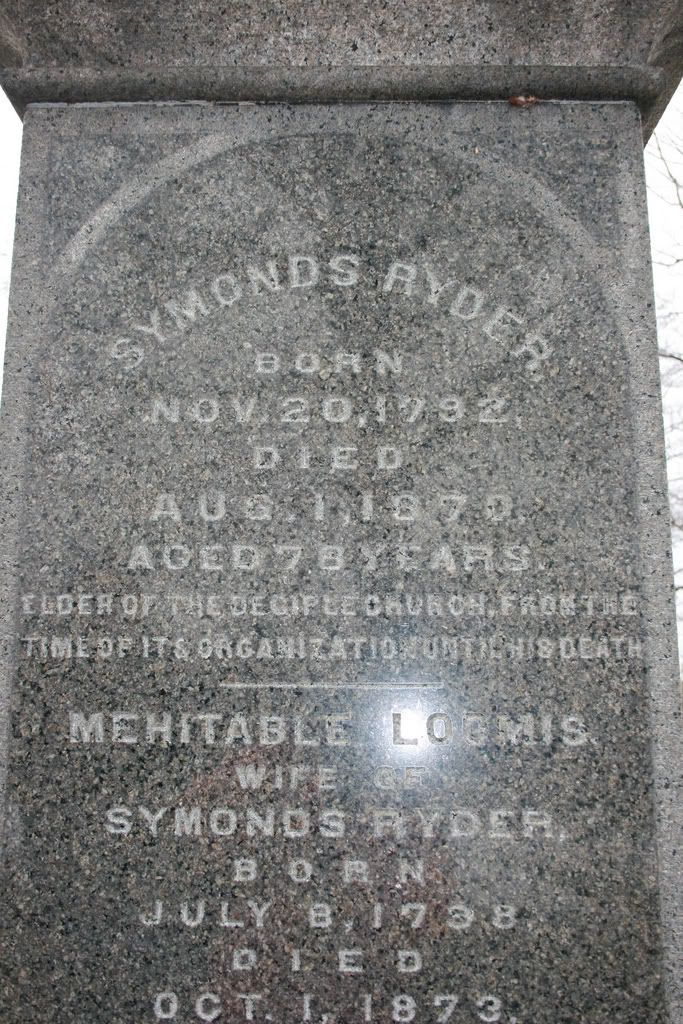
UPDATE: I've added this picture of Ryder's gravestone, with the name of the "Desciples" church spelled wrong!
He Said: Symonds Ryder An Orthographically Challenged ExMo

During the Ohio years of the Church of Jesus Christ of Latter-day Saints, Symonds Ryder was one of several converts made in Hiram, Ohio in 1831. He was the presiding elder or overseer of the Disciples of Christ Church (Campbellite) in that area before and after his membership in the church. He along with one of his closest friends Ezra Booth and their families were baptized and remained members of the church for a few short months in 1831. Latter-day Saints say he left the church because of a misspelling in his name Simonds Ryder [sic] (See D&C 52:37). As BiV points out in her blog many LDS church historians and scholars attribute this to his leaving the church.

Guy L. Dorius citing the History of the Church says of his leaving the church:

He was baptized that same month, but his enthusiasm was short-lived. He soon received a ministerial call signed by the Prophet Joseph Smith and Sidney Rigdon that stated that it had been given them by the Spirit and that it was the Lord’s will he be called to preach the gospel. In both the informal letter he received and in the official commission to preach, his last name was misspelled Rider, instead of Ryder. He left the Church, claiming that if the “ ‘Spirit’ through which he had been called to preach could err in the matter of spelling his name, it might have erred in calling him to the ministry as well; or, in other words, he was led to doubt if he were called at all by the Spirit of God, because of the [scribal] error in the spelling of his name!” 8
It is interesting to note that at his funeral A.S. Hayden spelled his name Symonds Ryder. In the 1833 Book of Commandments his name is spelled Simonds only with no last name. In the 1835 Doctrine and Covenants it is spelled Simonds Rider. In the 1981 (current edition) his name is spelled Simonds Ryder.

What is even more fascinating is that I am sure his family knew how to spell the man's name as did his parishioners over whom he ministered for fifty years. At no point in the various editions of the scriptures have the Mormon scholars or leaders felt to correct the name if that indeed was the reason he left the church.

It would be about as ridiculous as when I first joined the church and was assigned to home teach a man that joined the church and went inactive over the stake president calling him to bear his testimony during stake conference. When I first went to the man's home I asked him why he no longer attended church. He said that he was offended by the stake president to whom he told that he was shy and never wanted to speak in a large public gathering on at least a few occasions. The stake president laughed whenever he said that and told him not to worry he would get over it. One day he called him impromptu out of the audience and asked him to share his testimony which the man did. The man said he walked out of the stake conference and never returned to church since the stake president disrespected him. I knew the stake president to be a very kind man so I went to see him and told him the story. I asked him to go apologize to the man who said if he did he would return to church. To my surprise the stake president said that wasn't a good enough reason to leave the church and he was prompted by the spirit to call on the man. The man was just using that as an excuse and he should just get over it and come back. He told me to go to the man and tell him he should come back. Needless to say I was between a rock and a hard place since neither man felt that what they had done was morally wrong. The man remained inactive.

I find it incredulous that a man would leave the church over something as stupid as a misspelling of his name but I have seen people leave for dumber reasons than that. You would think after all the printings of the scriptures that we could get Symonds Ryder's name spelled correctly. You would also think that he would suck it up and stay with the church since it was just that a small inconsequential matter.

In Ryder's mind he joined the church on the basis of modern day revelation or that the Spirit speaks to man today. He really didn't realize that the Spirit just puts impressions in the mind of the prophet. The prophet just related the revelation which was recorded. If they had over a hundred years of record keeping like today the recorder or scribe might have checked with the recipient of the blessing like they do today and ask if everything is spelled right. It is easy to add an i where a y is since they both sound the same in English. If you are a hard liner like Ryder was you might doubt the power of the revelation if it is recorded incorrectly.

Speaking to patriarchs in the LDS Church I can understand this as many people even today question the lineage when they declare something like you are the seed of Abraham through Joseph. Since Joseph had two sons Ephraim and Manassah and Ephraim is the royal line he needs to be very precise. A couple of patriarchs told me that they forgot to say Ephraim a few times and went back later and fixed it or they misspelled the person's name on the patriarchal blessing even though the form had the correct spelling that is why the person is given a copy before it is submitted and asked to check it. It is later sent in to the church in Salt Lake City in case you lose it.

I think Symonds Ryder had a bigger problem. His downfall was pride and rationalization. He used the misspelling as a reason not to take a mission that was assigned. If he had gone on his mission he might have had a different trajectory in his life. His buddy Ezra Booth went on a mission but he thought it was a tough mission and got his buddy back home to begin persecuting the Saints particularly the Prophet whom Ryder was mad at.

Without naming names we tell of Ryder's turning on the prophet over his doubting his revelatory power to our children. In the Primary 5 lesson manual on the Doctrine and Covenants (1997) we read about both Booth and Ryder:

Ezra Booth joined the Church in 1831 after seeing the Prophet heal Elsa Johnson’s arm (see lesson 19). Several months later he was called on a mission to Missouri. He was angry because he had to walk the entire journey and because missionary life was not what he had expected. He was disappointed because he did not see any more miracles like the healing of Elsa Johnson. He began to think and say bad things about the leaders of the Church. Because of his improper behavior during his mission, Ezra Booth was excommunicated when he returned to Ohio. This meant that he was no longer a member of the Church. Instead of repenting, Booth began writing letters to a local newspaper, telling lies about Joseph Smith and the Church. These letters influenced many people in Ohio to become suspicious of Church members and to persecute them.

One winter night a group of men who believed Ezra Booth’s letters got drunk and attacked the homes of Joseph Smith and Sidney Rigdon in Hiram, Ohio. Joseph had been up late caring for his adopted son, who had the measles, and had just fallen asleep when the angry mob broke into the house. The men dragged Joseph outside, swearing and threatening to kill him. They choked him, tore off his clothes, and tried to push a paddle of hot tar and a bottle of acid into his mouth. The bottle of acid broke, chipping one of Joseph’s teeth and causing him to speak with a whistle for the rest of his life. The men in the mob also dragged Sidney Rigdon from his home. When Joseph saw Sidney lying on the ground, he thought Sidney was dead. The mob decided not to kill Joseph, but they scratched him severely, spread hot tar all over his body, and covered him with feathers.

The ring leader of the group was according to Joseph Smith none other than Symonds Ryder. A supposedly religious man who certainly didn't turn the other cheek over a supposed slight. It just proved that if a guy is on the road to apostasy he will rationalize his bad behaviors.