Showing posts with label church policy. Show all posts

Thursday, June 25, 2009

She Said: Unintended Consequences of Church Correlation

Formal organization of a Correlation Committee in the LDS Church occurred in 1908. At this time, the auxiliary organizations which had been independent and operated on a local level, were elevated to a general church level, under the direction of the First Presidency and the Quorum of the Twelve Apostles.

Further reorganization occurred during the early 1960s, and in 1972 the Correlation Department was extended to the planning, preparation, translation, printing, and distribution of church materials. The intent of correlation in the Church is as follows:

  • Maintaining purity of doctrine.

  • Emphasizing the importance of the family and the home.

  • Placing all the work of the Church under priesthood direction.

  • Establishing proper relationships among the organizations of the Church.

  • Achieving unity and order in the Church.

  • Ensuring simplicity of Church programs and materials.


Unfortunately, there were some perhaps unintended consequences of Church correlation which have occurred since the early '70's. Here are some of the things that I see as regrettable:

  • Curricula and policies which impose a mountain-states U.S. framework on the entire world and is not attuned to actual local circumstances.

  • Decreased autonomy in auxiliaries, especially for women. [1]

  • Gradual decline in creative endeavors in wards and stakes (musical performances, three act plays, hand work projects, welfare farm work, speech contests, instructional and recreational dances, road shows)

  • Suspicion and hostility toward publications not known to be "approved." (women's and auxiliary publications [2], private publications like Dialogue, Sunstone, and most of the books not published by Deseret; extending even to the Journal of Mormon History and BYU Studies).

  • Limiting of approved music to be performed in Church meetings, excluding classical sacred music as well as cultural and traditional pieces.

  • Loss of creativity, immediacy and interest in lessons and talks, art, architecture and music. [3]


It is comfortable for members in the continental U.S. to be able to visit anywhere in the world and be able to find their way around the church building. I have no doubt I could find the Relief Society room in any chapel in the world. Perhaps it is soothing for some to know that wherever they go, Mormons are hearing the same Sunday School lesson. But, as Claudia Bushman has said concerning correlation,
"I am not convinced that unity is as desirable as some seem to be. Unity requires much squelching of initiative."

Are the advantages of a correlated Church worth having chapels which look like Kentucky Fried Chicken franchises? Are they worth being served a "Big Mac" Sunday School lesson?

____________________________________________

[1] "...curriculum reform paled in significance next to [Harold B. Lee's other goals of reining in the auxiliary organizations and placing day-to-day control of the church in the hands of the Twelve."

"[We] could see the auxiliaries running the Church, as it were. We had no Priesthood board but they had large and talented and powerful Mutual boards and Sunday School boards and Relief Society boards and Primary boards. And they scattered throughout the Church teaching their message, and they were talented people and taught so well that the auxiliaries of the Church were far more effective and powerful in the members idea and view than were the Priesthood quorums. So I would say, to characterize the Church prior to Correlation, that the auxiliaries ran it and everything took second place to them." (A. Theodore Tuttle from an interview of 1977 quoted in David O. McKay and the Rise of Modern Mormonism, by Gregory A Prince, Wm Robert Wright (2005) pp. 155, 143)

[2] see Empowerment and Mormon Women’s Publications by Vella Neil Evans, summarized in a post at FMH.

[3]
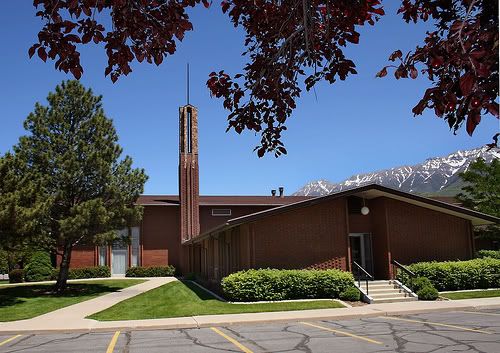
LDS Chapel in Orem, Utah


LDS Chapel in Bangnaa, Thailand


LDS Chapel in Mexico City, Mexico


LDS Chapel in Holdenhurst, U.K.

He Said: Church Correlation

When everything is said and done church correlation comes down to two things: doctrinal orthodoxy and money. In dealing with doctrinal orthodoxy a committee of the church made up of very conservative people usually Church Educational System employees that are trusted by the General Authorities approve and/or edit material that is disseminated to the various organizations or printed officially by the church under its publishing arms such as Deseret Book, BYU Press etc. Money is involved because the manuals are printed and so there is a factor involved in how many pages they are and how much does it cost to print them. I once overheard the conservation of a general authority while visiting the Church Administration Building with another general authority concerning the printing of a church manual, he was telling the vendor he was eating lunch with that by limiting the pages to under 200 that the church saves millions of dollars in cost.

For much of my lifetime Daniel Ludlow was in charge of the correlation department of the church. Back in the 1990s I submitted my manuscript of Prepare Ye the Way of the Lord: LDS General Authorities Speak on Missionary Work. The committee read over my manuscript and felt that doctrinally it was acceptable. However Sheri Dew at Deseret Book didn't want to go to the trouble of getting special approval to publish my work. At that time they discouraged any non-general authority from compiling a teachings book. The irony was that Clyde J. Williams a member of the BYU Religion department was able to publish several books without much trouble. So I have personal acquaintance with this department. I spoke to Dan Ludlow about my manuscript when he came to a Know Your Religion talk in El Centro, California where I was living. He suggested to me that I get a general authority to co-compile but I could never interest one in doing that. I finally got Intellectual Reserve to let me put it up on my blog since it was not for sale and a private compilation just for research purposes.

I frankly did not have a problem with this group and found Dan Ludlow to be helpful and honest in his comments. I don't have any trouble with correlation looking over material and suggesting possible inclusions and exclusions. I have worked with editors for many years in publishing in the Multicultural Review. Although I think the committee is a bit narrow in who is on it and could use a few more progressive scholars it does make sure to protect the church. However when you select people including CES types there is the problem of bias. What one considers to be sensational or questionable doctrine is very subjective.

I personally feel they should use the faculty at their church universities and go beyond more traditional CES people. Even though many of these professors might have one time been CES they are a little more connected to the research since many of their former students bring the stuff to their attention or generate it. I am not questioning that a few CES types occasionally are on the scholarly side I am just saying that in comparison most aren't cut out of the same cloth as the Richard Neitzel Holzapfel, the Bruce Van Ordens, or even the David Seeley. Although many of them get graduate degrees they aren't as rigorous as the ones who end up at the universities. I don't want to name the names of the ones I am thinking since kindness is better than blunt honesty. In addition they tend to be more insular in their approaches and more easily controllable. However their scholarship or lack of exposure to all the new stuff coming out actually is a detriment to their making informed decisions on content or eliminating new content. They didn't get to work in SLC in the CES by not being politically correct.

My best example is the new Joseph Smith Papers. I don't doubt that some of the CES types might peruse such works but it takes a person with a certain mentality to really analyze the implications and debunking of earlier stories. Correlation tends to whitewash and give a faith-promoting spin to history and doctrine. They look at different things like the perceived level that the general member is at.

It is kind of like when I was a school teacher in Tennessee. One day the assistant superintendent came to talk to me since my lowest level 5th graders had passed the highest class in reading. He told me that my fellow teachers were not happy that my students were doing as well as their students and that I was to slow them down and give them one day of writing out the definitions of the spelling words. The superintendent told me that I was to teach to the middle not to the top. Correlation assumes it knows what a member can handle that they need milk before the meat. Just like my students needed to not excell beyond the top group since they had been tested and assigned the lowest level members should not be given the mysteries of the kingdom. They need to stick to the basic principles of the gospel and correlation's job is to insure that.

Another important function that correlation provides is to make sure that the church is not embarrassed by any doctrines or stories that could hurt our advances in getting along with people in the outside world. They check to make sure that we don't cover negative aspects such as Mountain Meadows Massacre history or polygamy or blacks in the priesthood etc. Correlated history is more apologetic or revisionist in nature. A guy like Will Bagley writes an uncorrelated version while a guy like Richard Thorley writes a correlated version. Most authors who publish through Deseret Book have their material looked at by the correlation committee.

Personally I think correlation is a good process and anything they look at is closer to the what we as members should believe. I don't like the sensational stuff that a lot of times is subjective. Orson Scott Card said "history is a creative reconstruction of the past." In terms of history and some doctrine not everything said or written is totally accurate so correlation sanitizes it by getting a committee of trusted people together who can communicate with the general authorities and get their arbitration on what can be problemmatic.

It keeps imperfect authors from making mistakes that could hurt the church by revealing things that may or may not be true. I think writers don't always consider the implications of ripples that can be made if they clash with viewpoints, practices and doctrines that inspired men of God have already officially said or written. Correlation doesn't hide the truth it just disseminates it in the right time and the right setting.

Tuesday, June 16, 2009

She Said: Adoption

The LDS Church believes that every effort should be made to assist young women who conceive out of wedlock to first try to establish an eternal family relationship. If the unwed parents are unable or unwilling to marry, they are then encouraged to place the child for adoption, preferably through LDS Family Services.

The Church stresses that unwed parents who do not marry should not be urged to keep the infant as a condition of repentance or out of some desire to care for one's own. They consider that the best interests of the child in this situation is to be placed for adoption. The Proclamation on the Family states:
Children are entitled to birth within the bonds of matrimony, and to be reared by a father and a mother who honor marital vows with complete fidelity.

The wording of this sentence makes me uneasy and raises a few doctrinal questions. If children are "entitled" to birth within just such a traditional family, then why does God permit them to come to earth in such varied circumstances as they do? I presume he has control over where the spirits are sent, over men's and women's fertility, and such. I am tempted to believe that when a child is sent to a certain mother that she is "entitled" to raise it as her own.

Since I now have 6 girls who could potentially bear children, this is a topic of concern to me. I would be devastated if a child who was born into our family was given up for adoption. I would be willing to provide any support needed for such a child to remain in the family. I am also concerned that because of the Church's policy, LDS Social Services is not providing much needed information and support so that young women can make informed decisions. Michelle Renaud provides one example involving Don Staheli, who worked for LDS Family Services and now is Regional Representative of the Twelve.

The LDS Family Services site "It's About Love" shows how heavily slanted this organization is toward convincing a young woman to give her child up for adoption. The many options are explored with a purpose of convincing the pregnant woman that the best and most moral choice is adoption.

I have seen a great change in this policy just in the course of my lifetime. When I first joined the Church, the counsel to young women was that they should keep and raise their children. It often was suggested to them that this would be part of the repentance process. I don't feel that this policy, any more than the current one, is perfect for every situation. I feel that the families involved should be counseled on their options and encouraged to pray and make their own decisions based on their desires and family resources. Since the preferred counsel has changed so much over the years, I feel satisfied in declaring that giving up children for adoption is merely a policy currently preferred by Church agencies which may change and is not doctrinal. I don't think that anyone can make a blanket statement that certain types of families or individuals are any less able to successfully raise children than the traditional, two-parent, husband and wife pair.

What do you think?