Showing posts with label polygamy. Show all posts

Monday, June 8, 2009

He Said: Book Review: Stolen Innocence

Elissa Wall with Lisa Pulitzer, Stolen Innocence: My Story of Growing Up in a Polygamous Sect, Becoming a Teenage Bride, and Triumphing over Warren Jeffs. New York: William Morrow, 2008.


Elissa Wall with the help of Lisa Pulitzer does a good job painting the FLDS as a very repressive people with some very controlling behaviors and Warren Jeffs as a scum ball. I have never had the respect that my wife BiV has for fundamentalists and her romanticized view that they are just good religious people trying to live the "principle." Wall reinforced my viewpoint that living polygamy is almost impossible due to the selfish behavior of the participants to control one another. I think if I were a member of the FLDS Church in my current maritial condition that I would have ended up much like Wall's father with my original wife in the end. My own children might have very well gone down the road that Wall's siblings did--or end up the opposite, as very gungho FLDS.

The premise behind this book is that fourteen is too young to lose your innocence, with which most of us in the United States or Canada that are not FLDS would have to agree. Being the parent of seven daughters I personally would not have allowed Wall to be married at such a young age. Even if I were a member of the FLDS faith I wouldn't have let any of my children go anywhere without my keeping in contact on a weekly or monthly basis even if I had been stripped of the priesthood like Wall's father. If anything I would have been more determined to regain my children. I would have known if anyone was trying to coerce a daughter of mine into a marriage that wasn't mutually agreed on by all parties that it just wouldn't happen. Her father is not totally blameless here since he was an absent caregiver out of choice. I read constantly how Wall was talking to different people by cell phone so why not call her dad from time to time. The FLDS are not like the Amish--they drive cars, play in the symphony orchestra and have telephones. They aren't totally as shut off from the world as Wall portrays in her book. She did after all work at the Mark Twain where I am sure even outside truckers frequented for a good home-cooked meal and where she got to know her future lover and current husband.

Wall paints a picture of her family being tragically broken apart by the FLDS leaders for their inability to get along with one another. The FLDS leaders were just trying to help, as I see it, the father being a weak leader and unable to control his family. I saw something even more ominous in that her own mother destroyed her father's family. The mother is very controlling and comes from a fundamentalist family that is well-connected while the father is a convert and has little influence.

Wall and Pulitzer paint a picture of passivity for the mother but from the readings I see that she was quite forceful when she wanted to be particularly in dissolving her marriage from Wall's father. When the mother can't get her own way she takes down the whole family so she can get herself married to a high ranking FLDS leader who is some old guy close to death. The mother seems happy when she remarries now that she is near to the action again. The mother was very manipulative and Wall downplays her own mother's role as being passive when in reality she probably had a great deal of input in to what happened in Wall's life including the marriage that toppled the FLDS leadership.

We learn in the end of the book that Fred Jessop rather than Warren Jeffs orchestrated the marriage. The mother had direct access to Jessop since she occasionally slept with him. She could have suggested when the daughter should be married or even the timing. I find it hard to believe she didn't say something to Jessop in a tender moment. Even after Wall is married the mother is always encouraging Wall to get along with her new husband. Wall never really makes much of an effort to get along but rather goes out of her way to be disobedient. It makes you feel sorry for the husband who is just some teenager without much social skills. She is constantly denigrating him including when he testifies near the end of the book. She never gives the guy a break as you paints him as a buffoon who is weak and spineless. I mean when her boyfriend goes out with a larger group and tells him to buzz off he goes quietly. Then he testifies he would have stayed married to her.

Then when the family members leave the FLDS faith one by one she paints it as if they are merely victims of a bad system when in reality it is their desire to live their lives differently than the what mainstream FLDS follow. Her sisters run off with men they fall in love with as do many of her friends. The truth is that they all left because they wanted to and wanted to follow their own lifestyles. Walls could have left sooner if she really had wanted to since she went away at least twice to Oregon and Canada. I think her staying with her former husband was more complex than simply wanting to remain "sweet."

In the end she leaves the very same way committing adultery, divorcing someone she married for time and all eternity and taking down Warren Jeffs. I agree that she lost her innocence involuntarily when she was forced in to marriage at fourteen but I disagree that the sequence of events had to transpire the way they did after that point. I think she could have adhered to her beliefs and still have broken free. Being a fundamentalist didn't help her live a very moral life in the end. Elissa Walls voluntarily lost the rest of her innocence by her choices from sixteen through eighteen. If Wall were really the good faithful Saint that she portrays herself as being, she certainly wouldn't have been out there listening to Bon Jovi, questioning her religious beliefs, drinking beer in the deseret, fighting with her husband, not having children with him nor sleeping with Lamont Barlow. I give her the benefit of the doubt that she was immature but there are literally hundreds of FLDS youth and tens of thousands of LDS youth who wouldn't have done any of those things particularly committing adultery when they are sealed to another man for time and all eternity.

I don't fault her for taking down Warren Jeffs for that she should be commended. I think she was hypocritical for absolving her father and mother who in my opinion caused the situation when they converted to the FLDS faith. To be fair Wall should have also taken down her own father for getting her in the mess in the first place as well as Fred Jessops (if he had lived longer), and any and all FLDS men who pressure girls under eighteen in to forced marriages.

Warren Jeffs only had the power that Wall and the other believers gave to him. The group had a few opportunities to stop him and looked the other way. The Centennial group proved that when their feet did the walking. If the FLDS had stood up to Jeffs he would have had to back down. Even today they are feeling the heat from the Texas debacle. Now that outside forces are putting pressure on them they are finally able to say we won't be bad anymore. Now they have a revisionist mentality we don't engage in girls under eighteen being married is their public statement.

I think from my reading that most FLDS are pretty spineless people including the heroine of the story. For one thing I think the whole concept of letting people out of marriages and giving them to other people is against what Jesus taught except for the cause of fornication or adultery no divorces should be given. If polygamous preached there will be no divorce except for physical abuse or adultery there would be fewer broken homes like Wall's parents had. The father would then have been put to the test since he was let off as an absent parent.

The problem with polygamy is that anyone can get out of a bad marriage if they want it bad enough and complain hard enough. Wall wants to say she tried a couple of times but when she had Allen in the position where she could have delivered the death blow to her marriage she slept in her car and avoided him while messing around with Lamont. If she had gone every other week to Jeffs and said I am going to run off with Barlow he would have whisked her off some place else and gotten her out of the marriage. Of course she would have been married to who Jeffs and the leading elders wanted not Barlow perhaps. She got the same effect in the end she was free but she and Barlow are now on the outside looking in. The truth is she wanted to be with Lamont Barlow not whoever Jeffs would have chosen.

I think Wall and the Utah court case and the recent events in Texas have started to reform their practices. Will they completely adhere to this practice of only marrying legal age wives? I doubt it. I mean after all they are breaking the U.S. law by entering in to polygamy in the first place. I think if they were smart and didn't want the United States government to crack down on all fundamentalist like they did one hundred years ago they would agree among all independent groups and FLDS groups to only marry legal age wives and stick to that practice. Otherwise I think they should suffer the full extent of the law and should be prosecuted.

I don't deny Warren Jeffs got what he had coming and he did what she probably said. But her mother who was her legal guardian gave permission and she should also be prosecuted. She knew full well what was going on. Her mother is no more the dupe of the FLDS than other FLDS woman. Unlike a bunch of innocent women in the Texas compound who didn't have underaged daughters married off Wall's mother did and in my opinion should have her remaining children given to non-FLDS family members or placed in protective services.

In the end the principles Wall purported to believe in didn't keep her on the moral path. Her victory is that she took down a bad man in a very screwed up cult. I admire her for getting out of a bad situation but she could have done it a little more nobly. She would have had a greater victory if she had taken Jeffs down while remaining true to her moral compass.

Thursday, June 4, 2009

She Said: Mormons and Civil Disobedience


The concept of civil disobedience has been around for centuries--we see it as far back as ancient Greece. But the term coined as "civil disobedience" is a lot more modern. American author Henry David Thoreau popularized it in an 1849 essay, Civil Disobedience, dramatically urging that although one does not necessarily have to physically fight the government, it should not be supported if the disagreement is urgent enough. The essay had a wide influence on many later practitioners of civil disobedience. In it, Thoreau explained his reasons for having refused to pay taxes as an act of protest against slavery and against the Mexican-American War.

Civil disobedience, then, consists in publicly announced defiance of specific laws and policies which an individual or group believes to be unjust. The defiance must be publicly announced, since the point of it is to bring the injustice to the attention of the public and to effect change. The perpetrator must understand that this defiance is illegal and carries prescribed penalties. Willingness to accept such penalties is a crucial part of civil disobedience.

Modern civil disobedience theory began to take shape in the mid-1800's. This was precisely the time when Mormon settlers in Utah were faced with a conflict of conscience of their own against the government of the United States. Early Church leaders preached unequivocally that members of the Church must practice the principle of plural marriage in order to attain the highest degree of the celestial kingdom. At the same time, polygamy was illegal in the Territory of Utah.

Approximately twenty to thirty percent of the Mormons then living in Utah followed civil disobedience by contracting marriages which were against laws they felt were unjust. Although most of them attempted to conceal their marital arrangements, Church policy and publications openly and publicly defended the practice. Members understood that there would be penalties, and many served jail sentences for their illegal practices.


Under the United States government's constitutional power to enact laws governing territories, Congress enacted the Morrill Act (1862), making bigamy in a territory a crime punishable by a fine and five years in prison. The statute was upheld in Reynolds v. United States (1879), although the defendant argued that the law violated the First Amendment guarantee of the free exercise of religion. The Edmunds Act (1882), made bigamous cohabitation a misdemeanor and barred persons living in polygamy from jury service, public office, and voting. Over 1,300 Latter-day Saints were jailed as a result of the Edmunds Act. The Edmunds-Tucker Act (1887) disincorporated both the Church and the Perpetual Emigrating Fund, authorized seizure of Church real estate, disenfranchised women, and annulled Territorial laws allowing illegitimate children to inherit.


In 1890, after 40 years of Mormon civil disobedience, it became clear that plural marriage was leading toward the economic and political destruction of the Church. President Wilford Woodruff then withdrew the requirement for worthy males to take plural wives and announced a manifesto formally stating his counsel to Latter-day Saints to abide by antibigamy laws (D&C Official Declaration—1). The Manifesto was intended to end the legal confrontation between the U.S. government and the Church.

For several reasons, it took many years for the LDS Church to completely end the practice of plural marriage. The Manifesto was couched in what, for Mormons, was ambiguous language. Instead of a "thus saith the Lord" type of revelation, Wilford Woodruff instead publicly declared "that my advice to the Latter-day Saints is to refrain from contracting any marriage forbidden by the law of the land." In an address in Logan, Utah, he asked:
The question is this: Which is the wisest course for the Latter-day Saints to pursue—to continue to attempt to practice plural marriage, with the laws of the nation against it and the opposition of sixty millions of people, and at the cost of the confiscation and loss of all the Temples, and the stopping of all the ordinances therein, both for the living and the dead, and the imprisonment of the First Presidency and Twelve and the heads of families in the Church, and the confiscation of personal property of the people (all of which of themselves would stop the practice); or, after doing and suffering what we have through our adherence to this principle to cease the practice and submit to the law, and through doing so leave the Prophets, Apostles and fathers at home, so that they can instruct the people and attend to the duties of the Church, and also leave the Temples in the hands of the Saints, so that they can attend to the ordinances of the Gospel, both for the living and the dead?

Some apparently felt that the "wisest course" was to continue to live the fundamental spiritual principles they had been taught by the early leaders of the Church. Priesthood holders in top leadership positions continued to solemnize plural marriages, and much confusion ensued. Nonetheless, with the issuance of the Manifesto, Mormon civil disobedience had effectively ended. No longer was the Church attempting to change the laws of the land to align with conscience, but to comply in order to gain Statehood.

Never again would the LDS Church participate to such a degree in civil disobedience. Instead, members are urged to follow the laws of the land strictly, wherever they live. They feel that through proper legal conduct, they can gain the good graces of political authorities and thereby advance other Church objectives. For example, Blogger Silver Rain recently wrote:
"Because we are painstakingly compliant to local laws wherever we go, the LDS church has been granted many freedoms that other religions have not always enjoyed. Countries in the Middle and Far East have welcomed us in as service missionaries when we were not allowed to proselyte. We were one of few religions allowed practice in Cold War East Germany. Doors have opened to us multiple times in multiple places because we show respect to the law."

There's something in me that rather respects the willingness of those early members, and even Mormon offshoots today, who will take the risks of civil disobedience to take a stand for what they believe. Mainstream members are now urged to show caution, sometimes to the detriment of conscience. This quotation is a case in point:
“Our participation in life’s important events may be jeopardized if we fail to follow the rules contained in our Father in Heaven’s commands. Involvement in sexual sin, illegal drugs, civil disobedience, or abuse could keep us on the sidelines at key times.” (Bishop David Burton, ”And That’s The Way It Is,” Ensign, May 2003)

I disagree with Bishop Burton that civil disobedience should be included in that list of foibles. For, as Thoreau put it:
"Indeed, you serve your country poorly if you do so by suppressing your conscience in favor of the law — your country needs consciences more than it needs conscienceless robots."


________________________________________________

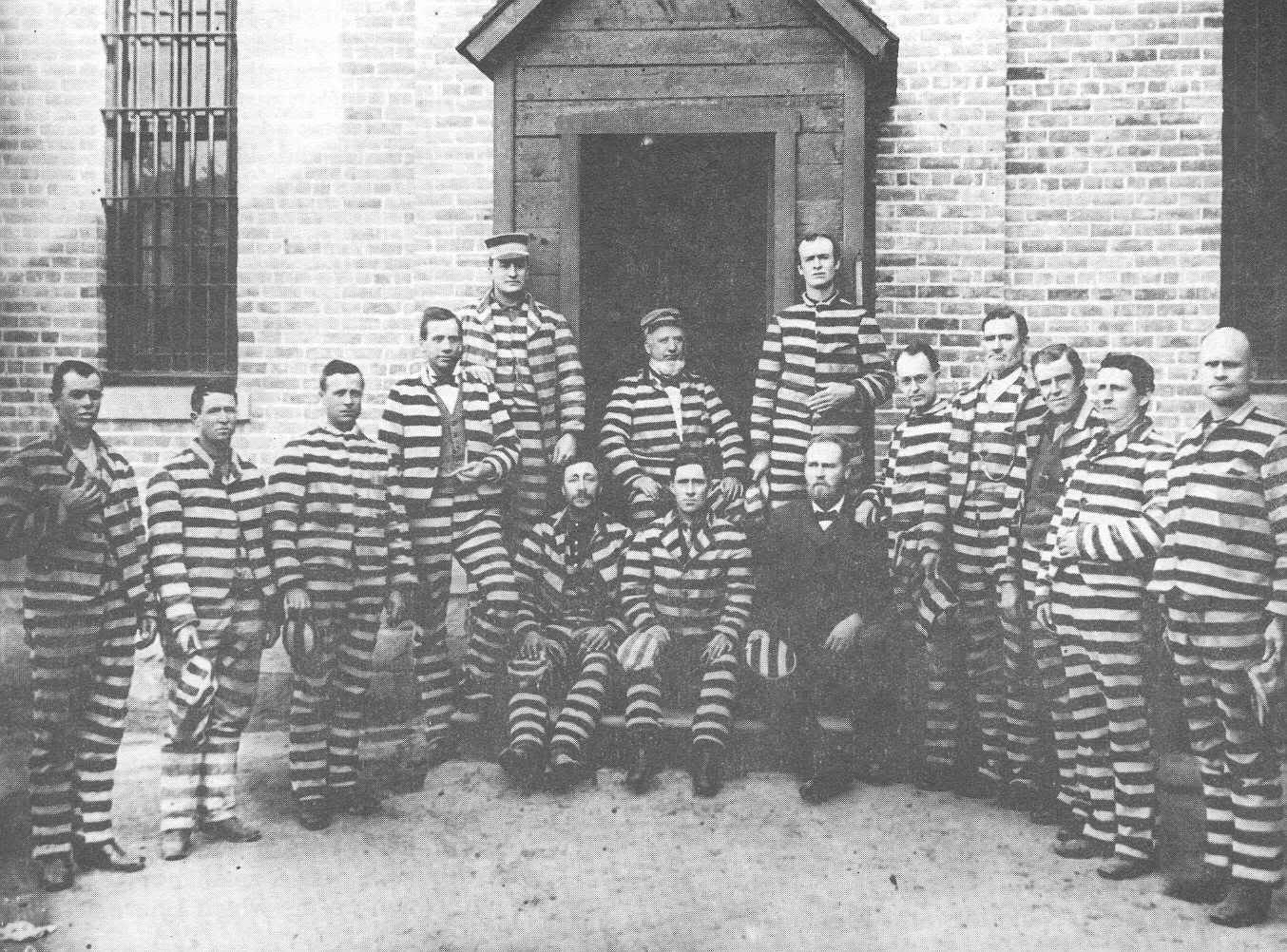
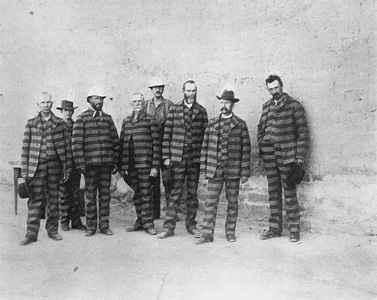
Picture (1): In the Utah penitentiary in 1885 are (L-R) Francis A. Brown, Freddy Self, Moroni Brown, Amos Milton Musser, George H. Kellogg, Parley P. Pratt, Jr., Rudger Clawson, and Job Pingree. Photographer: John P. Soule.

Picture (2): Utah Territorial Penitentiary 1888-9, located at the Sugarhouse site, now the northwest corner of Sugarhouse Park on 21st South & 13th East of Salt Lake City, Utah. Standing(L-R): Sylvester Frazer Jones, Simon Topham, Joseph S. Barney, Lorenzo D. Watson, Thomas Chamberlain, Henry Langford, Samuel Wooley, Nephi J. Bates, Frances Webster, Cornelius Mc Greavy, Jonathan Covington. Sitting on Step in center: Benjamin Perkins, William Butler, Francis M. Lyman. Doorway: George Q. Cannon.

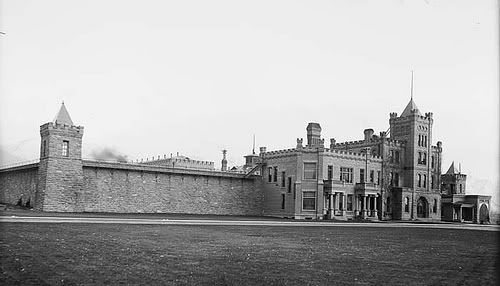
Picture (3): The site of the Utah Penitentiary, selected by Brigham Young in October 1853, then a safe six miles from the center of the city. The first buildings of adobe brick, surrounded by a twelve foot wall, were occupied in January 1855. Early accounts indicate that escapes were frequent because of poor facilities and the lack of guards. In 1866 the penitentiary was renovated. The three buildings, wall and the guard houses were upgraded to stone. Later a dining hall, hospital and women's quarters were added. By 1882 the penitentiary included 244 steel cells and 250 capacity chapel. A new 19 foot wall enclosed 2 acres. A large area surrounding the prison was used by inmates to farm and raise livestock for inmate consumption.

He Said: Mormons and Civil Disobedience

As a conservative member of the LDS Church I have always been taught in Article of Faith 12 "We believe in being subject to kings, presidents, rulers, and magistrates, in obeying, honoring, and sustaining the law." For the most part I have always strictly adhered to the laws of the land except occasionally speeding.

As a history major at BYU I learned that we as Latter-day Saints try to adhere to the laws of the land except on occasion when religious principle clashes with the law.

Bored in Vernal covers the historical roots of plural marriages for the living, but I say that a spiritual form of the practice remains.

Even though polygamy was officially abolished by 1904, LDS leaders still practiced a limited form of civil disobedience in that they continued the practice of spiritual polygamy. I am aware of Ezra Taft Benson being sealed to a deceased distant cousin in the 1940's. I suspect he wasn't the only one to receive that honor. So vicariously apostles and other high ranking church leaders participated in a religious ceremony which did not require a marriage license and entered into spiritual polygamy. Apostles and other worthy priesthood holders whose wives died naturally could also remarry and be sealed to other spouses one at a time since they were not in violation of the laws of the land. Despite fundamentalists' contention that the church fell we have an unbroken chain back to Joseph Smith that does not violate the law in the strictest sense. An interesting aside is that recently some of the more well-known Fundamentalists such as the LeBaron brothers are now being baptized for the dead in our temples. I would consider the continuation of polygamy a form of civil disobedience skirting on the edge but adhering religiously to both the law and religious principle. Plural spiritual marriage is a way to keep the practice alive while still adhering to the law.

In fact, this is the way that I would say civil disobedience continues to be practiced in the Church. In studying LDS history there have been many examples of civil disobedience or just plain not following the law when it comes to Latter-day Saints worshiping according to the dictates of their own conscience.

As early as the late 1930s and early 1940s totalitarian regimes like the Nazis, Facists and Communists resisted the Church's efforts to gain official sanction to worship or send missionaries in to their countries. During the Nazi regime our efforts were opposed. Kahlile Mehr wrote about mission president Wallace Toronto's failed attempts for 29 years to gain official recognition in Czechloslovakia under both the Nazis and later the Communists (See “Czech Saints: A Brighter Day,” Liahona, Sep 1997, 10). Mehr described Toronto's experiences:

In 1949 the Communist government began to restrict the missionaries. Still, baptisms rose from 28 in 1948 to 70 in 1949. (see “JirĂ­ and Olga Snederfler: A Closer Look at Two Czech Pioneers,” page 16).

Late in January 1950, two missionaries disappeared. No word of their fate was received until 11 days later. They had been arrested for entering a restricted border zone and were accused of spying. The Communist authorities released the two elders in prison on the condition that all the missionaries would be evacuated. A Czech governmental decree liquidated the mission on 6 April 1950.

For the next 14 years, Czech members kept their faith in silence, unable to worship publicly or to enjoy any regular contact with the Church beyond Czech borders. From his home in Utah, President Toronto continued to provide what assistance he could. When possible, he corresponded and sent financial aid, clothing, medicine, and Church publications. During those years, he applied nine times for a Czech visa—and received nine refusals.

It was not until 1964 that the official presence of the Church once again entered the nation. President John Russon of the Swiss Mission and Lynn Pettit, an early missionary in Czechoslovakia, arrived in Prague. Word of their arrival spread, and a small group met at a member’s home for a celebratory testimony meeting.

Meanwhile, President David O. McKay advised Wallace Toronto to apply again for a visa, saying, “[The members] have been carrying on underground long enough. They need the authority of their mission president.” Within a week the Torontos received visas. They visited members in Brno and Prague.

In July 1965 President Toronto returned to Prague, intent on reestablishing the Church. Although he was well received by many governmental officials, the secret police arrested him and evicted him from the country. Mission growth would be suppressed for another 25 years before reemerging in a new epoch of freedom.
This is just one example, that has been repeated in various countries during the 20th century.

In Islamic and Communist countries which have strict laws concerning religion there have been sizable groups of Latter-day Saints who either were converted elsewhere and returned to their native countries or went there for work opportunities. In such countries LDS members have learned to be creative in finding ways of worshiping without alienating these militaristic governments. The last few years I have participated in civil disobedience myself when I attended church each week. In the country where I lived it was expressly forbidden that anyone meet in a formal or informal religious gathering of any kind other than the official state religion. This is not uncommon in many countries throughout the Middle East or in Asia.

In order to meet we had to gather as private citizens and take extra precaution so as not to draw attention to ourselves. We actually had security rules that stated we were not to enter the residence in large groups and that women needed to adhere to strict dress codes. A long-time member described earlier members as being deported who made their religious attendance known to employers or co-worker. Even though LDS members were meeting at the U.S. Embassy which was officially U.S. ground they agreed in employment contracts not to show any form of civil opposition.

Today members realize that they could still be arrested and deported if someone became angry with them getting together. The law calls for the termination of anyone attending any philosophical group other than the official one of that country, possible arrest, beating and deportation.

In the country described above I was told by a church leader that a former ruler of the country told us that we could meet privately if we didn't draw attention to ourselves. The new ruler hasn't made any proclamation other than the official one that only one religion is recognized in that country. By gathering together we are practicing civil disobedience since there are employment policies which preclude meeting about any ideology other than the official one.

My last form of civil disobedience has to do with immigration law in the United States of America. I lived right on the border in Calexico, California which is a suburb of Mexicali, Mexico. In my ward there are many people who live on the U.S. side who are not American citizens. Members of the church know that they are illegal aliens. In fact many members of the church work for the border patrol. A few of them have a don't ask don't tell mentality. Leaders even know who many of the illegal immigrant members are. They still call them to positions of leadership. Many of the men have been former bishops and members of stake presidencies.

Many of the children of these members are called to missions in the United States. They can't get a passport or VISA but they go on missions. I am not opposed to this practice since it seems to me that they can spend their whole lives going to U.S. schools. I know of one boy who was valedictorian of his high school class but not able to attend college on a scholarship because he had no proof of residence. In such cases it is more humane to either give them amnesty. One boy in one of our wards mother did not get amnesty so our bishop who was a lawyer was trying to help him get a green card so he could serve. It is a complicated mess. One girl we know was raised totally in English and she would have been hard pressed to go to her mother's home which she never knew.

I think the LDS Church walks a fine line in obeying the stated law but in the grey areas it chooses religious worship or conscience in actual practice. In none of the cases I have described is there a clear resistance to any law. It is not against the law to practice spiritual polygamy but actual living polygamy even in legal settings is eschewed. Even in Africa where polygamy is legal or the Middle East LDS worthy males only have one wife. In countries which are restrictive where religious meetings are concerned we are just a bunch of friends enjoying a day together. Even in the case of illegal immigrants the U.S. government ignores the young men in question. They are not revolutionaries trying like Thoreau or Paulo Freire trying to overthrow bad practices they are just trying to practice religion without overturning the apple cart.